
In this article
- Does the language rule apply to you?
- British residents and the Withdrawal Agreement cards
- Which level, and what A2 and B1 mean
- Which proofs count
- Which test to book, and how a weak skill counts
- Timing: results, validity and your appointment
- The civic exam for residence cards
- OFII and the integration contract
- If you are not at A2 or B1 yet
- How to prepare: my coaching view
- Frequently asked questions
Rules checked against official sources in October 2026.
Since 1 January 2026, most non-EU adults who apply for their first carte de séjour pluriannuelle (the multi-year residence card, valid two to four years) must prove French at level A2, and those who apply for their first carte de résident (the 10-year resident card) must prove B1. Both cards also require a pass in a civic exam. The rule is real, but it is narrower than most forum posts suggest. It never applies at a renewal, it does not apply after 65, and several common cards, including the visitor card many American retirees hold, are outside the A2 rule altogether.
The short answer. You need A2 for a first multi-year card if your card comes with the integration contract (CIR), which is the case for salaried workers and for spouses and parents of French nationals, and B1 for a first 10-year card in the categories the law lists. The proof is a TCF or TEF attestation less than two years old, taken in person in one session, or a diploma such as the DELF, the DCL or a French diploma from level 3. For the test route, book the TCF IRN or the TEF IRN. Plan the test so that you have the result, and the civic exam certificate, before you file at the préfecture.
I coach English-speaking adults who need a certified level of French for a residence card or for citizenship, and I prepare them for the DELF and the TCF. I am writing this as a coach and not as a lawyer, and every rule below comes from the official pages linked in the text as they stood at the end of October 2026. The B2 needed for citizenship is a separate rule, explained in the guide to the French citizenship language requirement, so this page stays with the two residence cards.
Does the language rule apply to you?
The service-public page on proving your French for a residence card (checked on 10 February 2026) sets out who is concerned. Three conditions have to be true at the same time. You are applying for a first multi-year card or a first resident card, you are under 65, and your card is one of the categories the rule covers.
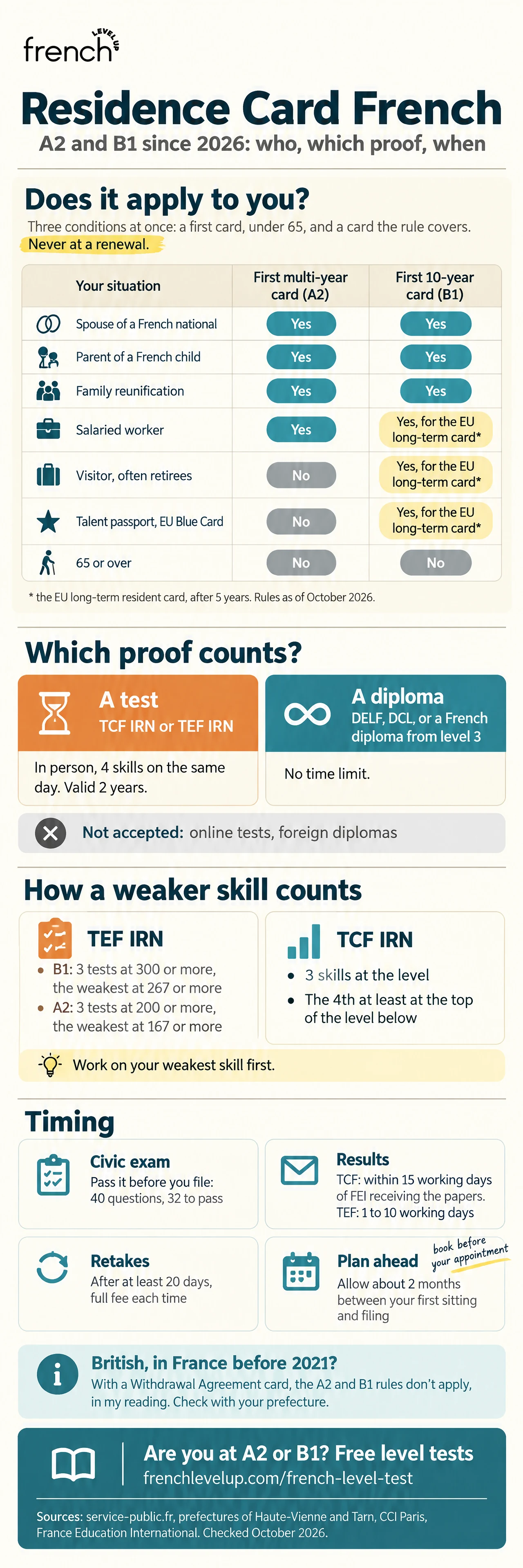
For the multi-year card, the A2 rule only concerns cards that come with the contrat d’intégration républicaine (CIR), the integration contract new residents sign with the French state through OFII. The service-public page on the CIR (checked on 26 June 2026) lists which titles are concerned. For the resident card, the B1 rule only concerns the cards the law lists one by one. The table below puts the two lists side by side for the situations I meet most often.
| Your situation | First multi-year card (A2) | First 10-year card (B1) |
|---|---|---|
| Spouse of a French national (vie privée et familiale card) | Concerned | Concerned (resident card after 3 years of marriage) |
| Parent of a French child | Concerned | Concerned |
| Family reunification | Concerned | Concerned |
| Salaried worker (salarié long-stay visa, then card) | Concerned | Concerned if you apply for the EU long-term resident card after 5 years |
| Visitor (visiteur), often retirees | Not concerned (no CIR) | Concerned if you apply for the EU long-term resident card after 5 years |
| Talent passport, including the EU Blue Card | Not concerned (no CIR) | Concerned for the EU long-term resident card after 5 years |
| Student, intern, seasonal worker, au pair | Not concerned (no CIR) | Depends on the card you apply for later |
| Anyone 65 or over | Not concerned | Not concerned |
Sources for the table: service-public F34501 and F17048, the service-public page on the carte de résident, the Tarn prefecture’s page (updated 31 December 2025) for the exempt cards, and the Gisti’s June 2026 note on the new language and civic requirements.
A few points the table cannot hold:
- The B1 list covers three resident cards. Service-public names the ordinary carte de résident (spouse of a French national, parent of a French child, family reunification), the carte de résident de longue durée - UE (after five years of regular residence with stable resources, or after five years on a talent card or an EU Blue Card, and for refugees and beneficiaries of subsidiary protection), and the first carte de résident permanent.
- This is why visitors and talent holders should not relax. A visitor or a talent passport holder escapes the A2 because those cards come without the CIR, but the EU long-term resident card is on the B1 list. So for many Americans on a visitor card, the first French requirement they meet is B1, five years in, if they apply for the 10-year card before 65.
- The cards with no B1 condition. The Tarn prefecture lists, among others, the resident card for a parent or grandparent of a French national, for a former holder of a retraité card who settles in France, and for refugees, and the Gisti’s note gives the same reading of the law. The Tarn page also lists the beneficiaries of international protection, young people between 16 and 18 covered by a specific article, and people who studied in France for at least a year at university or three years in secondary school.
- Changing card type can bring the B1 back. The Gisti points out that moving from an ordinary resident card to the EU long-term resident card, or from a multi-year card to the EU long-term resident card, brings the B1 condition back.
- Health and disability. Test accommodations are possible, and if your condition makes the test impossible you can be exempted, with a medical certificate from your doctor. The prefecture can check it.
- Algerian nationals fall under the 1968 Franco-Algerian agreement, and the Tarn prefecture lists them as exempt.
- EU, EEA and Swiss citizens do not need a residence card at all, so none of this applies to them.
Only first cards, never renewals
The language condition is checked when you apply for the card for the first time. The Haute-Vienne prefecture (page updated 9 January 2026) gives the example plainly. If you already hold a two-year card, you do not need A2 to renew it, but you will need B1 if you apply for a first resident card. The same page adds that the new rules apply to cards whose validity starts on or after 1 January 2026, whatever the date you filed.
There is also no language test for a long-stay visa or for a first one-year card. In the usual path, you arrive on a long-stay visa that serves as a residence permit, or on a one-year carte de séjour temporaire, and the A2 question comes up when you ask for the multi-year card at the end of that first year.
British residents and the Withdrawal Agreement cards
If you are British and you lived in France before 1 January 2021, you probably hold a Withdrawal Agreement residence card (titre de séjour “Article 50 TUE / Article 18(1) Accord de retrait”), the card often called the WARP. In my reading of the sources, the A2 and B1 rules and the civic exam do not apply to that card, neither when you renew it nor when you move to the 10-year permanent version.
Three things support that reading. First, the A2 and B1 rules are written for the multi-year card and the resident cards of French immigration law, and the service-public list of cards concerned does not include the Withdrawal Agreement card. Second, Article 13(4) of the Withdrawal Agreement says the host state “may not impose any limitations or conditions for obtaining, retaining or losing residence rights” on the people it covers, “other than those provided for in this Title”, and that Title contains no language condition. Third, the UK government’s Living in France guide, updated on 2 October 2026, describes the renewal of the five-year card and the move to the 10-year card with a passport, proof of address, photos and the old card, and mentions no language test or civic exam.
I found no French official page that says this in so many words, so if your prefecture asks you for a language proof for a Withdrawal Agreement card, check with the prefecture and the British Embassy’s guidance before you book anything. Two cases are different. If you moved to France from 2021, you are a non-EU national like any other and the table above applies to you in full. And if you apply for French citizenship, the B2 rule applies whatever card you hold.
Which level, and what A2 and B1 mean
Service-public describes the two levels in a few lines. At A2 you understand isolated sentences and common expressions about daily life, you handle simple routine exchanges, and you can describe your background and your immediate surroundings in simple terms. At B1 you follow the main points of clear standard speech on familiar subjects, you manage most situations when traveling, you produce simple connected speech on familiar topics, and you can recount an experience and briefly give reasons for a plan or an opinion.
Both levels are required orally and in writing, in understanding and in production. What B1 looks like skill by skill, and how the DELF B1 and the IRN tests measure it, is in the guide to B1 French. The guide to French language levels describes what each level looks like in real life, from A1 to C2.
Which proofs count
The accepted proofs come from an order of 22 December 2025 on proving your French, which service-public reproduces. There are four kinds.
| Proof | Issued by | How long it counts |
|---|---|---|
| TCF attestation at the level required | France Éducation International | 2 years |
| TEF attestation at the level required | CCI Paris Île-de-France | 2 years |
| DELF, DALF or DELF Pro at the level required or above | France Éducation International | No limit, the diplomas are for life |
| DCL (diplôme de compétence en langue) at the level required or above | Ministry of Education | No limit |
| DUEF (university French diploma) or DFP (CCI Paris business French diploma) | ADCUEFE universities, CCI Paris | No limit stated |
| RNCP professional certification at level 3 or above | The certifying body | No limit stated |
| French national diploma at level 3 or above (CAP, BEP, CFG), or the brevet | French State | No limit stated |
Proofs as listed on service-public F34501, checked on 31 October 2026.
Three details matter more than they look.
Only two tests are recognized. Service-public names the TCF and the TEF and no other test. The test must assess the four skills separately (listening, reading, writing and speaking), in person in an exam center, on the same day in a single session, with supervision and an identity check. The attestation must show your identity, checked against a valid residence permit or passport, and a photo taken before the exam. So an online test taken from home does not count, whatever it is called.
Foreign diplomas are not accepted. Service-public says a diploma issued by a foreign authority in another country does not count, even if that country is French-speaking. A degree from a university in Québec, Belgium or Senegal does not replace a French proof for the card.
One small inconsistency on service-public. In the “Voir aussi” box at the bottom of F34501, the DCL is attributed to CCI Paris Île-de-France, while the body of the page names the Ministry of Education. The DCL is a Ministry of Education diploma, so go by the body text.
The Gisti adds a useful reading. A French diploma from level 3 or an RNCP certification at level 3 proves your French whatever level is required, so a prefecture should not ask its holder for a TCF on top. The official exam options are compared side by side in the guide to French proficiency exams, with the DELF covered in detail in what the DELF is.
Which test to book, and how a weak skill counts
For the test route, book the IRN version, for Intégration, Résidence et Nationalité. The TCF IRN and the TEF IRN are the versions the two test bodies built for residence and nationality files. The TCF ANF no longer exists, and TCF Canada and TEF Canada are built for Canadian immigration, so neither is the one to book for a French card.
Both tests give you a level per skill and an overall level, and the overall level is the one that counts for the card. A weaker skill does not sink you on either test, within limits.
TEF IRN. CCI Paris publishes the rule on its TEF IRN page. Each of the four tests is scored out of 499.
| Overall level you need | Three tests at least | Weakest test at least | What it serves for |
|---|---|---|---|
| A2 | 200 | 167 | First multi-year card |
| B1 | 300 | 267 | First resident card |
So a candidate with 320 in reading, 310 in listening, 305 in writing and 275 in speaking reaches B1 overall, because three scores are at 300 or more and the fourth is above 267. With 255 in speaking, the same candidate would be at A2 overall.
TCF IRN. Listening and reading are scored out of 499, with A2 at 200 to 299 points and B1 at 300 to 399, and speaking and writing are marked out of 20, with A2 at 2 to 5 and B1 at 6 to 9, according to France Éducation International’s level grid. The attestation then shows OUI or NON under each overall level. FEI’s TCF candidate manual (version of September 2026) gives the rule behind that line. For the resident card, three skills at B1 minimum and the fourth at least at “the top of A2”, and for the multi-year card, three skills at A2 and the fourth at least at “the top of A1”. FEI does not say where “the top” of a level starts in points. The TCF IRN guide explains the four tests, the attestation and this rule in detail.
The diploma route. The DELF A2 or DELF B1 is pass or fail, with 50 out of 100 overall and at least 5 out of 25 in each of the four papers, and the diploma never expires. The DCL FLE is a single integrated exam where your performance sets the level, from A2 to C1, and the Ministry of Education sets a national registration fee of €100. Its sessions are few, though, so check the dates well ahead.
What the tests cost. Each center sets its own price. On 31 October 2026, CAVILAM in Vichy listed the TCF IRN at €174 and the Alliance Française de Paris listed the TEF IRN on computer at €205. Ask two or three centers near you, because dates and fees vary a lot.
If you are torn between the DELF and the TCF, the DELF vs TCF comparison works through the choice for citizenship, and the same logic holds one or two levels down.
Timing: results, validity and your appointment
The timing is where most of the stress comes from, so it helps to know each delay.
- TCF IRN results arrive within 15 working days of FEI receiving the session material from your center, not from the day of the test, so some centers tell candidates to allow three to four weeks.
- TEF IRN results take 1 to 10 working days, and the Alliance Française de Paris says the digital attestation is emailed within 10 days.
- Retakes are possible as often as you like, with at least 20 days between two sittings of the same test, and each sitting costs the full fee.
- TCF re-marking of speaking and writing is suspended for sessions from 1 September 2026, with a return planned for about autumn 2027. The TEF IRN allows an appeal within 30 days of the attestation date.
- Validity. A TCF or TEF attestation counts for two years. The CCI says the TEF IRN’s two years run from the date the attestation is issued. No official page I found says at which moment the prefecture checks the two years, so the safe reading is that the attestation must still be valid on the day you file.
- Diplomas have no expiry, so a DELF A2 you passed in 2024 still counts today.
Put together, I count about two months between the first sitting and the filing date when a student takes the test route. That leaves room for the results and for one retake if the first result falls short.
The civic exam for residence cards
Both cards also require a pass in a civic exam since 1 January 2026, and service-public sets it out on its page on the civic exam for residence cards (checked on 10 February 2026). It is a multiple-choice test in French on a computer or tablet in an approved center, with 40 questions on the values of the Republic, institutions, rights and duties, history and daily life, and it lasts 45 minutes at most. You pass with 32 correct answers.
There are two versions for the cards, one for the multi-year card and one for the resident card, and a pass in the resident card version also counts for a multi-year card. The certificate never expires, and you can sit the exam again as many times as you need. The same exemptions apply as for the language rule, so renewals, applicants over 65 and cards outside the CIR are not concerned. The Haute-Vienne prefecture states that the exam must be passed before you file, because the certificate is a required document for the file to be accepted.
The exam tests your knowledge, but it is written in French with no interpreter. CCI Paris says the questions for the multi-year card version are written at A2 level and those for the resident card version at B1, so your French work helps you here too. The French citizenship test guide covers the format, the official question lists, registration and the separate naturalization version.
OFII and the integration contract
If your card comes with the CIR, you sign it with OFII (the Office français de l’immigration et de l’intégration) during your first year, after an interview. According to service-public F17048, the contract runs for one year and includes:
- A French test at the interview, written and oral, to place your level.
- A French course of 600 hours if your result is below A2. Once you accept it, it becomes compulsory under the contract, and it can also be followed on an online learning platform. If you already hold an accepted diploma, or a secure test attestation at A2 or above less than two years old, you are exempted from this placement test.
- A civic training of 24 hours in four sessions, which is compulsory.
The contract and the card are linked. At the renewal of your one-year card, the prefect can issue a multi-year card of two to four years if you respected the CIR, passed the civic exam and prove A2. The OFII course targets A2, but its certificate is not on the list of proofs above, so you still need a TCF, a TEF or a diploma for the card file. Service-public mentions no OFII course that targets B1. The Gisti also reports that since July 2025 OFII has moved most CIR signatories to a self-study app, with classroom courses kept for people with little schooling or little French. If you need speaking practice with a person, plan for it separately.
If you are not at A2 or B1 yet
The official pages say less here than people would like, so here is what they do say, and where they stop.
For the multi-year card. Without A2, the prefect cannot issue the multi-year card at the end of your first year. Service-public F17048 describes the multi-year card as something the prefect “can” issue at renewal when the conditions are met, and it refers to a limit of three renewals of the temporary title. The Gisti’s note reads the law the same way, with a cap of three consecutive renewals of a one-year card under the same label (CESEDA, article L. 433-1-1). The pages I checked do not describe what happens after that third renewal, so ask your prefecture early if you are close to it, and do not rely on any website that claims to know.
For the resident card. Without B1, you cannot get a first resident card in the categories listed above, but you can keep renewing the card you hold, because a renewal carries no language condition. Nothing in the official pages stops you from applying for the resident card later, once you have B1.
In both cases, a test can be retaken after 20 days, the civic exam can be retaken at any time, and the useful question is how much time you have before your current card expires.
For anything beyond the language rule (a refusal, a pending file, a change of status), ask your prefecture, a France Services office or an immigration lawyer.
How to prepare: my coaching view
My view as a coach is that A2 and B1 are reachable targets for most adults who live in France, but the proof has to be the right one and it has to arrive on time. Three habits make the difference in practice.
Test your level early. Before you pay a center, get an honest picture of each skill. The free French level test takes about 15 minutes, needs no email, and shows what you understand next to your own estimate of your speaking and writing. It is an estimate and has no value in a file, but it tells you which skill to start with. If you already know which card you are applying for, the A2 French test and the B1 French test check each skill against that level, with a writing and a speaking task, and give a verdict for each skill.
Prepare your weakest skill first. On the TEF IRN and the TCF IRN, the overall level depends on the weakest of your four skills, so working on what you already do well moves the result very little.
Book the exam before the appointment, not after. Count back from the date you will file, leave room for a retake and its results, and take the civic exam in the same window. If your appointment is more than two years away, a diploma such as the DELF B1 avoids the expiry question altogether, and a B1 diploma covers both the multi-year card and the resident card.
If you wonder how long it takes to get there, the guide on how long it takes to learn French converts the published hour figures into months at different paces. Read those hours as a rough guide, because the time it takes varies greatly from one student to the next.
If you are already around B1 and your next step is citizenship, the Bilan B2 is a 60-minute one-to-one assessment (€95) with an estimated score for each skill and a study plan. It is a coaching estimate on a DELF-style scale, not an official result. For what it is worth, five of my individually coached students sat the DELF B2 in 2026 and all five passed. The steps after the 10-year card, including the B2 and the civic exam for naturalization, are in the guide on how to get French citizenship.
Frequently asked questions
Do I need a French test to renew my carte de séjour?
No. The language condition applies to a first multi-year card and a first resident card only. If you already hold a multi-year card, you renew it without a language proof, but you need B1 if you then apply for a first resident card.
Do I need French for a long-stay visa or my first one-year card?
No. The long-stay visa and the first one-year card carry no language condition. The A2 question comes up when you apply for a multi-year card after your first year, if your card comes with the CIR.
What level of French do I need for permanent residency in France?
B1 for a first 10-year resident card in the listed categories, including the EU long-term resident card, if you are under 65. British residents with a Withdrawal Agreement card are in a separate situation, explained above.
Are retirees exempt from the French language requirement?
If you are 65 or over, yes, for both cards and for the civic exam. Under 65, a visitor card is outside the A2 rule because it comes without the CIR, but the EU long-term resident card after five years requires B1.
Can I take the test for a residence card online?
No. The TCF or TEF must be taken in person in an exam center, with all four tests on the same day and an identity check. Online tests are useful for practice only.
Which is easier for a residence card, the TCF or the TEF?
The official sources give no pass-rate or difficulty data that would rank them. They differ in format and in how they publish the overall rule, since the TEF IRN gives exact thresholds and the TCF IRN gives a rule without figures for the weakest skill, and in their timing, since TEF results usually come faster.
This article explains the language requirement for French residence cards as of October 2026 and is not legal advice. For your own file, the service-public pages linked above and your prefecture remain the reference, and a France Services office or an immigration lawyer can help with anything beyond the language rule.