

In this article
- What B1 French means on the CEFR scale
- B1 French level skill by skill
- B1 and B1+
- B1 vs A2 and B1 vs B2
- What B1 French sounds like: two illustrative examples
- The DELF B1 exam, paper by paper
- B1 on the TCF and the TEF
- B1 in France: the 10-year card, not citizenship
- How to know if you are B1 in French
- From A2 to B1, and from B1 toward B2
- B1 French: common questions
Rules checked against official sources in November 2026.
B1 is the level where French starts to work for you outside a classroom. You can explain a problem at the town hall or the bank, and you can tell a friend what happened last weekend and why it annoyed you. Since 1 January 2026 it is also the level France asks for a first carte de résident, the 10-year resident card, so for many adults living in France it now comes with a date attached.
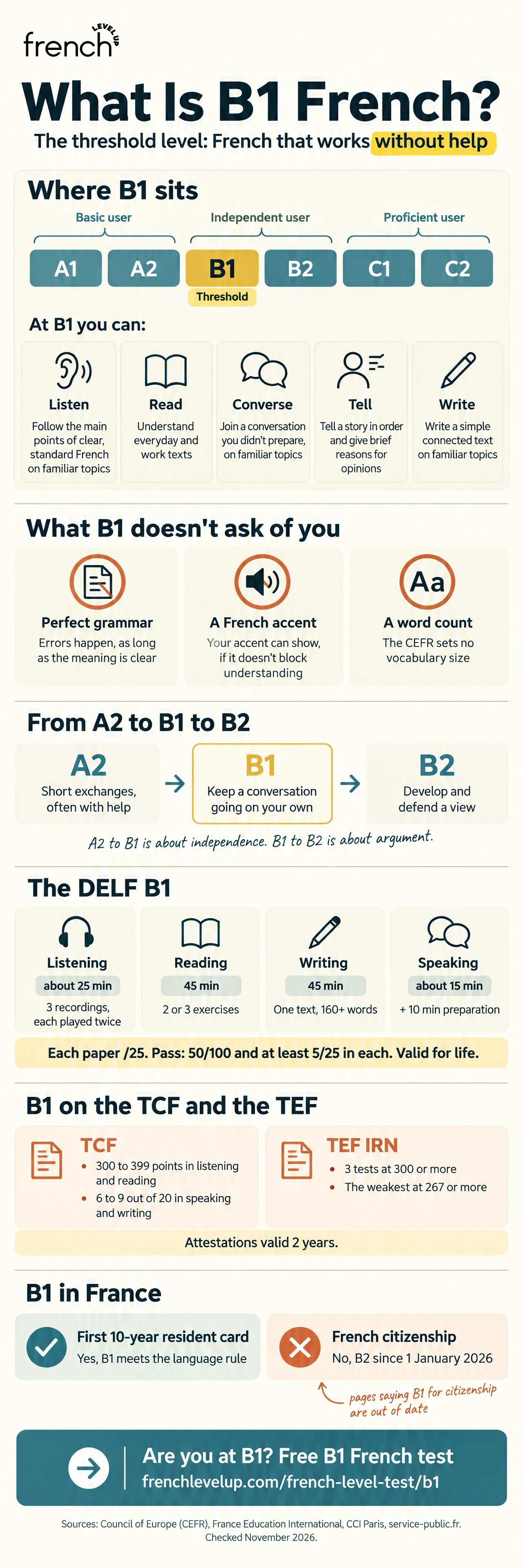
The short answer. B1 is the first of the two “independent user” levels of the CEFR, the six-level scale published by the Council of Europe, and its official name is the Threshold level. At B1 you understand the main points of clear, standard French on familiar subjects and you deal with most everyday situations without help. You can describe experiences and plans and give brief reasons for your opinions, and your mistakes don’t stop you from being understood. You prove it with the DELF B1, a diploma valid for life that you pass with 50 out of 100 and at least 5 out of 25 in each of its four papers, or with a TCF IRN or TEF IRN attestation at B1 overall, valid for two years. B1 meets the language rule for a first 10-year resident card, but it is no longer enough for French citizenship, which has required B2 since 1 January 2026.
I coach English-speaking adults who need a certified level of French for a residence card or for citizenship, and I prepare them for the DELF and the TCF. This page sits next to my overview of the six French language levels and goes deeper into B1: what the Council of Europe says skill by skill, what B1+ adds, how the DELF B1 is built and marked, how the TCF and the TEF report B1, and what B1 does and does not get you in France. Where I add my own view as a coach, I say so.
If you would rather know where you stand before reading on, the free B1 French test on this site checks each skill against B1 and asks for no email.
What B1 French means on the CEFR scale
The CEFR (Common European Framework of Reference for Languages) groups its levels in pairs. A1 and A2 are the “basic user” levels, B1 and B2 the “independent user” levels, and C1 and C2 the “proficient user” levels. The Council of Europe’s global scale describes a B1 user who understands the main points of clear standard input on familiar matters met at work, school or leisure and deals with most situations likely to come up while traveling. They can produce simple connected text on familiar topics, describe experiences, events, dreams, hopes and ambitions, and briefly give reasons and explanations for opinions and plans.
The French government’s page on language levels calls B1 the niveau seuil, the threshold level, and the name goes back a long way. The Council of Europe’s CEFR Companion Volume (2020), the current reference for the framework, says B1 “reflects the Threshold Level specification for a visitor to a foreign country” and picks out two features that define it.
The first is keeping an interaction going and getting across what you want to say in a range of contexts. Its examples include generally following the main points of an extended discussion around you if people speak clearly, giving or asking for personal views in an informal discussion with friends, and maintaining a conversation even though you “may sometimes be difficult to follow” when you try to say exactly what you mean. The second feature is coping flexibly with problems in everyday life, such as a less routine situation on public transport, making a complaint, entering “unprepared into conversations on familiar topics”, or asking someone to clarify what they have just said.
Read together, the two features describe someone who no longer needs a sympathetic listener to get through a conversation. Even at A2+, the Companion Volume still expects you to “compromise the message and search for words” in many situations. At B1 you can keep a conversation going on your own, and when something goes wrong, you can deal with it in French.
B1 French level skill by skill
The Council of Europe’s self-assessment grid splits each level into listening, reading, spoken interaction, spoken production and writing, so that learners can profile their own skills. The table paraphrases the grid’s A2, B1 and B2 descriptions and quotes only a few words.
| Skill | A2 | B1 | B2 |
|---|---|---|---|
| Listening | Frequent expressions about yourself, shopping and work, and the main point of short, clear messages and announcements | The main points of clear standard speech on familiar matters, and of many radio or TV programs on current affairs when the delivery is relatively slow and clear | Extended speech and complex lines of argument on reasonably familiar topics, most TV news and most films |
| Reading | Short, simple texts such as ads, menus and timetables, and short personal letters | Texts in high-frequency everyday or job-related language, and the description of events, feelings and wishes in personal letters | Articles and reports in which the writer takes a stance, and contemporary literary prose |
| Spoken interaction | Very short social exchanges and routine tasks, without usually understanding enough to keep the conversation going yourself | Most situations while traveling, and entering “unprepared into conversation” on familiar topics such as family, hobbies, work, travel and current events | Taking an active part in discussion in familiar contexts, explaining and sustaining your views |
| Spoken production | Simple phrases to describe your family, your living conditions and your job | Linking phrases simply to describe experiences, events, dreams and hopes, giving brief reasons for opinions and plans, and telling the story of a book or film | Clear, detailed descriptions on a wide range of subjects, and a viewpoint with its advantages and disadvantages |
| Writing | Short, simple notes and messages, and a very simple personal letter | Simple connected text on familiar topics, and personal letters describing experiences and impressions | Clear, detailed text on a wide range of subjects, and an essay or report arguing for or against a point of view |
Paraphrased from the CEFR self-assessment grid, © Council of Europe.
Listening. The B1 descriptors keep a condition in almost every line, which is that the speech is clear, standard and about something familiar. The Companion Volume’s overall listening scale puts it as understanding the main points “made in clear standard language or a familiar variety on familiar matters regularly encountered at work, school, leisure, etc., including short narratives”. So a B1 listener can follow a pharmacist explaining how to take a medicine, or a colleague summing up a meeting, and can still lose the thread at a family dinner where four people talk fast at the same time. That second situation is not a sign that you are below B1, because the level never promised it.
Reading. At B1 you read what the Companion Volume calls “straightforward factual texts” on subjects related to your interests “with a satisfactory level of comprehension”. In practice, that covers a letter from your landlord or an article in a local paper about a new tram line. Texts that argue a case with irony, or that rely on what is left unsaid, belong to the levels above.
Speaking. The grid separates conversation (interaction) from speaking at some length on your own (production), and B1 asks for both. In conversation, the key words are “unprepared” and “familiar”, because you can join a conversation you didn’t plan for, as long as the topic is part of your life. In production, you tell a story in order, describe how you felt, and give a reason for an opinion. The Companion Volume is honest about how this sounds, since its B1 fluency descriptor says you “keep going comprehensibly, even though pausing for grammatical and lexical planning and repair is very evident, especially in longer stretches of free production”. Pauses, restarts and self-corrections are part of B1.
Writing. B1 writing connects ideas into a simple text. The Companion Volume’s overall written production scale describes “straightforward connected texts” on familiar subjects, built “by linking a series of shorter discrete elements into a linear sequence”. That linear sequence is a good test of your own writing at B1, since the ideas come one after the other, joined by d’abord, ensuite, parce que and mais, rather than being weighed against each other.
What B1 does not ask of you
Some descriptions online make B1 sound harder than the official text, and the gap matters if you are deciding whether to book an exam.
Error-free grammar. The Companion Volume’s grammatical accuracy scale describes a B1 user who “uses reasonably accurately a repertoire of frequently used ‘routines’ and patterns associated with more predictable situations”. At B1+ the user “communicates with reasonable accuracy in familiar contexts”, with “noticeable mother-tongue influence”, and the line that matters most is “Errors occur, but it is clear what they are trying to express.”
A French accent. The Companion Volume’s phonology scale expects B1 pronunciation to be “generally intelligible”, with intonation and stress that “do not prevent understanding of the message”, and it states that your accent “is usually influenced by the other language(s)” you speak. The DELF B1 candidate manual puts it simply, as mon accent ne gêne pas la compréhension (my accent does not get in the way of understanding).
A word count or a grammar list. The CEFR describes what you can do, so it gives no vocabulary size and no list of tenses for B1, and the figures of 2,000 or 4,000 words you see online come from schools and apps. For exam purposes, the most precise guide is the DELF B1 marking criteria described below, which name the past tenses and the conditional and do not mention the subjunctive.
Sub-levels such as B1.1 and B1.2. Many schools split B1 into course stages, which is their own way of organizing classes. The only subdivision the Companion Volume describes is B1+, the strong B1.
B1 and B1+
The Companion Volume calls B1+ a “strong Threshold”. The two features of B1 are still there, and B1+ adds the exchange of larger quantities of information. Its examples are concrete, such as taking messages about enquiries or problems, describing symptoms to a doctor “with limited precision”, explaining why something is a problem, giving detailed instructions, and summarizing a short story, an article, a talk or a documentary and giving your opinion of it.
B1+ has no diploma of its own, because the DELF goes from B1 to B2 and the TCF reports the main levels. It shows up in the DELF B1 marking, though. On the current grids, the examiners score each criterion of the writing and speaking papers in one of three columns, “below the level”, “B1” and “B1+”, and only the B1+ column gives full marks. On FEI’s performance descriptors for the writing paper, a B1 text “globally” meets the task and justifies an opinion with a few examples, while a B1+ text is “fully” adapted to the task, supports the opinion with concrete examples and can develop “a simple argument”. A B1 text uses suitable connectors, and a B1+ text is clear, well organized and uses varied connectors. I come back to what this means for your score in the exam section.
In my sessions, B1 brings more freedom than A2, and mistakes are less of a barrier. This is the stage where students really start to spread their wings. At B1+, their storytelling gets richer and they want to go further. The mistakes are easy to fix at that point, and with connectors they start building more complex sentences.
B1 vs A2 and B1 vs B2
The steps on either side of B1 are not the same size. The Companion Volume describes B2 as “a new level as far above B1 (‘Threshold’) as A2 (‘Waystage’) is below it”, so the step up to B2 is a large one, and the step up from A2 is where most adults first feel French become usable.
| What changes | A2 | B1 | B2 |
|---|---|---|---|
| Conversation | Short routine exchanges, often with help from the other person | Keeping a conversation going on familiar topics without preparation | Discussion without strain for either side, defending your view |
| Talking at length | Short descriptions linked with et, mais and parce que | A story in order, feelings, brief reasons for opinions and plans | A viewpoint developed with advantages and disadvantages |
| Writing | Two short texts of at least 60 words on the DELF A2 | One text of at least 160 words on the DELF B1, ideas as a sequence of points | One argued text of at least 250 words on the DELF B2 |
| Accuracy | Simple structures, with basic mistakes | Frequent patterns used reasonably accurately, errors that don’t block meaning | No mistakes that cause misunderstanding |
Descriptions paraphrased from the CEFR Companion Volume (© Council of Europe) and FEI’s DELF exam pages.
From A2 to B1, the main change is independence. The self-assessment grid says an A2 speaker can handle very short social exchanges “even though I can’t usually understand enough to keep the conversation going myself”, and B1 is precisely the level where you can. You also move from describing things to telling and explaining them, so the past tenses and the connectors that link a story become everyday tools rather than grammar exercises.
From B1 to B2, the main change is argument. B1 gives brief reasons for an opinion, while B2 develops a viewpoint, follows someone else’s reasoning and holds its ground when the other person pushes back. The DELF marking shows it clearly, because a B1 text can order its ideas comme une suite de points (as a list of points), while a B2 text has to build an argument and handle concession. I describe that step with the same exam task answered at both levels in what B2 French means in practice.
What B1 French sounds like: two illustrative examples
These examples show the patterns FEI’s examiners look for at B1. They are written in correct French on purpose, so the difference you see is in what each answer does rather than in mistakes.
Speaking: the interaction task
In the DELF B1 speaking paper, one part is a role play in an unusual everyday situation, with no preparation time. FEI’s candidate manual says you have to propose solutions, react to the examiner’s arguments, give your opinion and insist when needed.
Illustrative example written for this article, not a real exam subject.
Votre voisin fait des travaux chez lui tous les soirs jusqu’à 22 heures. Vous allez le voir pour trouver une solution. L’examinateur joue le rôle du voisin. (Your neighbor does renovation work every evening until 10 p.m. You go and see him to find a solution. The examiner plays the neighbor.)
Examinateur : Je suis désolé, mais je travaille toute la journée, je n’ai pas le choix.
Réponse de niveau A2 : Oui, mais le bruit, c’est difficile pour moi. Mes enfants dorment. S’il vous plaît, arrêtez à 20 heures.
Réponse de niveau B1 : Je comprends, mais mes enfants se couchent à 20 heures et, avec le bruit, ils n’arrivent pas à dormir. Est-ce que vous pourriez faire les travaux les plus bruyants le samedi matin, par exemple ? Et le soir, vous pourriez peut-être vous arrêter vers 20 heures. Qu’est-ce que vous en pensez ?
The A2 reply states the problem and makes a request, which works but leaves the neighbor with nothing to answer. The B1 reply acknowledges the other person’s point, explains the problem with a reason (avec le bruit, ils n’arrivent pas à dormir), makes two concrete proposals with the conditional (vous pourriez) and hands the conversation back with a question. That is the B1 feature the Companion Volume calls coping flexibly with a problem in everyday life.
Writing: a forum message
The DELF B1 writing paper asks for one text of at least 160 words in which you give a personal point of view, often in a letter, an email, an article or a forum post.
Illustrative example written for this article, not a real exam subject. The answer is shortened, and a real DELF B1 text must reach at least 160 words.
The prompt. Sur le forum de votre ville, un habitant propose d’interdire les voitures dans le centre-ville le samedi. Vous réagissez en racontant une expérience personnelle et en donnant votre opinion. (On your town’s forum, a resident suggests banning cars from the town center on Saturdays. You reply with a personal experience and your opinion.)
Bonjour à tous,
Je viens de lire ce message et je suis plutôt d’accord. L’année dernière, j’ai passé un samedi à Strasbourg, et le centre était presque sans voitures. C’était très agréable : on pouvait marcher tranquillement, les enfants jouaient sur les places et il y avait beaucoup moins de bruit.
D’abord, je pense que c’est bon pour la santé, parce qu’il y a moins de pollution. Ensuite, les petits commerces peuvent en profiter, car les gens restent plus longtemps en ville. Par contre, il faut penser aux personnes âgées et à ceux qui travaillent le samedi.
À mon avis, la mairie pourrait organiser des navettes gratuites depuis les parkings. Comme ça, tout le monde serait content !
Bonne journée,
Sam
What makes it B1. It answers the task, tells a past experience with the passé composé and the imparfait (j’ai passé, c’était, on pouvait), justifies the opinion with parce que and car, and presents the arguments in order with d’abord and ensuite, which is exactly the “sequence of points” FEI’s criteria describe at B1. It also makes a proposal with the conditional (pourrait, serait), a use the B1 grammar criteria name, and it opens and closes the way a forum message should.
What would push it toward B1+. Following FEI’s performance descriptors, the same text would score higher if its arguments were linked to each other rather than listed, for example by answering the objection it raises (Certes, les personnes âgées auraient plus de mal à venir, mais…) and by varying the connectors. That is also the first step toward the argued text of B2.
The DELF B1 exam, paper by paper
The DELF B1 tout public, the version for adults, is an official diploma of the French Ministry of Education, designed by France Éducation International (FEI). It has three group papers taken together in one room and an individual speaking test in front of two examiners. Each paper is marked out of 25.
| Paper | Time | What you do | Marks |
|---|---|---|---|
| Listening | About 25 minutes | Three recorded documents, each played twice, with questions | /25 |
| Reading | 45 minutes | Two or three exercises, depending on the format: finding information for a task, then an article | /25 |
| Writing | 45 minutes | One text of at least 160 words giving a personal point of view | /25 |
| Speaking | About 15 minutes, plus 10 minutes of preparation | A guided interview, an interaction and the expression of a point of view | /25 |
From FEI’s DELF B1 page and its DELF B1 candidate manual (July 2026), read on 1 November 2026.
The three group papers take 1 hour 55 minutes in a row. With the speaking test and its preparation, the whole exam comes to about 2 hours 20 minutes, but the speaking test is a separate appointment and can fall on another day.
Listening
You hear three documents, and the candidate manual describes them as a dialogue about an everyday situation, a radio program on a work-related subject and a radio program on a general topic, with no more than 6 minutes of recordings in total. Each document is played twice. The questions can be multiple choice with three options, or short answers where a word, a name or a number is enough. FEI’s advice is to read the questions before the first listening, catch the general situation the first time (who is speaking and about what) and check your answers during the second.
Reading
FEI uses two official formats for the listening and reading papers, which differ in the number of exercises, the length of the documents and the form of the questions, and FEI states that neither format favors candidates. In reading, that means two or three exercises. The first asks you to pick out information in brochures, ads or a menu to complete a task, usually by ticking criteria for several options and then choosing one, and the manual warns that an answer that doesn’t follow from your own ticks loses a point. The other exercises are about an article of general interest. True or false questions often ask you to copy the sentence that justifies your answer, and you get the point only if both the choice and the justification are right.
Writing
You write one text of at least 160 words in 45 minutes, in which you give a personal point of view on a general subject, often from a short written document. It can be a letter, an email, a newspaper article or a forum post, and the instructions tell you which. The manual suggests about 10 minutes to plan, 30 to write and 5 to reread, and your draft is not marked. Count your words and write the total at the bottom of the paper, because a text under 80 words, half the minimum, gets 0 on every criterion.
Five criteria are each marked out of 5: task completion, coherence and cohesion, sociolinguistic appropriateness (register, tu or vous, the right greetings), vocabulary, and grammar. The grammar criterion in the manual lists simple and complex sentences with relative pronouns such as qui and que and conjunctions such as quand, comme and si, the past tenses (passé composé, imparfait, plus-que-parfait and the recent past), the conditional for hypotheses, advice and proposals, and agreement of nouns and adjectives. A text that misses the subject loses marks in a specific way, set out on the grid, so read the instructions twice before you plan.
Speaking
You draw two subjects for the third part, choose one and get 10 minutes to prepare it. The first two parts have no preparation time. Then the three parts follow each other, in the order of FEI’s candidate manual, sample paper and marking grid.
- The guided interview (entretien dirigé), 2 to 3 minutes. You talk about yourself, your activities and interests, your past, your present and your plans, and the examiner asks follow-up questions such as what you did last weekend. The manual expects you to speak on your own for at least 1 minute 30 to 2 minutes with plenty of detail.
- The interaction (exercice en interaction), 3 to 4 minutes. You draw two subjects, choose one and play a role in an unusual everyday situation, like the example above. You propose solutions, react to the examiner, insist if needed, and use tu or vous as the role requires.
- The expression of a point of view (expression d’un point de vue), 5 to 7 minutes. From a short document, you present the theme it raises and give your opinion in a structured talk of about 3 minutes, with an introduction (the document, the theme and your plan) and examples, and then the examiner may ask a few questions.
FEI’s own DELF B1 web page lists the three parts in a different order, with the point of view before the interaction, so if your center’s papers disagree with this page, follow your center.
How the papers are marked, and what it means for your score
The pass rule is the same as at the other DELF levels. You need 50 out of 100 overall and at least 5 out of 25 in each paper, because a mark below 5 in any paper is eliminatory. Two examiners mark each writing and speaking paper.
The writing and speaking grids explain why candidates who feel solidly B1 sometimes get a lower score than they expected. On the writing grid, each of the five criteria is marked 0, 1, 3 or 5, and the 3 is the “B1” column while the 5 is the “B1+” column. A text that is solidly B1 on every criterion therefore scores 15 out of 25, and the higher marks go to B1+ work. The speaking grid works the same way, with 2.5 or 3 for B1 and 4 or 5 for B1+ on each criterion, which puts a solidly B1 performance at about 15.5 out of 25. As a simple calculation, a candidate at that level in both productions has about 30 out of 50 there, and needs about 20 out of 50 across listening and reading to pass. That is a comfortable margin, and it also shows that the strong papers carry the total, so the comprehension papers deserve as much practice as the speaking.
The same rule protects an uneven profile only up to a point. With 20 in reading, 18 in listening, 8 in writing and 6 in speaking you have 52 and you pass, but with 23, 22 and 21 and a 4 in speaking you have 70 and you fail.
Validity, uses and retakes
The DELF B1 is valid for life, and each DELF level is independent, so you can register for the B1 without holding the A2. FEI’s candidate manual notes that the DELF counts in some administrative procedures, including residence permits in France and applications for French nationality, and it advises checking the level each procedure requires. For nationality, that level is now B2. If you don’t pass, you can register again as soon as you have received your results.
Registration, dates and fees
You register with an approved exam center, not with FEI, and the center gives you its dates, its fee and its deadline. In France, FEI’s 2027 calendar sets the DELF B1 group papers on ten Wednesdays at 10 a.m.: 13 January, 3 February, 17 March, 26 May, 16 June, 7 July, 4 August, 6 October, 17 November and 8 December. Each center then sets its own speaking dates, within 30 days of the group papers, and a center doesn’t have to run every session.
Each center also sets its own fee. On 1 November 2026, the Institut français du Royaume-Uni in London listed the DELF B1 at £155 in its 2027 fees, and the Alliance Française Strasbourg Europe listed it at €180 on an undated page. My guide to what the DELF is compares the fees, results times and retake rules of several centers in the US, the UK and France.
Sample papers
FEI publishes free DELF B1 sample papers with the audio files, one example for each of the two formats of the group papers, a speaking subject, and the writing and speaking grids with an explanation of each criterion. Work through them in real time at least once before the exam, because the timing of the reading paper surprises many candidates.
B1 on the TCF and the TEF
The DELF is a diploma that certifies one level. The TCF and the TEF are tests that place you on the scale on a given day, and they produce an attestation valid for two years rather than a diploma. For a French residence card, the only tests service-public recognizes are the TCF and the TEF, taken in person with the four skills tested separately on the same day.
The TCF
On the level grid of FEI’s TCF results guide, B1 is 300 to 399 points on the multiple-choice tests and 6 to 9 out of 20 in speaking and writing. FEI’s grid names B1 Intermédiaire and describes “limited but effective command of the language”, with an understanding of clear standard input on familiar matters.
For a residence card, book the TCF IRN, the version FEI built for residence and nationality files. Its attestation shows a level for each skill and an overall line with OUI or NON under each level, and the card needs OUI under B1. The rule behind that line is in FEI’s TCF candidate manual (version of September 2026, re-checked on 1 November 2026). For the resident card, three skills must be at B1 at least and the fourth at least at “the top of A2” (le haut du niveau A2). FEI does not say where the top of A2 starts in points, so the safe plan is to have all four skills at B1 before you sit the test.
The TEF
CCI Paris publishes an exact rule for its TEF IRN. You reach B1 with at least 300 points on three of the four tests and at least 267 on the weakest one. A candidate with 340 in reading, 315 in listening, 300 in writing and 270 in speaking is B1 overall, and the same candidate with 260 in speaking is A2 overall. The attestation is valid for two years from the date it is issued.
Which one to choose for B1
If your filing date is far away or uncertain, the DELF B1 avoids the two-year question, because it never expires, and a B1 diploma also covers the A2 needed for a first multi-year card. For a result within weeks, the TCF IRN and the TEF IRN give one quickly, and the TEF IRN’s published thresholds tell you exactly how much one weak skill can cost. Every official option, including the DCL, is compared in French proficiency exams explained.
B1 in France: the 10-year card, not citizenship
Since 1 January 2026, most non-EU adults under 65 who apply for a first resident card must prove B1 in French. Service-public’s page on proving your level for a residence card (verified on 10 February 2026) lists the cards concerned: the ordinary carte de résident for spouses of French nationals, parents of French children and family reunification, the EU long-term resident card (carte de résident de longue durée - UE), and the first carte de résident permanent. The same page lists the accepted proofs, a TCF or TEF attestation less than two years old, or a diploma such as the DELF or DALF at the required level or above, and it excludes diplomas issued abroad, “even francophone” ones. Health and disability exemptions exist, and a civic exam is also required for the card.
Two details catch people out. The A2 required for a first multi-year card only concerns cards that come with the integration contract (CIR), and service-public’s page on the CIR shows that visitor, student and talent cards don’t sign it, so for many American retirees and talent passport holders, B1 is the first French requirement they meet, five years in, if they apply for the EU long-term resident card. And the rule applies to first cards only, never to renewals. Who is concerned card by card, the exemptions and the timing of results and appointments are all in my guide to French residence card language requirements.
B1 is no longer enough for French citizenship. Service-public’s naturalization page (verified on 1 January 2026) requires a level “at least equal to B2” of the CEFR, both spoken and written, and the same rule applies to declarations of nationality by marriage. Until the end of 2025, the requirement was B1, which is why many pages and even search engine summaries still say a DELF B1 is enough for nationality. If a page tells you that, it predates the 2026 change. The accepted proofs for B2 are in my guide to the French citizenship language requirement.
This section explains the language rule only and is not legal advice. For your own file, your prefecture remains the reference, and a France Services office or an immigration lawyer can help with anything beyond the language requirement.
How to know if you are B1 in French
Start with the self-assessment grid and FEI’s checklist for DELF B1 candidates, headed Je choisis le DELF B1 si je peux (“I choose the DELF B1 if I can”). It asks whether you can tell the story of an event, an experience or a dream, describe a hope or a plan, give your opinion and justify it, express agreement or disagreement and explain why, understand the important points of the news in a paper or on TV or radio, convince someone and cope with unexpected situations in daily life. If most of it describes an ordinary day for you, rather than a good day, B1 is a realistic target.
Then take the B1 French test on this site. It is free, asks for no email and checks every skill against B1 only, with grammar and vocabulary, reading, real French audio you can play twice as in the exam, and a short writing and speaking task you check yourself, and it gives a verdict for each skill. If you are not sure you are near B1 at all, the free French level test places you anywhere from A1 to C1 and shows your understanding and your own estimate of your speaking side by side. Neither test is a certificate, and only a TCF, a TEF or a diploma such as the DELF B1 can prove your level to the prefecture.
If you are already at B1 and your next step is citizenship, the Bilan B2 is a one-hour, one-to-one assessment with me (€95) that estimates where you stand against B2 in each part of the exam, on a DELF-style scale, with a written plan. It is built for people aiming at B2, so it is not the right tool to check a B1.
From A2 to B1, and from B1 toward B2
Getting from A2 to B1 is mostly about speaking for longer and dealing with the unexpected. In practice, that means telling stories in the past and reacting when the conversation goes somewhere you didn’t plan. The step toward B2 is mostly about argument, because you start answering other people’s reasoning instead of listing your own points. My guide to intermediate French resources collects material to read and listen to for that step.
How long it takes depends far more on you than on any table. The figure you will see most often, 350 to 400 guided hours from beginner to B1, is a guideline Cambridge English publishes for learners of English, and the Council of Europe gives no hours at all. I explain where each figure comes from in how long it takes to learn French, but read any number of hours per CEFR level as a rough guide, because the time it takes varies greatly from one student to another.
If what holds you back is speaking, which is the most common case I see at B1, my one-to-one sessions work on the situations that matter in your week, with written corrections after each session.
B1 French: common questions
Is B1 French fluent?
No CEFR level is called “fluent”, because the Companion Volume’s fluency scale has descriptors at every level. At B1 you keep going comprehensibly, and your pauses to plan and repair are “very evident”, especially when you speak for a while. If fluent means getting through everyday life and familiar conversations in French without help, B1 is where that starts, while speaking without visible effort comes later.
Is B1 enough for French citizenship?
No. Since 1 January 2026, naturalization applications and declarations of nationality by marriage require B2, both spoken and written. B1 was the requirement before 2026, so pages that still say a DELF B1 is enough are out of date. B1 does meet the language rule for a first 10-year resident card.
How long does it take to get B1 in French?
There is no honest single figure. The Cambridge guideline of 350 to 400 guided hours from beginner is widely quoted, but it was written for learners of English, and your starting point, your weekly hours and how much you speak change the answer a lot. The section above links to the details.
Is the DELF B1 hard?
FEI publishes no pass rate for the DELF B1 on the pages checked for this article, so nobody can give you an official figure. The demanding part is the rule of at least 5 out of 25 in every paper, together with a role play in the speaking paper that has no preparation time. On the other hand, the pass mark of 50 out of 100 leaves room for one weaker paper, as the calculation in the exam section shows.
Does the DELF B1 expire?
No, the DELF B1 is valid for life, like every DELF and DALF diploma. TCF and TEF attestations are valid for two years, and residence card files accept them only within that time. A DELF B1 from years ago still proves B1 for a resident card, but it says nothing about your level today, and it does not prove the B2 needed for citizenship.
Can I take the DELF B1 without the DELF A2?
Yes. FEI’s candidate manual says each DELF diploma is independent, so you can register directly for the B1, and you can also register for several levels in the same session.
Can I reach B1 in French in 3 months?
From zero, not on any published guideline, since Cambridge’s figure for B1 is 350 to 400 guided hours, about 27 to 31 hours a week for three months. From a solid A2 with time to practice every day, three months can take you a long way, and the B1 test above shows which skill to start with.