
In this article
Rules checked on 2 October 2026.
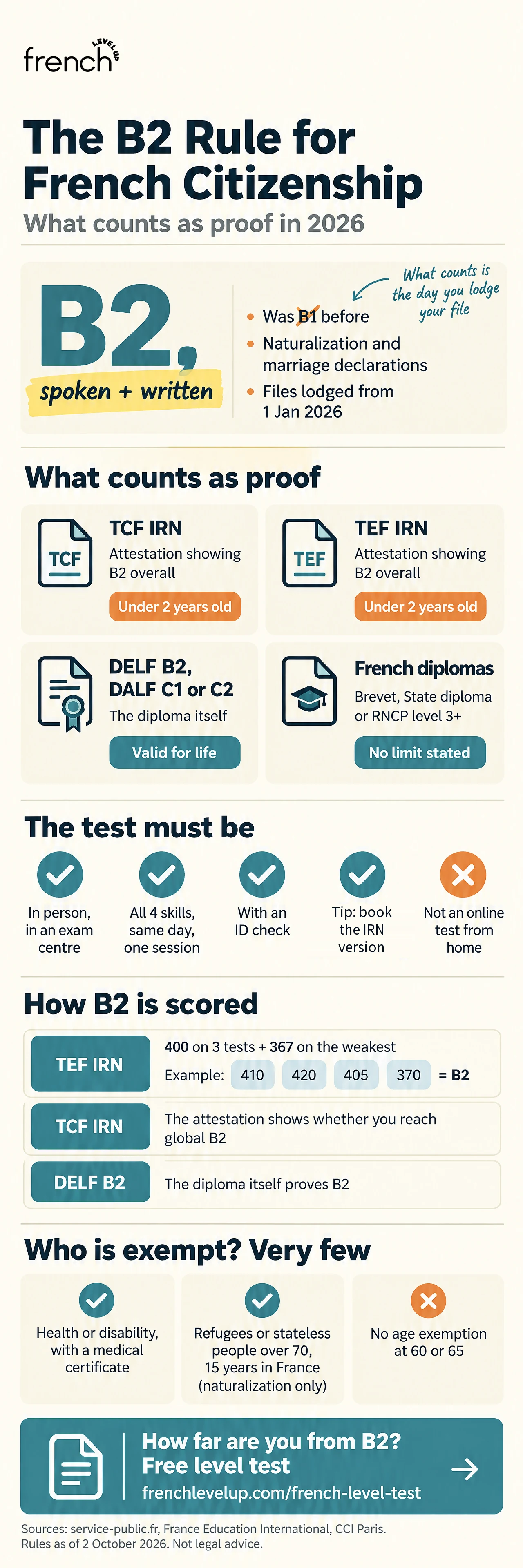
If you are preparing a naturalization file, or a nationality declaration through marriage to a French citizen, you have probably heard that the language level went up. It did, and since 1 January 2026 the bar is B2 in spoken and written French, where it used to be B1. The short answer is that you prove it with a TCF or a TEF taken in person in a single session, with a DELF B2 or a higher diploma, or with certain French diplomas.
That answer is the easy part, because the questions that decide your file come after it. Which version of the test should you book, how is B2 scored, when does your result stop counting, and are you one of the very few people exempted? I prepare English speakers for the DELF B2 and the TCF, so I am writing this as a coach and not as a lawyer, and every rule below comes from the official texts and the test bodies’ own pages as they stood on 2 October 2026. At the end I explain what I would do first if you are not at B2 yet.
What the rule says since 1 January 2026
For French nationality by decree (naturalization) and by declaration after marriage, you must show a knowledge of French “at least equal to level B2” of the Common European Framework of Reference, orally and in writing. This is stated on the official service-public page on proving your level of French, which also lists the proofs accepted. These are two different procedures: naturalization is an application decided by decree, and the marriage route is a declaration made by the spouse of a French citizen.
In plain terms, B2 is the level where you can follow and hold a real discussion and defend your own opinion, not only manage everyday situations.
The date comes from décret n° 2025-648 du 15 juillet 2025. Its article 11 says the new rules apply to marriage declarations made from 1 January 2026 and to naturalization applications lodged from the same date. So the date that matters is the day your file was lodged or your declaration was made, not the day you started to prepare it. The decree replaces “B1” with “B2” only for files from that date, so a file lodged before 2026 stays at the previous level, B1. If yours is still pending, confirm the details with your prefecture all the same.
Two points are easy to mix up here. First, the decree covers both routes, so a spouse declaring nationality by marriage also needs B2. Second, the residence permits have their own, lower levels: A2 for a first multi-year residence card and B1 for the ten-year carte de résident. If someone tells you “B1 is enough”, they may be thinking of the carte de résident and not of nationality.
Which tests and diplomas count
The list of accepted proofs is short. It comes from two orders of 22 December 2025, one on how to justify your level and one on the tests, and service-public reproduces it.
| Proof | What you need | How long it stays valid |
|---|---|---|
| TCF (France Education International) | An attestation showing B2 overall, with all four tests taken in one session | Must be issued less than 2 years ago |
| TEF (CCI Paris Île-de-France) | An attestation showing B2 overall, with all four tests taken in one session | Must be issued less than 2 years ago |
| DELF B2, or DALF C1 or C2 | The diploma itself | No limit, the DELF is valid for life |
| Other diploma attesting at least B2 | The diploma | No limit stated |
| French diplomas | The brevet, or a French State diploma or RNCP-registered certification at level 3 or above | No limit stated |
The DALF is not named in the text, but the rule accepts “any diploma attesting at least B2”, and a DALF C1 or C2 is above B2, so it falls in the same category.
The difference in validity comes from the nature of the document. The DELF and the DALF are diplomas, and France Education International describes the DELF as valid for life and states that the DELF B2 allows you to obtain French nationality. The TCF and the TEF give you an attestation of your level on a given day, which is why the rule only accepts a recent one.
Book the IRN version
The order on tests names “the TCF” delivered by France Education International and “the TEF” delivered by CCI Paris, but it does not name a version. Each test exists in several versions, and the ones built for this use are the IRN versions, for Intégration, Résidence et Nationalité. France Education International presents the TCF IRN as the test for foreigners over 16 applying for nationality or for a residence card, and CCI Paris presents the TEF IRN for the same uses.
I have not found an official statement that settles whether other versions, such as the TCF tout public, are accepted, so I will not tell you they are refused. But the IRN version is the one the test bodies designed for a nationality file, so it is the safe booking, and I would not pay for any other.
The test conditions
The order on how to justify your level sets conditions that the test must meet, and they explain why some tests sold as “French tests” do not fit. The four tests (listening, reading, writing and speaking) must cover B2 overall, and they must be taken in person in an exam center, on the same day, in a single session, with supervision and an identity check. The attestation itself must carry your identity details, a photo taken before the exam and a way to check its authenticity online. So an online test taken from home, or one where you sit the oral on another day, does not meet the rule. Taking the TCF on a computer inside the exam center is a different thing, and France Education International offers that format.
Some official pages are out of date
This one catches people who research alone. On 2 October 2026 the Ministry of the Interior page on the conditions for nationality still said B1, and the TEF IRN page still described the exemptions of a 2018 circular, for example a French language diploma at B1 for naturalization and an exemption at 65 for the carte de résident. When two official pages disagree, the service-public page on proving your level and the texts behind it are the current reference.
How B2 is scored on each test
TEF IRN. The TEF IRN has four tests: reading (20 questions, 30 minutes), listening (20 questions, 20 minutes), writing (two sections, 30 minutes) and speaking (two sections, 10 minutes), all on the same day. According to the TEF IRN page of CCI Paris, you reach B2 with a score of at least 400 on three tests and at least 367 on the weakest one. In practice, a candidate who scores 410 in reading, 420 in listening, 405 in writing and 370 in speaking is at B2, because three scores are above 400 and the fourth is above 367. The attestation will still show B1 for that speaking score, since each test also gets its own level, but the global level is B2. So a weaker skill does not sink you, as long as it stays at 367 or above.
TCF IRN. The TCF IRN also has four compulsory tests: listening (25 questions, 20 minutes), reading (25 questions, 35 minutes), writing (three tasks, 30 minutes) and speaking (three tasks, 10 minutes face to face), so about 1 hour 35 minutes in total. Listening and reading scores are mapped to a level up to B2, and writing and speaking are marked out of 20. The results then show in a table whether you reach the global level A1, A2, B1 or B2, and France Education International labels B2 as the level required for French naturalization. I have not read the official grid that gives the per-skill thresholds, so I will not quote numbers for the TCF.
DELF B2. The DELF B2 is a diploma at B2 level, so if you pass it, you hold proof of B2 without an expiry date.
The two kinds of proof suit different plans. The TCF IRN can be retaken as often as you want, with 20 days between two sittings, and results come within 15 working days of France Education International receiving the exam material. But you should not count on a re-mark to save a borderline result, because France Education International has suspended re-marking requests for speaking and writing from the sessions of 1 September 2026, with a return planned for about autumn 2027. With the DELF B2, on the other hand, you sit the exam and, once you pass, you never need to sit it again.
Validity and timing
A TCF IRN attestation is valid for two years from the date the results are issued, and a TEF IRN attestation for two years from the date it is issued. Service-public says the attestation must have been issued “less than 2 years” ago.
What no official text I have found says is at which moment those two years are checked, whether it is the day you lodge your file or a later stage of the procedure. Because of that uncertainty, I would time the test close to the moment you are ready to lodge, and not a year before. A DELF or DALF diploma does not have this problem, which is a good reason to prefer it if your file is still far off.
Who is exempt
The answer is very few people. For naturalization by decree, service-public lists only two situations where you do not need to produce a language proof:
- A disability or a health condition makes the assessment of your French impossible, and you provide a medical certificate.
- You are a refugee or stateless, over 70, and have lived in France for at least 15 years with a valid permit.
For a declaration by marriage, only the first case, health or disability, is listed. A separate order of 30 December 2025 organizes this medical certificate route. The model certificate annexed to it also provides that a person who can only communicate in sign language is exempted from the language test. And if your situation does not justify an exemption, accommodations for the test are possible with a medical certificate, although the administration can order a new medical assessment.
There is no general age exemption for nationality, at 60, 65 or any other age. Some pages still show an exemption at 65, but it comes from the old residence card rules. If you are over 60 and were counting on it, you need B2 like everyone else, unless you are in the refugee or stateless case above.
The civic exam is a separate step
Naturalization also requires an interview at the prefecture and the civic exam, created by the law of 26 January 2024. The civic exam is a digital multiple-choice test in French with 40 questions (28 on knowledge and 12 on practical situations), it lasts 45 minutes at most, and you pass with 32 correct answers. You must pass it before you lodge your application, and the certificate has no time limit.
The important distinction for couples is that the civic exam does not concern declarations, such as nationality by marriage. So a spouse needs B2 in French but not the civic exam, while a naturalization candidate needs both.
Where to start if you are not at B2 yet
The mistake I would avoid is booking a test before you know where you stand, because a failed TCF sitting costs you at least 20 days before you can retake it, and the re-marking route for speaking and writing is closed for now. So the first step is an honest estimate of your level in each skill.
That is what I built the Bilan B2, a one-hour level check, for. It is a one-to-one session on Zoom or Google Meet, with a short writing task and a short listening task, and it costs €95. Afterwards you receive a written debrief with an estimated score for each of the four skills and a study plan. To be clear about its limit, this is an estimate on a DELF-style scale (out of 25 per skill), it is not a TCF or TEF result, and it cannot replace the official test in your file. Its job is to tell you how far you are from B2 and which skill is holding you back.
Then the choice of proof follows your level and your timeline:
- If your estimate is close to B2 and you plan to lodge your file soon, a TCF IRN or TEF IRN taken close to the lodging date is the logical choice, because the attestation must be less than two years old.
- If you are further away, or your file is more than a year or two off, a DELF B2 makes sense, because once you have it, it does not expire.
- If your estimate shows one weak skill, look at the TEF IRN rule again, since three scores at 400 and one at 367 is still B2, but do not build your plan on the weakest skill staying just above the floor.
If you are already at a solid B1+ and want structured preparation, I also run Objectif B2, an eight-week small-group course for the DELF B2 and the TCF with two mock exams. The next group is not scheduled yet, so it works as a waiting list for now.
Frequently asked questions
What level of French do I need for French citizenship? B2 in spoken and written French, for naturalization applications lodged and marriage declarations made from 1 January 2026. If your file was lodged before that date, it falls under the previous rules, and you should confirm the details with your prefecture.
Does a DELF B2 count for citizenship? Yes, and so does a DALF C1 or C2, because the rule accepts any diploma attesting at least B2. A DELF B2 you passed years ago still counts, since the diploma is valid for life, which is not the case for a TCF or TEF attestation.
Can I take the French citizenship language test online? No. The test must be taken in person in an exam center, with all four parts on the same day in one session and an identity check. Online level tests can help you practice, but they cannot go in your file.
Is there an age exemption for the French language test? Not a general one. The only age-related case for naturalization concerns refugees and stateless people over 70 who have lived in France for at least 15 years. Pages that mention an exemption at 65 are describing old residence card rules, not nationality.
This article explains the language requirement and is not legal advice. For your own file, the service-public page on proving your level of French and your prefecture remain the reference.