
In this article
Checked against official sources in October 2026.
If you need to prove your French for a residence card, French citizenship, a university place or a job in France, you need an official French proficiency exam or diploma, taken in person at an approved center. A free online level test only tells you roughly where you stand, and it isn’t on any list of documents a prefecture accepts.
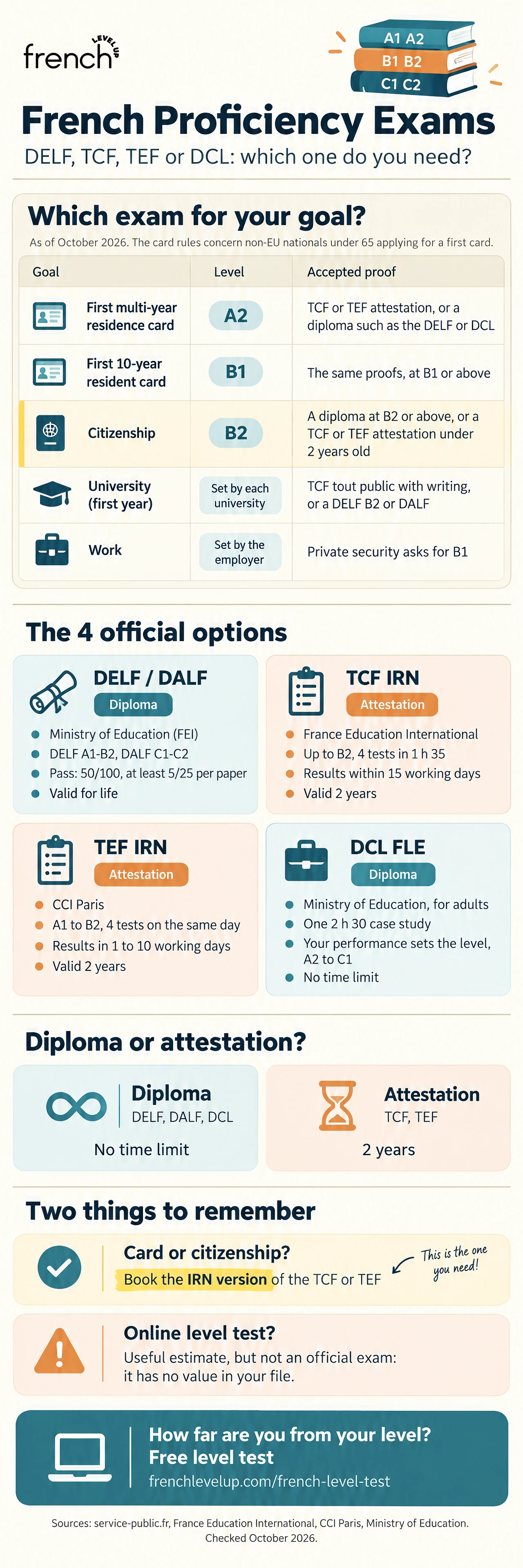
France has four main official options. The DELF and DALF are diplomas from the French Ministry of Education, the TCF and the TEF are tests that give you a dated attestation of your level, and the DCL is a lesser-known Ministry of Education diploma for adults. As of October 2026, non-EU nationals need A2 for a first multi-year residence card and B1 for a first 10-year resident card, with some exceptions covered below, and citizenship requires B2 in both spoken and written French. If those letters are new to you, this guide to French language levels explains what each one means in practice.
For a card or citizenship, the safe choices are the IRN version of the TCF or TEF, or a diploma such as the DELF at the level your goal needs. Which one suits you depends on how long your proof has to last, because diplomas never expire and test attestations are valid for two years. I coach English-speaking adults for the DELF B2 and the TCF, and this page maps which official test each goal accepts and how the tests differ once you sit them.
A free level test is not an official exam
Online French tests give you an estimate of your level. They are useful for deciding what to work on, but none of them appears on the lists of proofs that service-public, the French administration’s official information site, gives for residence cards or citizenship.
An official exam is taken in person at an approved exam center, with an ID check. For the residence cards, service-public even sets out what a language test must look like to count. It needs four separate tests taken in person on the same day under supervision, and the attestation must carry your ID details and a photo taken before the exam.
A free test is still a sensible first step. The free French level test on this site is adaptive and gives you two levels, one for what you understand and one for what you can say, so you can see how far you are from the level your goal needs before you pay for an exam. It is an estimate too, though, and it has no value in a file.
The official French exams for France
This section covers four official exams open to adult learners. The goal table further down also lists a few other diplomas that count for the residence cards, such as the DFP from CCI Paris and the DUEF.
DELF and DALF
The DELF and DALF are diplomas of the French Ministry of Education, designed and managed by France Education International (FEI), the public body that runs the ministry’s French certifications. The DELF covers A1 to B2 in four separate diplomas, and the DALF covers C1 and C2. Each level is independent, so you can sit the B2 without holding the B1, and every diploma is valid for life.
Each DELF level is pass or fail. You need 50 out of 100 overall and at least 5 out of 25 in each of the four papers, so a strong total can’t rescue a very weak skill. The DALF C1 uses the same rule, and the DALF C2 has its own scoring. The complete guide to the DELF covers levels, format and registration in detail, and if B2 is your target, the DELF B2 guide goes through each paper.
TCF
The TCF is also run by FEI, but it works differently from the DELF. It is a test, so you don’t pass or fail it. You receive an attestation that shows the level you reached, and it is valid for two years from the date the results are issued.
FEI’s current list of tests includes four TCF versions, two of them for Canada and Québec, and the version you book decides whether your attestation fits your file.
- The TCF IRN is the version for nationality and residence files, including the multi-year card and the long-term resident card. It has four compulsory tests (listening, reading, writing and a face-to-face speaking test) that take 1 h 35 in total, and it measures your level up to B2. Results arrive within 15 working days of FEI receiving the session papers from the center.
- The TCF tout public measures all six levels from A1 to C2 and is taken for study, work or personal reasons. It has three compulsory multiple-choice tests, with writing and speaking as options. With the writing test, it is the official test for the DAP, the procedure for first-year university admission.
FEI’s current list does not include a TCF ANF. Every TCF version can be taken on computer, apart from the speaking test. The guide to the TCF IRN and TCF tout public covers each test, how the attestation is read, results, retakes and registration.
TEF
The TEF is run by the Paris Île-de-France Chamber of Commerce and Industry (CCI Paris), which has delivered it since 1998. Like the TCF, it gives you an attestation of your level, and it comes in four versions, TEF Études for studies, TEF Canada, TEF Québec and TEF IRN.
The TEF IRN is the version for French files. It covers A1 to B2, and CCI Paris lists it for the multi-year card at A2, the resident card at B1, nationality at B2 and private security work at B1. CCI Paris also says it is not suitable for higher education. You take its four compulsory tests on the same day, and the results arrive by email within 1 to 10 working days as a download, which prefectures accept once printed.
The attestation is valid for two years, but CCI pages disagree on whether that counts from the test date or from the date the attestation is issued, so check the date printed on yours. CCI Paris also publishes exactly how the TEF IRN turns four scores into one level. For B2 you need at least 400 points on three tests and at least 367 on the weakest one. The TEF IRN guide covers each test, the scoring rule, results, retakes and registration.
DCL FLE
The DCL (diplôme de compétence en langue) is a national professional diploma from the Ministry of Education, created for adults. The version for learners of French is the DCL FLE (français langue étrangère).
It works differently from the other three. There is a single exam, a 2 h 30 case study in which you read documents, listen to recordings and work with the information, then present and argue your conclusions and write a summary. You don’t choose a level in advance. Your performance sets the level, from A2 to C1, and a jury proposes the diploma. You also get a detailed skills profile online.
Registration costs €100, a fee set nationally, and the diploma has no time limit. Because the DCL is listed in France Compétences’ Répertoire spécifique, it can be funded through your CPF (compte personnel de formation) training account. Dates are limited, though. The DCL FLE has three national dates in 2026, on 16 March, 15 June and 7 December, and registration for the December session closed on 7 October. A session can be cancelled if too few candidates sign up, and the exam is held in approved centers in mainland France and the overseas departments.
The DCL appears by name on the service-public list of diplomas for the residence cards. For nationality, service-public accepts any diploma attesting at least B2 without naming the DCL, and the Ministry of Education says the DCL FLE covers the B2 needed for nationality. A DCL FLE at B2 or above fits that wording, but check with your prefecture before you rely on it.
Other tests you may come across
ACTFL tests such as the OPI and the College Board’s CLEP French exam are used in North America, the CLEP for US college credit, and neither appears on the lists service-public gives for French residence cards or citizenship. TCF Canada, TCF Québec, TEF Canada and TEF Québec serve Canadian and Québec immigration, so they are outside the scope of this page.
Which test for which goal in France
As of October 2026, these are the levels and proofs service-public lists for each goal. The card rules apply to non-EU nationals applying for a first card, and the full conditions are on the service-public page on the language requirement for residence cards.
| Goal | Level | Accepted proof | Validity of proof |
|---|---|---|---|
| First multi-year residence card (under 65, card subject to the CIR) | A2 | TCF or TEF attestation, or a diploma such as DELF, DALF, DCL, DFP, DUEF or a French diploma from level 3 | Tests: 2 years. Diplomas: no limit |
| First 10-year resident card (under 65, listed cards only) | B1 | The same types of proof, at B1 or above | Tests: 2 years. Diplomas: no limit |
| Citizenship (naturalization, reintegration, declaration by marriage) | B2, spoken and written | Any diploma attesting at least B2, a French State diploma from level 3, or a TCF or TEF attestation at B2 | Attestation issued less than 2 years ago. Diplomas: no limit |
| First-year university (DAP) | Set by each university | TCF tout public with writing, or a DELF B2 or DALF, which exempts you from the TCF | TCF: 2 years. Diplomas: no limit |
| Work | Set by the employer | Private security asks for B1, for example with a TEF IRN | Depends on the proof |
For a card or citizenship, book the IRN version of the TCF or TEF. Service-public names the TCF from FEI and the TEF from CCI Paris as the only recognized tests for the cards, and the IRN versions are the ones built for these files. The official pages checked for this guide don’t confirm that a TCF tout public or TEF Études attestation is accepted.
The A2 rule only applies to cards subject to the CIR (contrat d’intégration républicaine), the integration contract for new residents. Holders of visitor, student and talent cards don’t sign the CIR, so the A2 rule does not apply to them, as the CIR page on service-public shows. Both card rules also apply only to applicants under 65. Diplomas issued by a foreign authority in another country are not accepted for the cards, even when that country is French-speaking. Both cards also require a pass in a civic exam, and the resident card page sets out that second condition. Which cards and situations are concerned, card by card, is in the guide to French residence card language requirements.
For citizenship, the service-public nationality page asks for B2 in both spoken and written French and accepts a TCF or TEF attestation issued less than two years ago. The pages checked for this guide don’t say at which stage of the application the two years are checked, so leave yourself a margin. The French citizenship language requirement guide covers every accepted proof and the exemptions.
Some exam and center pages still describe the rules from before January 2026, so treat service-public as the reference when two pages disagree.
How the exams differ in practice
| Exam | What you get | Valid for | Results |
|---|---|---|---|
| DELF and DALF | A pass or fail diploma for one level | Life | Within 2 months at most, according to FEI |
| TCF IRN | An attestation with a level per skill and a line showing which overall level you reached, up to B2 | 2 years from the results | Within 15 working days of FEI receiving the papers |
| TEF IRN | An attestation with points and a level per test | 2 years | 1 to 10 working days |
| DCL FLE | A diploma stating the level reached, from A2 to C1 | No limit | Online, timing not confirmed |
If one of your four skills lags behind, look at how each exam treats it. The DELF lets a strong total make up for a weaker paper, but only above the 5 out of 25 floor, and the TEF IRN publishes the thresholds shown above. The TCF IRN prints whether you reached each overall level, and FEI’s TCF candidate manual (version of September 2026) gives the rule for B2: three skills at B2 minimum and the fourth at least at “the top of B1”, a margin it does not put in figures. The DCL gives you one level for one integrated performance, along with a skills profile. The full DELF vs TCF comparison goes into how these rules play out for different profiles.
Dates differ too. In France the DELF follows a national calendar, with ten DELF B2 dates in 2026, and each center chooses which ones it runs. TCF and TEF centers set their own sessions, and FEI says TCF sessions run throughout the year. The DCL FLE has three national dates in 2026. You can retake the TCF or TEF as often as you like with 20 days between sittings, and you can register again for a DELF once you have your previous results.
What the exams cost: center examples
Each center sets its own price for the DELF, TCF and TEF, so the figures below are examples from individual centers, read on their websites in October 2026. Only the DCL has a national fee.
| Exam | Center | Price |
|---|---|---|
| TCF IRN | CAVILAM, Vichy | €174 |
| TCF IRN | Institut français, London | £215 (from 1 July 2026) |
| TCF IRN | L’Alliance New York | $350 for members, $399 for non-members, plus a $15 admin fee |
| TEF IRN | Alliance Française de Paris | €205 |
| DELF (A2 to B2) | Alliance Française de Paris | From €190 |
| DELF B2 | L’Alliance New York (December 2026 session) | $190 plus a $50 admin fee |
| DCL FLE | Any approved center in France | €100, set nationally |
Check your own center’s page before you budget, because fees and cancellation terms differ from one center to the next.
Where to start
Start from your goal and the level it needs, then find out how far you are from it. If your goal is a card or citizenship, the B2 for citizenship checklist lists what to do in order, with a version you can print. The free level test linked earlier on this page gives you a first estimate. If you have a deadline and you are at around B1 or above, the Bilan B2 is a 60-minute assessment (€95) that gives you a DELF-style estimate of your level and helps you decide which exam to book and when. It doesn’t predict a TCF, TEF or DCL score. If you settle on the DELF B2, for what it’s worth, five of my individually coached students sat it in 2026 and all five passed.
Frequently asked questions
What language test is required to apply for French nationality?
You need B2 in spoken and written French, proved either by a diploma at B2 or above, such as the DELF B2, or by a TCF or TEF attestation issued less than two years ago. For the test route, the IRN versions are the ones built for nationality files.
Is an online French level test accepted for a residence card or citizenship?
No. Online tests give you an estimate, and they aren’t among the proofs service-public lists for residence cards or nationality.
Which is easier, the TCF or the DELF?
The sources behind this guide contain no pass-rate or difficulty data that would rank them. They differ in format and scoring, and the DELF vs TCF comparison linked in the section on practical differences covers which one suits which profile.
Update log
- 31 October 2026. The TCF IRN rule for global B2 is now quoted from FEI’s TCF candidate manual (version of September 2026, FAQ on page 41), which this page previously described as unpublished.
This page summarizes official rules and center prices as of October 2026 and is not legal advice. Rules and fees change, so check your own case on service-public or with your prefecture before you book.