
In this article
- What the DELF B2 is and who it is for
- The DELF B2 exam format at a glance
- The listening paper
- The reading paper
- The writing paper
- The speaking paper
- How DELF B2 marks add up
- On DELF B2 exam day
- DELF B2 dates, registration and cost
- DELF B2 results, diploma and retakes
- How hard is the DELF B2?
- How to prepare for the DELF B2
- DELF B2: common questions
Checked against France Education International on 3 October 2026.
You know you need the DELF B2, perhaps for French citizenship or a French university, and you have probably seen its four papers listed with their timings and their 25 points each. What those lists rarely show is how a text or an oral is actually marked. France Education International (FEI), the body that designs the exam, publishes the grids its examiners use, and once you have read them you prepare differently, because they explain why a text of 124 words or fewer scores zero whatever its quality and why the debate at the end of the oral is marked separately from the presentation you rehearsed.
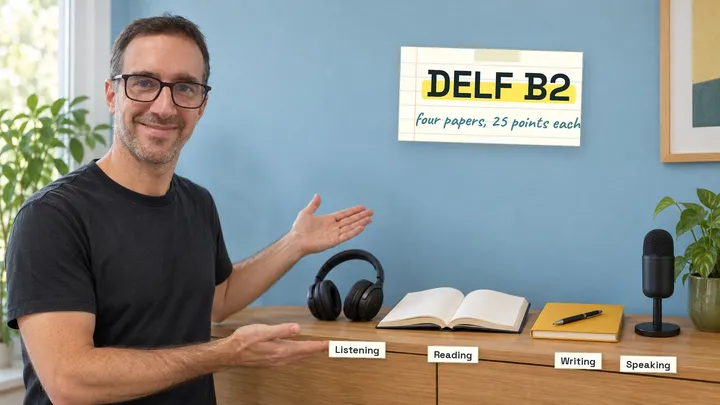
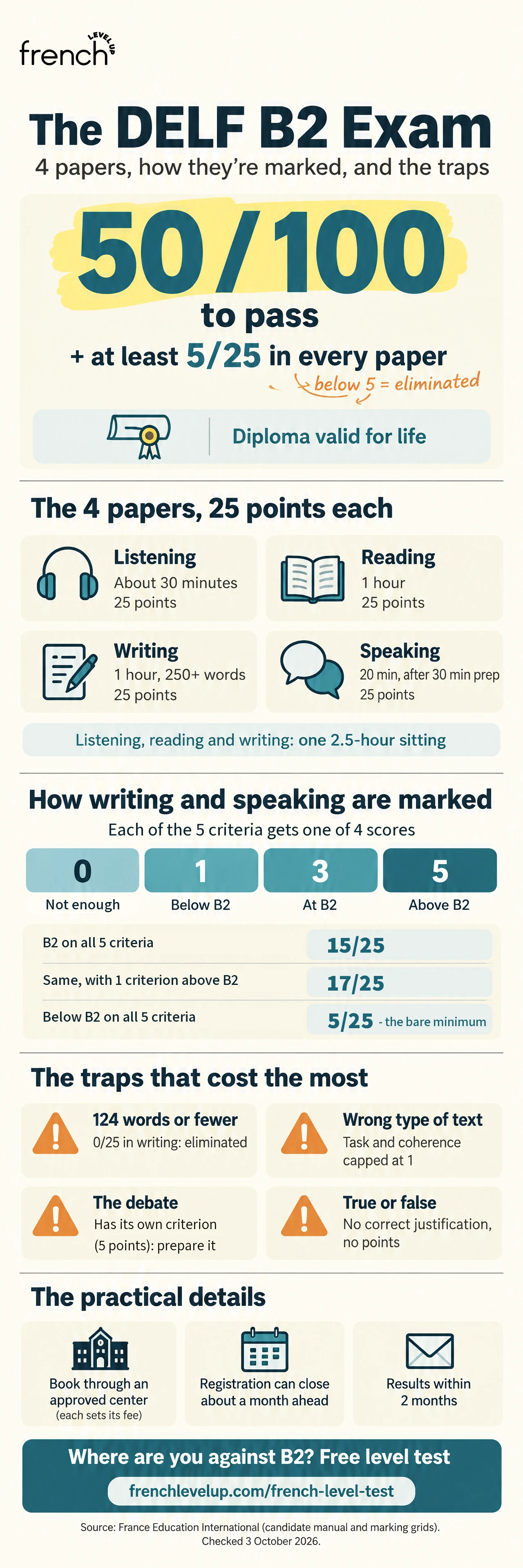
In short, the DELF B2 is an official French diploma with four papers worth 25 points each. Listening, reading and writing are taken together in one sitting of two and a half hours, and the oral is a 20-minute individual test after 30 minutes of preparation. You pass with 50 out of 100 and at least 5 out of 25 in every paper, the diploma is valid for life, and you book it through an approved exam center rather than through FEI.
This guide follows FEI’s July 2026 candidate manual paper by paper. I prepare English speakers for this exam and mark their mock exams against the official grid, so where I add what I see in preparation, I say so in the first person.
What the DELF B2 is and who it is for
The DELF (Diplôme d’études en langue française) is a diploma of the French Ministry of Education, designed and issued by FEI. The DELF B2 certifies level B2 of the Common European Framework of Reference for Languages (CEFR), and what B2 French means explains that level skill by skill, so this guide sticks to the exam.
FEI is not an exam center itself. You sit the DELF at a center it approves, such as an Alliance Française, an Institut français or a university language center, and that center registers you, sets the fee and gives you the dates.
The tout public version is for adults and older teenagers, the junior and scolaire versions adapt the same kind of themes for teenagers, and DELF Prim is for children and stops at A2. FEI asks candidates to choose the version that matches their profile, so as an adult you sit the DELF B2 tout public, which is the version this guide describes. Each level is a separate diploma, so you do not need to hold the B1 first.
French citizenship. Since 1 January 2026, naturalization applications and declarations of nationality by marriage require French at B2 or above, spoken and written, and any diploma attesting at least B2 is accepted as proof. Because the DELF never expires, it is not caught by the rule that TCF and TEF attestations must be less than two years old, and the tout public version is the safe choice for a nationality file, since it is the one FEI designs for adults. Our guide to the French citizenship language requirement lists every accepted proof.
University, work and residence. Holders of the DELF B2 are exempt from the TCF that the Demande d’admission préalable (the pre-admission procedure for a first year of licence) otherwise requires, but universities and programs still set their own level, and some ask for C1. FEI also notes that DELF diplomas count for some residence permits and advises checking the required level with the administration concerned, and an employer who asks for B2 decides which proof it accepts.
The DELF B2 exam format at a glance
| Paper | How it is taken | Time | What you do | Points |
|---|---|---|---|---|
| Listening | In a group | About 30 minutes | Answer questions in two or three exercises on recorded documents, some heard twice and some only once | 25 |
| Reading | In a group | 1 hour | Answer questions on two or three texts | 25 |
| Writing | In a group | 1 hour | Write one argued text of at least 250 words | 25 |
| Speaking | Alone, in front of two examiners | 20 minutes, after 30 minutes of preparation | Present and defend a point of view for 5 to 7 minutes (monologue suivi), then debate it with the examiner for 10 to 13 minutes (exercice en interaction) | 25 |
This is the structure on FEI’s DELF B2 page, with the timing of each part taken from the candidate manual. The three group papers follow each other in that order, and your center organizes the oral separately, on the same day or on a different one. With the preparation time, the whole exam takes about three hours and twenty minutes.
To pass, you need 50 out of 100 overall and at least 5 out of 25 in each paper. A mark below 5 in any paper is eliminatory whatever your total, so strong papers can carry a weaker one only as long as none of them falls below 5. The B2 level guide works through an uneven profile with real numbers if you want to see how that plays out.
Two official formats for listening and reading
FEI uses two formats of the listening and reading papers in official sessions, and you find out on the day which one you get. They differ in the number of exercises, the length of the documents and the form of the questions, and FEI states that neither one gives candidates an advantage, which is why two sources can give different exercise counts and both be right.
| Format 1 | Format 2 | |
|---|---|---|
| Listening | Three exercises worth 9, 9 and 7 points. The first two are each heard twice (in FEI’s sample, the first is a radio program), and the third is made of three short documents heard once. The recordings last 15 minutes at most in total, and the questions are multiple choice. | Two exercises. A recording of about 5 minutes heard twice (18 points), then a recording of 1 minute 30 to 2 minutes heard only once (7 points). |
| Reading | Three exercises worth 9, 9 and 7 points. Two texts that are informative or argumentative, then three short opinions posted on a forum, where you identify each writer’s point of view. | Two exercises. An informative text (13 points) and an argumentative text (12 points). |
FEI’s DELF B2 sample papers include an example of each format, so you can work through both before the day.
The listening paper
The listening paper lasts about 30 minutes, and the recording itself tells you when to read, listen and write. In format 2, you get 1 minute to read the questions on the long recording, a first listening, 3 minutes to answer, a second listening and 5 more minutes, then 1 minute to read, a single listening and 3 minutes to answer on the short one. Some prep material gets this backwards, but in format 2 it is the long recording you hear twice.
Questions are either multiple choice, with three options and one right answer, or short written answers. If you change your mind on a multiple-choice question, FEI asks you to circle the answer you keep.
The paper checks whether you understand what the speakers think as much as what they say, and FEI’s own description of the B2 candidate includes explaining what is left implicit. When I prepare people for it, I see points go in three ways. Candidates try to understand every word, they follow the facts but miss the speaker’s position or what is implied, and they dwell on one answer they missed and lose the information that comes right after it. That last habit costs more than it seems, because a single question is worth between 0.5 and 2.5 points in FEI’s format 1 sample, while the freeze that follows can cost you the next several.
The reading paper
The reading paper lasts one hour, with two or three texts depending on the format, and each of its three kinds of question has its own rule.
- Multiple choice, with three options and one right answer, as in listening.
- Short answers, and some of them ask you to reformulate avec vos propres mots (in your own words), so read each instruction to know whether you must rephrase.
- True or false with a justification, where you tick true or false and copy the sentence from the text that proves it. You get the points only if both the tick and the justification are correct, and otherwise you get nothing for that item.
The two kinds of written answer pull in opposite directions, because the justification must be copied from the text while an answer marked avec vos propres mots must not be.
For timing, a split in proportion to the points gives roughly half an hour per text in format 2, and about 20, 20 and 15 minutes in format 1, with a few minutes left to check your justifications. That is arithmetic rather than an FEI instruction, so adjust it once you know which kind of text slows you down.
The writing paper
You write one text in one hour, and it must be at least 250 words long, although you are allowed to write more. The task always asks you to defend a personal point of view, and the instruction tells you which kind of text to write, such as a contribution to a debate, a formal letter, a critical article or a report. In one of FEI’s sample papers, for example, you write to the mayor to contest a plan to run a bus route through a pedestrian zone.
FEI advises you to plan on the draft paper and leave time to copy the final text onto your answer sheet, to keep 5 to 10 minutes at the end to check spelling and grammar, and to write the word count at the bottom of your text.
The writing grid
Two markers each score your text on five criteria, using the official DELF B2 writing grid. Each criterion gets 0, 1, 3 or 5 points and nothing in between. A 0 means the criterion is not addressed or the answer is insufficient, 1 means below B2, 3 means at B2 and 5 means above it (B2+).
| Criterion | What the marker looks at | What “at B2” (3 points) means |
|---|---|---|
| Task achievement (réalisation de la tâche) | Whether the text type and the topic match the instruction, and whether you take a position and argue it | A clear argument for or against, which weighs the advantages and disadvantages of the options and gives examples. Below B2, you state an opinion simply. |
| Coherence and cohesion (cohérence et cohésion) | Paragraphs, punctuation, the layout of the genre and the connectors that link ideas | A generally well organized text with a range of connectors. A slip such as one idea split over two paragraphs is tolerated. Below B2, you use a few basic connectors. |
| Sociolinguistic appropriateness (adéquation sociolinguistique) | Register, and greetings and closing formulas suited to the reader | You adapt to the reader and the register, with rare confusions. |
| Vocabulary (lexique) | Range, precision, synonyms and spelling | A wide range on familiar and social topics, varied enough to avoid repetition. Some errors remain, and spelling is fairly accurate. |
| Grammar (morphosyntaxe) | Past tenses, the conditional, the subjunctive, agreement, and complex sentences with relative pronouns | Good control of the most frequent complex structures, even if they are not varied, and errors in elaborate structures do not lead to misunderstanding. |
Paraphrased from FEI’s writing grid, its performance descriptors for markers and its candidate criteria.
To reach B2+ on task achievement, the text presents the problem, the opinion and the conclusions clearly and integrates arguments that take the reader’s point of view into account.
The rules that override the grid
The grid also lists anomalies that override the normal scoring, and they can cost you more than any single criterion.
- 124 words or fewer. A text with less than half the expected length, which FEI sets at 124 words or fewer, scores 0 on every criterion. That is 0 out of 25, below the 5-point floor, so the text eliminates you whatever you score in the other three papers.
- The wrong type of text. If you write, say, an essay when the instruction asks for a formal letter, task achievement and coherence are both capped below B2, at 1 point each.
- The right type of text on the wrong subject. Task achievement and vocabulary are capped below B2+, at 3 points each.
- Completely off-topic. Task achievement, coherence and sociolinguistic appropriateness get 0, and vocabulary and grammar are capped below B2. By the grid’s own steps that leaves at most 2 points out of 25 per marker, which is again below the floor.
- A blank paper scores 0.
Between 125 and 249 words the grid states no specific rule, so do not count on any particular treatment, and treat FEI’s 250-word minimum as a length to reach and go past.
Where I see points lost in writing
The mistakes I correct in mock writing papers fall into three groups, and each one lands on a grid criterion. The first is the task itself. Candidates misread part of the prompt, use the wrong format (an essay where a formal letter was asked for), drift off-topic or stop short of 250 words, and these mistakes can affect several criteria at once, since a wrong format alone caps both task achievement and coherence.
The second is argument. Listing opinions is not the same as developing them, and the B2 descriptor for task achievement asks for what a list leaves out, which is precise examples, consequences, advantages and disadvantages, and some concession or nuance.
The third is coherence and register, which the grid marks separately. I see texts with no clear paragraph structure, the same connector repeated, formal and conversational French mixed in the same letter, and greetings or closing formulas that do not suit the reader.
One smaller habit shows up in both writing and speaking. A common mistake I correct is using je pense every time you give an opinion, and varied verbs and formulas for expressing a view are well received in the DELF B2, because the vocabulary criterion at B2 asks you to vary your wording to avoid repetition.
Illustrative example, not a model answer. Instead of a third je pense que, you might write Il me semble que cette mesure est utile, mais je doute qu’elle suffise. Other options include à mon avis, selon moi, j’estime que and je suis convaincu que.
The speaking paper
On the day of the oral, you draw two topics and choose one. Each topic is a short document that raises a question for debate, and FEI’s sample papers include themes such as school and parents, happiness at work, university and jobs, and living without television. You then have 30 minutes alone to prepare before you meet two examiners for 20 minutes.
Part 1, the monologue suivi (5 to 7 minutes). You defend an argued point of view. FEI expects you to identify the problem the document raises (the problématique, meaning the question at stake rather than the topic in general), announce a plan, and present your opinion with arguments and examples in a logical order.
Part 2, the exercice en interaction (10 to 13 minutes). Without further preparation, you defend your view in a debate with the examiner, who asks questions that build on what you have just said in your presentation, not on your written paper. FEI encourages you not to hesitate to take the opposite view from the examiner, because the point is to argue and to nuance, and you can ask for a question to be rephrased. Both examiners may speak, and both take notes on what you get wrong and right.
The speaking grid
The DELF B2 speaking grid uses the same 0, 1, 3 or 5 steps and the same double evaluation. It marks task achievement twice, once for each part, plus three language criteria judged across the whole oral.
| Criterion | What “at B2” (3 points) means |
|---|---|
| Task achievement, monologue (part 1, 5 to 7 minutes) | You present the problem in a brief introduction and give concrete arguments with relevant examples, generally well organized with connectors. Below B2, you identify the theme and give your opinion simply, with a few personal examples, and some passages lack organization. |
| Task achievement, interaction (part 2, 10 to 13 minutes) | You express, confirm and nuance your opinion with further examples, and you react to the examiner’s questions and counter-arguments. Below B2, you answer simply and struggle once the questions leave personal or everyday topics. |
| Vocabulary (lexique), both parts | A wide range on familiar and social topics, varied enough to avoid repetition, with some errors. |
| Grammar (morphosyntaxe), both parts | Good control of the most frequent complex structures, and errors in elaborate structures do not lead to misunderstanding. |
| Pronunciation (maîtrise du système phonologique), both parts | Intonation and stress generally right and articulation clear, so that any difficulties do not affect meaning or communication. |
Paraphrased from FEI’s speaking grid and its performance descriptors for examiners.
The pronunciation descriptors judge clarity rather than the absence of an accent, and at B2+ FEI’s descriptor says outright that a possible foreign accent does not affect comprehension in any way.
Where I see points lost in speaking
A pattern I correct in mock orals is a candidate who has prepared the monologue carefully and has not prepared the debate at all. In the debate they give short answers, repeat the same argument when the examiner pushes, or agree straight away instead of defending or nuancing their position. The grid makes this costly because interaction is a criterion of its own, worth up to 5 points, and its B2 descriptor asks for confirming, nuancing and reacting to counter-arguments, which a quick vous avez raison does not show. The debate is also the longer of the two parts, so it supplies much of the French the examiners mark for vocabulary, grammar and pronunciation.
How DELF B2 marks add up
Every paper is double marked. Listening and reading are scored question by question, and for writing and speaking each marker gives an individual mark out of 25 on the grid, which becomes a harmonized mark out of 25 (note harmonisée). The grids and the candidate manual do not say how the two individual marks are combined.
A calculation from the grid’s steps, not an official scoring table. Each of the five criteria takes only 0, 1, 3 or 5 points per marker.
- A production judged “at B2” on all five criteria scores 5 × 3 = 15 out of 25.
- A production judged “below B2” on all five criteria scores 5 × 1 = 5 out of 25, exactly the floor.
- Each criterion judged B2+ instead of B2 adds 2 points.
Because FEI does not explain in these documents how the two markers’ scores are combined, a final harmonized mark can fall between these steps.
Two things follow for your preparation. A text and an oral judged at B2 throughout would bring 30 points between them, so you would need 20 more from the 50 available in listening and reading to reach the pass mark. And a production judged below B2 on every criterion has no margin at all, so a mock exam where most criteria sit at 1 is a warning sign rather than a near pass.
On DELF B2 exam day
Your convocation, the notice the center sends after you register, gives the place, date and time, along with your candidate code, the number that identifies you on your papers instead of your name.
- Arrive 30 minutes early for the group papers and again for the oral.
- Bring an original ID that is valid and carries your photo and signature, because FEI does not accept a digital ID or a photocopy. Some centers, such as the Alliance Française de Paris, ask for it at every part of the exam.
- Bring your convocation and a pen with black or blue indelible ink.
- Sign the attendance sheet and copy your candidate code onto your papers. Your name and surname are hidden so the markers do not know who you are.
- Never write your real name in your answers. If the writing task is a letter, sign it with a made-up name, and avoid any distinctive mark on your paper.
- Use the draft paper, but remember it is not marked. Only what is on your answer sheet counts.
- You may not leave the group-paper room during the first hour.
- At the oral, sign the sheet and greet the examiners.
DELF B2 dates, registration and cost
How to register for the DELF B2
- Find a center. FEI’s exam center finder lists DELF-DALF centers in France and abroad by country, as a list or on a map, and the United States is one of the countries listed.
- Ask the center for its B2 sessions, fee and registration period. You can choose any approved center and register for more than one level in the same session.
- Register and pay within the center’s registration period. If you have sat a DELF or DALF before, give the center your candidate code.
- Receive your convocation with the place, date and time of each part.
Book early, because a center’s registration period can close about a month before the exam and a session can fill up. At the Alliance Française de Paris, for example, registration for the 4 November 2026 written papers closed on 4 October 2026, and the session already showed as complete on 3 October. If you miss a session through illness, FEI’s rules allow a refund or a transfer to the next session with a medical certificate.
DELF B2 dates in France for 2027
In France, FEI sets a national calendar for the group papers, and in 2027 every DELF B2 tout public session starts at 2 pm on a Wednesday. These are the dates on FEI’s 2027 calendar for France, as of October 2026.
| Month | DELF B2 group papers, 2027 |
|---|---|
| January | Wednesday 13 January |
| February | Wednesday 3 February |
| March | Wednesday 17 March |
| May | Wednesday 26 May |
| June | Wednesday 16 June |
| July | Wednesday 7 July |
| August | Wednesday 4 August |
| October | Wednesday 6 October |
| November | Wednesday 17 November |
| December | Wednesday 8 December |
There is no session in April or September 2027. As of 3 October 2026, the remaining 2026 dates are Wednesday 7 October, Wednesday 4 November and Wednesday 2 December, but with registration closing about a month ahead at a center like the Alliance Française de Paris, the 2027 calendar is the realistic one to plan with.
The oral is not on the national calendar. FEI’s calendars for France, for 2026 and for 2027, set the rule that each center schedules its orals after the group papers, at the earliest on the same day, within 30 consecutive days, and finishing no later than the 15th of the following month, so your center will tell you the date. A center also does not have to run every national session, and the Université Clermont Auvergne, for example, lists B2 sessions only in December 2026, March 2027 and June 2027.
DELF B2 dates outside France
Outside France, FEI does not publish one calendar and tells candidates to contact their center, because calendars differ from one country to another. L’Alliance New York, for example, runs two sessions in 2026, in June and December, with the December DELF B2 written papers on Wednesday 9 December from 12 to 2:30 pm and the oral the same day. The Institut français du Royaume-Uni in London scheduled the B2 oral for its October 2026 session on Monday 5 October, the day before the written papers, so the order printed on FEI’s France calendar does not bind every center abroad.
How much the DELF B2 costs
There is no single DELF B2 price, because each center sets its own fee. These are the fees four centers listed when this guide was checked on 3 October 2026.
| Center | DELF B2 fee | What the center adds |
|---|---|---|
| Alliance Française de Paris | €280 | Includes a €20 handling fee that the school’s own students do not pay. Adults (18 and over) only. |
| Université Clermont Auvergne (Centre FLEURA) | €200 | B2 listed only in December 2026, March 2027 and June 2027. |
| L’Alliance New York | $190 plus a $50 administrative fee | Cancellation before the deadline is refunded minus $80, a transfer before the deadline costs $50, and no-shows are not refunded. |
| Institut français du Royaume-Uni | £170 | Listed as the 2027 fee. The 2026 fee was not shown. |
If you live in France and hope to use your CPF training account, FEI’s page on CPF lists the TCF tout public and the TCF IRN as eligible among its certifications, and not the DELF.
Accommodations for a disability or health condition
If you have a disability or a health condition, the center must provide equipment or staff to restore equal conditions, or exempt you from one skill without eliminating you, but the papers themselves are not adapted. FEI’s examples include extra time, a separate room, help to read or write, technical aids such as enlarged papers, and braille versions.
To apply, you hand the center FEI’s medical certificate at least two months before the session. A doctor fills it in, it must be less than two years old, and it can be written in French or another language the head of the center understands. FEI’s page on declaring a disability has the form.
DELF B2 results, diploma and retakes
FEI promises results within a reasonable time, two months at most, and your center publishes them, so ask the center for its publication date. The Institut français du Royaume-Uni, for example, lists 27 November 2026 as the results date for its October 2026 session, whose B2 written papers are on 6 October, and it sends results by email.
If you pass, you collect the diploma at your center with your ID, and you can ask for a provisional certificate in the meantime. The diploma is printed on secure paper and is valid for life, but it can be slow to arrive, and the Institut français du Royaume-Uni warns that it may take three to four months to reach its office. If you lose it, FEI issues a duplicate on request to delfdalf@france-education-international.fr, and its FAQ lists the details to send, including your candidate code if you know it.
If you fail, the center can give you a transcript of your marks. You cannot contest the marks themselves, except for a material error or irregular exam conditions, but you can consult your paper according to your center’s arrangements.
You can sit the DELF B2 as many times as you want, and FEI’s only condition is that you have your results before you register again, so the next possible session is the one after your results arrive. Some centers add their own rules, and the Alliance Française de Paris, for example, requires at least 45 days between two sittings of the same level. You can even re-sit a level you have already passed.
How hard is the DELF B2?
The FEI documents I checked for this guide give no pass rate for the DELF B2, so I won’t quote one. What I can describe is where the difficulty sits, from preparing people for it.
In my view listening is often the hardest paper, because it combines authentic speech with immediate time pressure, and you cannot go back to a recording the way you go back to a text. Reading gives you the text for a full hour, and some of the points it costs come from answer rules rather than from your French, such as the justification for a true-or-false item. In writing and in speaking, the risk lies as much in the task as in the language, because the writing grid caps or zeroes a text that misses the instruction or the length, and the speaking grid marks the unrehearsed debate on its own.
Behind all four papers is the step the B2 level asks for, from giving your opinion to arguing it, and both grids reward exactly that.
How to prepare for the DELF B2
Start from the grids rather than from vocabulary lists. Read the two grids, work through FEI’s sample papers in both formats with a clock running, and judge your own writing criterion by criterion, as the markers will. Where to find every official practice paper, and an example plan built around them, is in the guide to DELF B2 practice tests.
I always mark mock exams against the official grid, and I train timing explicitly. During a mock exam, the only things on the shared screen are my face and a stopwatch, which adds some of the stress of the real exam so that students learn to handle it before the day. For a mock oral, I send the two topics exactly 30 minutes before the session, the student picks one, as with the draw, and prepares for exactly 30 minutes. I then give two rounds of feedback, one on the spot and a second, detailed one against the official grid after I have rewatched the recording, when the session was recorded.
If you want an official rehearsal, some FEI-approved centers run training tests for listening and reading under real exam conditions with real papers. For B2 they last 1 hour 45 minutes to 2 hours, FEI marks them and sends the results within seven days, and you register with the center.
To see where you stand before you choose a session, the free French level test takes about ten minutes, needs no email and gives a first, unofficial picture from A1 to C1. To find out which paper is costing you points before you register, the Bilan B2 is a 60-minute one-to-one session (€95) in which you speak, write and listen, and you leave with an estimated score on a DELF-style scale, a written debrief and a study plan. It gives an estimate, not an official result.
If you are around B2 and want to prepare with the grid in hand, Objectif B2 is my eight-week small-group preparation for the DELF B2 and the TCF, with four seats per cohort, two sessions a week, feedback on every piece you write or record, and two mock exams debriefed one to one (€790, or two payments of €395). The next cohort’s dates are not set yet, so the page works as a waitlist for now.
DELF B2 or TCF?
For a citizenship file, the alternative you will hear about is the TCF. The DELF B2 is a diploma that you pass or fail at one level and keep for life, while the TCF places you on the scale and gives you an attestation valid for two years. The version for nationality files, the TCF IRN, has four compulsory tests in 1 hour 35 minutes, with at least 20 days between sittings. Both are accepted, but the TCF attestation must be less than two years old when you apply, so the choice is between a permanent diploma and a dated result timed to your file. The B2 level guide linked above compares how the TCF and the TEF score B2.
DELF B2: common questions
Can I take the DELF B2 without the B1?
You can, because each DELF level is an independent diploma and you register directly for B2 without proof of a lower level. The DELF is aimed at people without a diploma from French public secondary or higher education, but holders can still sit it when a host country or university asks for proof of a CEFR level.
Can I take the DELF B2 in the US or elsewhere abroad?
You can, because FEI’s center finder lists approved centers in France and abroad, including the United States, and each center abroad sets its own sessions and fee.
Can I take the DELF B2 online?
FEI describes the DELF B2 as an exam you sit in person at an approved center. The three group papers are taken in the same room as other candidates, the oral is taken alone in front of two examiners, and your convocation gives the place, date and time of each part.
Does the DELF B2 expire?
No, the diploma is valid for life. FEI’s FAQ adds that diplomas obtained before 1 September 2005 remain valid, and that the old DELF 2nd degré corresponds to today’s DELF B2.
Is the DELF B2 accepted for French citizenship?
It is. Since 1 January 2026, naturalization and declarations of nationality by marriage require B2, and any diploma attesting at least B2 counts, the DELF B2 included.
How long do DELF B2 results take?
FEI sets a maximum of two months, and your center publishes the results and tells you the date. The diploma itself can take longer to reach your center.