
In this article
- What B2 French means on the CEFR scale
- B2 French level skill by skill
- What B2 does not ask of you
- What B2 French sounds like: a B1 and a B2 answer compared
- How B2 French is tested and scored
- What you need B2 French for
- Is B2 French fluent, and how hard is it to reach?
- How to know if you are B2 in French
- B2 French: common questions
Checked against the Council of Europe, France Education International, CCI Paris and service-public.fr on 3 October 2026.
Someone has told you that you need B2 French. It might be the prefecture, because French naturalization now asks for it, or a university or an employer, or it might be your own question after years of living partly in French without knowing where you stand. Many explanations online call B2 “upper intermediate” and stop there, while others promise that B2 makes you fluent, and neither tells you whether you are there or what is missing.
The short answer is that B2 is the higher of the two “independent user” levels in the Common European Framework of Reference for Languages (CEFR), the six-level scale published by the Council of Europe. At B2 you can follow a complex discussion on a subject you know and take part in it, defending your view, and you can write a clear, structured text. You still make mistakes at this level, but they do not cause misunderstanding.
I prepare English speakers for the DELF B2 and the TCF, so where I add my view as a coach, I say so.
What B2 French means on the CEFR scale
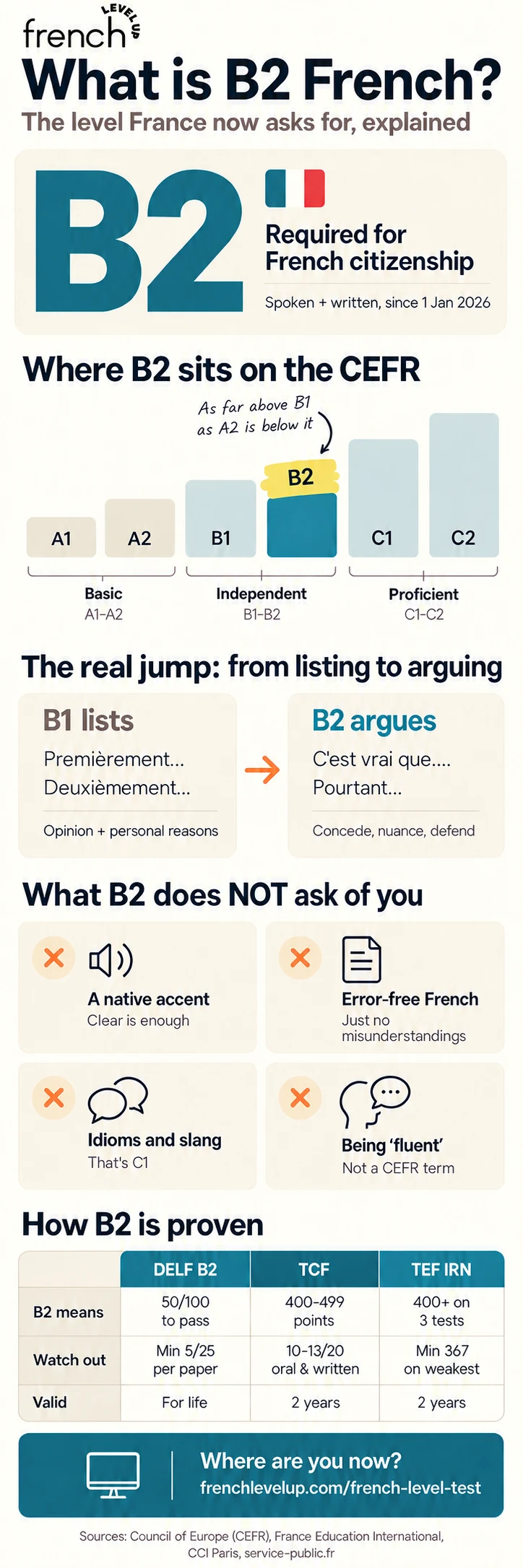
The CEFR groups its six levels in pairs. A1 and A2 are the “basic user” levels, B1 and B2 are the “independent user” levels, and C1 and C2 are the “proficient user” levels. On the Council of Europe’s global scale of the CEFR levels, a B2 user understands the main ideas of complex text on both concrete and abstract topics, including technical discussions in their own field. They can interact with enough fluency and spontaneity that regular conversation works “without strain for either party”, and they can write clear, detailed text and explain a viewpoint on a current issue by weighing the advantages and disadvantages of different options.
The levels on either side make this clearer. At B1 you understand the main points of clear, standard French on familiar matters and you can produce simple connected text. At C1 you understand demanding, longer texts, including meaning that is only implied, and you express yourself fluently without much obvious searching for words.
B2 sits between the two, and the step up from B1 is a large one. The Council of Europe’s CEFR Companion Volume (2020), the updated reference for the framework, says B2 is as far above B1 as A2 is below it. It describes B2 as what comes after a learner has been “progressing slowly but steadily across the intermediate plateau”, and it names what changes at that point. Lower B2 focuses on effective argument, and two new focuses run through the level, holding your own in conversation and a new awareness of your own language, which means noticing and correcting your mistakes. If you have spent a long time at B1 feeling that you understand a lot without quite holding your own, this is worth knowing, because the official description of the next level starts with argument.
B2 French level skill by skill
The Council of Europe also publishes a self-assessment grid that splits each level into listening, reading, spoken interaction, spoken production and writing. It is designed to help learners profile their own skills, and the word profile matters, because a level does not have to be the same in all five. The table below paraphrases the grid’s B1, B2 and C1 descriptions and quotes only a few words.
| Skill | B1 | B2 | C1 |
|---|---|---|---|
| Listening | Main points of clear standard speech on familiar matters, and of many radio or TV programs when the delivery is fairly slow and clear | Extended speech and lectures, and complex lines of argument if the topic is “reasonably familiar”. Most TV news and current affairs programs, and most films in standard French | Extended speech even when it is not clearly structured and connections are only implied. TV and films without too much effort |
| Reading | Texts in high-frequency everyday or job-related language, and personal letters | Articles and reports on contemporary problems in which the writer adopts a particular stance or viewpoint, and contemporary literary prose | Long, complex factual and literary texts, with an eye for differences in style, and specialized articles outside your field |
| Spoken interaction | Most situations while traveling, and joining a conversation on familiar topics without preparation | Interacting “with a degree of fluency and spontaneity”, and taking an active part in discussion in familiar contexts, explaining and sustaining your views | Expressing yourself fluently and spontaneously without much obvious searching for expressions, and using the language flexibly for social and professional purposes |
| Spoken production | Linking phrases simply to describe experiences, events and hopes, giving brief reasons for opinions, telling a story | Clear, detailed descriptions on a wide range of subjects related to your interests, and explaining a viewpoint on a topical issue with its advantages and disadvantages | Clear, detailed descriptions of complex subjects, bringing in sub-themes and rounding off with a conclusion |
| Writing | Simple connected text on familiar topics, and personal letters about experiences | Clear, detailed text on a wide range of subjects, an essay or report giving reasons for or against a point of view, and letters showing what events mean to you | Clear, well-structured text that develops points of view at some length, in a style chosen for the reader |
Paraphrased from the CEFR self-assessment grid, © Council of Europe.
Listening. The B2 descriptor comes with a condition, because complex arguments are within reach provided the topic is reasonably familiar. A fast exchange between friends about something you know nothing about can still lose you at B2, and that alone does not put you below the level.
Reading. The change from B1 is the stance in the text. At B1 you read mostly everyday or work-related language, while at B2 you can follow a writer who is arguing a case, which is what an opinion column or a policy report does.
Speaking. The grid treats conversation (interaction) and talking at some length on your own (production) separately. At B2, interaction means taking an active part in a discussion rather than joining in from time to time. A B1 speaker can already give brief reasons for an opinion, so the difference lies in how long you can keep going and whether you can defend the view when someone pushes back.
Writing. B1 writing connects simple ideas about familiar topics and experiences, while B2 writing takes a position and gives reasons for and against it. In practice, B2 is where a formal complaint or a reasoned opinion in French becomes something you can write on your own, still with mistakes, but organized.
As a coach, I pay most attention to the gap between the first two rows of this table and the next three. Many of the English-speaking expats I work with understand far more than they can say, and they follow almost everything at the dinner table and still go quiet when it is their turn. The grid allows for that profile, and so do the exams, as the testing section below shows. In my view it usually comes from a habit people built to protect themselves rather than from a lack of French, and it is the part of the level that a vocabulary list will not fix.
What B2 does not ask of you
Several things people attach to B2 are not in the official descriptors, and some of them make the level sound further away than it is.
A native accent. The Companion Volume replaced the 2001 pronunciation scale, partly because its jump from B1 to B2 was unrealistic, and it moved the focus from accent to intelligibility. At B2 the new scale expects you to use appropriate intonation and stress and to articulate sounds clearly, and it accepts an accent influenced by your other languages as long as it has “little or no effect on intelligibility”. A few systematic mispronunciations are allowed. The DELF B2 marking criteria ask for une prononciation plutôt claire (a rather clear pronunciation), not a French one.
Error-free French. At B2 the Companion Volume describes a relatively high degree of grammatical control, and the key line is that a B2 user “does not make mistakes which lead to misunderstanding”. Complex structures may still come out rigid and somewhat inaccurate, and toward the top of the band slips still occur but are rare and can often be corrected afterwards. The same document notes that accuracy tends to drop when the task gets more complex, so a B2 speaker who stumbles on a subjunctive while defending a complicated point is consistent with the descriptor. Claims that B2 means mastering the subjunctive or making almost no mistakes go further than the official text.
Idioms and slang. The Companion Volume places recognizing a wide range of idiomatic expressions and colloquialisms at C1, and using them naturally at C2, where the self-assessment grid puts a good familiarity with them. You will pick plenty up long before that, but they are not part of the B2 description.
Sounding like a native speaker. The 2001 descriptors, which are still the wording in the Council of Europe’s online tables, describe B2 conversation as interaction with native speakers. The 2020 Companion Volume reformulated the descriptors that relied on that term because it “has become controversial”, and its B2 global description refers to “users of the target language” instead. The benchmark is a conversation that works for both sides.
Numbered sub-levels. Some schools divide B2 into course stages such as B2.1 to B2.4, and those numbers belong to the school’s own way of organizing classes. The only subdivision the Companion Volume describes for B2 is B2+, a plus level that is sometimes written B2.2.
B2 and B2+
B2+ is one of the CEFR’s plus levels, which the Companion Volume describes as a very strong performance at a level that does not yet reach the next one, so features of the level above start to appear. At B2+ the focus on argument, conversation and self-monitoring continues, and discourse skills come in. You relate your contribution to what others have said, link your ideas with cohesive devices, develop an argument systematically and negotiate. B2+ describes a strong B2 heading toward C1, but it has no diploma of its own, because the DELF stops at B2 and the DALF starts at C1, and the TCF reports the six main levels.
What B2 French sounds like: a B1 and a B2 answer compared
France Education International (FEI), which publishes the DELF, the DALF and the TCF, explains what its examiners look for at each level.
At B1, the written task is an email or a postcard of at least 160 words in which you describe facts and experiences and give and justify an opinion, and FEI notes that ideas can be ordered comme une suite de points (as a list of points), with adverbs such as premièrement and deuxièmement. At B2, the written task is a forum contribution or a formal letter of at least 250 words. You take a position and argue it in detail with examples, weigh advantages and disadvantages, organize the text in paragraphs with connectors and use the right register, and the grammar criteria mention complex sentences, past tenses, the conditional and the subjunctive.
Illustrative example written for this article, not a real exam script. Both answers are shortened, and a real DELF B2 text must reach at least 250 words.
The prompt. Sur le forum d’un magazine en ligne, un lecteur écrit : « Le télétravail isole les salariés et freine leur carrière. » Vous réagissez à ce message en donnant votre opinion de manière argumentée. (On an online magazine’s forum, a reader writes that remote work isolates employees and holds back their careers. You reply with an argued opinion.)
A B1 answer
Bonjour à tous,
Je ne suis pas d’accord avec ce message. Pour moi, le télétravail est une bonne chose. Premièrement, on ne perd pas de temps dans les transports. Avant, je mettais une heure pour aller au bureau. Deuxièmement, il y a moins de bruit à la maison, alors je travaille mieux. Troisièmement, on peut mieux organiser sa journée. C’est vrai qu’on est parfois un peu seul, mais ce n’est pas un gros problème parce qu’on peut voir ses collègues au bureau une fois par semaine. Pour conclure, je pense que le télétravail est bon pour les salariés.
A B2 answer
Selon l’auteur de ce message, le télétravail isolerait les salariés et nuirait à leur carrière. Je comprends cette inquiétude, mais à mon avis, le problème vient moins du télétravail lui-même que de la manière dont il est organisé.
Il est vrai qu’un salarié qui ne vient presque jamais au bureau risque de perdre le lien avec son équipe et de devenir moins visible pour sa hiérarchie. Pourtant, ce risque diminue nettement à condition que l’entreprise prévoie des jours de présence communs. Dans mon service, par exemple, nous travaillons à distance trois jours par semaine, mais nous avons choisi de nous retrouver le mardi et le jeudi, ce qui a suffi à préserver l’esprit d’équipe.
Par ailleurs, comme les salariés ne passent plus des heures dans les transports, ils commencent leur journée moins fatigués et sont souvent plus efficaces.
Le télétravail n’est donc pas un piège en soi. Bien encadré, il peut profiter aux salariés autant qu’aux entreprises.
What changed between the two. Both texts are written in correct French on purpose, so the difference you see is in how the ideas are built rather than in mistakes.
- The B1 answer states an opinion and then lists points (premièrement, deuxièmement, troisièmement), each justified by personal experience, which is the B1 pattern FEI describes. It answers the isolation half of the reader’s claim and never addresses careers.
- The B2 answer starts from the other person’s argument and reformulates it, using the conditional (isolerait, nuirait) to report a claim without endorsing it.
- It concedes before it disagrees (Il est vrai que… Pourtant), which is the concession FEI lists in its B2 criteria for the speaking interaction, and it links cause and consequence (comme…, ce qui a suffi à…).
- It gives a concrete example with a past tense (nous avons choisi), uses the subjunctive where the structure requires it (à condition que l’entreprise prévoie), and ends on a qualified conclusion rather than repeating the opening.
The same difference shows in speaking. In the interaction part of the DELF B2 oral, FEI expects you to confirm and nuance your opinion, concede, react to the examiner and defend your view. Suppose the examiner pushes back.
Examinateur : Mais le télétravail, ça isole quand même les gens, non ?
Réponse de niveau B1 : Oui, c’est vrai, un peu. Mais moi, j’aime bien travailler chez moi, c’est plus calme.
Réponse de niveau B2 : C’est un vrai risque, je vous l’accorde. Cela dit, je ne pense pas que ce soit inévitable. Si l’équipe se retrouve régulièrement, l’isolement reste limité.
The B1 reply agrees and falls back on personal preference. The B2 reply grants the point, keeps the position and states the condition under which it holds.
When I prepare English speakers for the DELF B2, this move from listing to arguing is where much of the work happens. The connectors themselves are a short list, but answering the other person’s argument before giving your own, in real time, takes practice, and that is exactly what the interaction part of the speaking test checks.
How B2 French is tested and scored
The B2 proofs you will see named in French requirements are the DELF B2, which is a diploma, and the TCF and the TEF, which are tests that produce a dated attestation.
The DELF B2 exam
The DELF B2 (tout public) has four papers, each marked out of 25. Listening, reading and writing are taken in a group, and speaking is an individual test in front of two examiners.
| Paper | Time | What you do | Marks |
|---|---|---|---|
| Listening | 30 minutes | Answer questions on recorded documents | /25 |
| Reading | 1 hour | Answer questions on written documents | /25 |
| Writing | 1 hour | One argued text of at least 250 words, a forum contribution or a formal letter | /25 |
| Speaking | 20 minutes, after 30 minutes of preparation | A monologue suivi, in which you present the theme of a short document, state the question it raises, announce a plan and defend a point of view, then a discussion with the examiners | /25 |
Added together, the four papers and the speaking preparation come to three hours and twenty minutes. FEI uses two official formats for the listening and reading papers, which differ in the number of exercises, the length of the documents and the form of the questions, and it states that neither format favors candidates. A fixed count of comprehension exercises that you read elsewhere may therefore not match your session, and FEI’s DELF B2 sample papers show both formats.
You pass with 50 out of 100, and you need at least 5 out of 25 in every paper, because a score below 5 in any paper is eliminatory. This rule matters if your profile is uneven. As a simple calculation, 17 in listening, 18 in reading, 8 in writing and 7 in speaking makes 50 and passes, while 24, 24 and 23 with a 4 in speaking makes 75 and fails.
The DELF is an official diploma of the French Ministry of Education and it is valid for life. FEI states that the DELF B2 can be used for French nationality, and that the DELF B2, and increasingly the DALF C1, give access to universities in France and other French-speaking or European countries.
The TCF
The TCF (Test de connaissance du français) is FEI’s test, and instead of a pass or fail at one level it places your results on the scale. In the TCF tout public, three multiple-choice tests are compulsory (listening, language structures and reading), while writing and speaking are optional. On the level grid published with FEI’s guide to TCF results, B2 corresponds to 400 to 499 points on the multiple-choice tests and 10 to 13 out of 20 in speaking and writing. For comparison, B1 is 300 to 399 points and 6 to 9 out of 20, and C1 is 500 to 599 points and 14 to 17 out of 20.
The TCF IRN, the version used for French naturalization files, has four compulsory tests and lasts 1 hour 35 minutes. Its listening and reading scores only go up to B2, while speaking and writing are scored up to C2, and the attestation states whether you reach B2 overall.
A TCF attestation is valid for two years from the results, and you can sit the test again with 20 days between sittings. FEI has also suspended the re-marking of speaking and writing for about a year from the sessions of 1 September 2026, so if a result is borderline, the practical option is to sit the test again.
The TEF
The TEF is the equivalent test from CCI Paris. For naturalization, the TEF IRN counts as B2 when you score at least 400 on three tests and at least 367 on the weakest one, with all tests taken on the same day, and the attestation is valid for two years from the date it is issued. These thresholds apply to the TEF IRN, so if you are taking another version of the TEF, check its B2 score band with your test center.
Which one fits you
If you want a proof of B2 that never expires, or you are aiming at a French university, the DELF B2 is the natural choice, because it is a diploma valid for life and it exempts you from the TCF in the university pre-admission procedure described below. If you need a B2 proof for a specific application, such as naturalization, the TCF IRN and the TEF IRN also count, but their attestations must be less than two years old when you apply, so it makes sense to time the test to the file.
After B2: the DALF C1
The next diploma is the DALF C1, which uses the same scoring rule (four papers out of 25, 50 out of 100 to pass, at least 5 in each) with longer papers, including a 2 hour 30 minute writing paper that combines a synthesis of 220 to 240 words with an argued text of at least 250 words. Like the DELF, the DALF is valid for life, and it is the diploma to aim for when a program asks for C1.
What you need B2 French for
French citizenship
Since 1 January 2026, naturalization applications and declarations of nationality by marriage require French at B2 or above, spoken and written. Accepted proof includes any diploma attesting at least B2, which covers the DELF B2 and, because they sit above B2, the DALF C1 and C2, as well as a TCF or TEF attestation issued less than two years before you apply. The full list of accepted proofs, including some French diplomas, and the IRN scoring are covered in our guide to the French citizenship language requirement, and the rest of the process is in how to get French citizenship.
French universities
Language requirements for French universities are set by institutions and programs rather than by one national level. For the first year of a licence (bachelor’s degree) or an architecture school through the Demande d’admission préalable (DAP), the pre-admission procedure, holders of the DELF B2, the DALF C1 or the DALF C2 are exempt from the TCF the procedure otherwise requires, according to FEI’s page on the DAP. The two Campus France country offices checked for this article (South Africa and Japan) give B2 as the minimum for first-year undergraduate entry, and both note that some programs ask for C1 or higher. Country offices describe the accepted tests differently, so confirm with the Campus France office for your country and with the program itself.
Work
When an employer asks for B2, the requirement is theirs, so ask which proof they accept. A DELF diploma and a TCF or TEF attestation are different documents with different validity, and that difference matters if the attestation would expire before you need it.
Is B2 French fluent, and how hard is it to reach?
Is B2 fluent?
No CEFR level is called “fluent”. The Companion Volume has a fluency scale with descriptors at every level from A1 to C2. At B2 you speak at a fairly even tempo, and you may hesitate while searching for patterns and expressions, but there are few noticeably long pauses, and toward the top of the band the descriptor speaks of “remarkable fluency”. At B1 you keep going comprehensibly, but your pauses for planning and repair are very evident. My reading, as a coach, is that if fluent means keeping a conversation going without strain on subjects you know, B2 is where that starts. If it means sounding native, no CEFR level promises it, and the Companion Volume states that even C2 “is not intended to imply native-speaker” competence.
Is B2 hard?
B2 is hard in a specific way. Up to B1, the descriptors are mostly about describing your experiences, events and plans and giving brief reasons. B2 asks you to argue, which means following someone else’s reasoning, conceding a point and holding a position in real time. This is also where the accuracy drop described above shows up, so expect your grammar to feel shakier while you learn to argue, because the task is harder and not because you are losing ground.
How long does it take to reach B2?
There is no honest single figure, and this article does not give one. The Companion Volume gives no learning-hours figure per level, and the FEI pages for the DELF, the DALF and the TCF checked for this article give none either. The figures you see online come either from individual schools, which do not agree with each other, or from the US Foreign Service Institute, whose training times target a different scale (level 3 on the ILR scale, in speaking and listening) rather than CEFR B2. A figure counted from zero would not help you much anyway if you are already B2 in reading and B1 in speaking, because the useful question is how far your weakest skill is from B2, and the next section helps you find out.
How to know if you are B2 in French
Start with the self-assessment grid. Read the B2 column for each of the five skills and ask whether it describes what you can do now, on an ordinary day, rather than on a good day after preparation. FEI’s own checklist for DELF B2 candidates makes a good second filter. It asks whether you can defend your opinion with arguments and examples, develop a point of view with its pros and cons, express cause and consequence, convince someone, correct yourself, take notes, reformulate an idea and explain what is left implicit.
Then take the free French level test on this site. It has 35 questions plus six statements about your speaking and writing, takes about ten minutes and asks for no email. The questions adapt from A1 to C1 across grammar and vocabulary, reading and listening, and your speaking and writing come out as a separate, self-estimated level, so you see the gap between understanding and speaking if you have one. It is not an official certification, but it tells you which skill to look at first.
A multiple-choice test can check what you understand, but it cannot hear you speak or read what you write, so those two skills need a person. If you want to know where they stand before you book an exam, the Bilan B2 is a one-hour, one-to-one video session (€95) in which you talk, write a short text in exam conditions and do a listening task, and you leave with an estimated score for each part of the exam on a DELF-style scale and a written plan. It gives an estimate, not an official result, and it is not meant for people below B1.
If you are already around B2 and want structured exam practice, Objectif B2 is an eight-week, small-group DELF B2 and TCF preparation with four seats and two mock exams. The next cohort is not scheduled yet, so the page currently works as a waitlist.
B2 French: common questions
Is B2 French good enough to live in France?
For the paperwork, B2 is above what residence permits ask for, since the multi-year residence card requires A2 and the carte de résident requires B1, and it meets the citizenship requirement that has applied since 2026. For daily life, B2 means you can follow the news and take part in discussions on familiar subjects. Unfamiliar topics and fast, informal speech can still take effort, and that is consistent with the level.
Is B2 the same as bilingual?
It is not, because “bilingual” is not a CEFR term and the scale still has C1 and C2 above B2. If you need to describe your level on a CV or a form, “B2 (CEFR)” with the name of your certificate is more precise than any adjective.
Is B1 or B2 better for French citizenship?
For a naturalization application or a declaration by marriage made since 1 January 2026, B1 is not enough, because the requirement is B2 in spoken and written French.
Does a DELF B2 expire?
The DELF and the DALF are valid for life, while TCF and TEF attestations are valid for two years. A DELF B2 from several years ago still counts as a diploma, but it says nothing about your level today.
Can I be B2 in reading and B1 in speaking?
You can, because the self-assessment grid profiles each skill separately, and the exams handle an uneven profile in different ways. The DELF adds the four papers together, so strong papers can carry a weaker one as long as none falls below 5 out of 25, and the TEF IRN accepts one weaker test down to 367 when the other three reach 400. Whichever exam you choose, the weaker skill is the one to measure first, and the level test above shows your understanding and your speaking as separate levels.