
In this article
- Step 1: Find your route to French nationality
- Step 2: Check the conditions for naturalization
- Step 3: Get your B2 proof and pass the civic exam before you file
- Step 4: Pay the €255 stamp and prepare your documents
- Step 5: File online and get your récépissé
- Step 6: The interview at the prefecture
- Step 7: The decision, and what to do if it is negative
- Step 8: After the decree
- If you are married to a French citizen
- Other routes in brief
- Will you keep your current nationality?
- FAQ
Rules checked on 2 October 2026.
If you have lived in France for a few years, you have probably wondered whether you could apply to become French now and what it would involve. The answer starts with your route, because naturalization through residence and the declaration for spouses of French citizens do not follow the same rules. The civic exam, the way you file and the time the administration has to answer all change from one to the other.
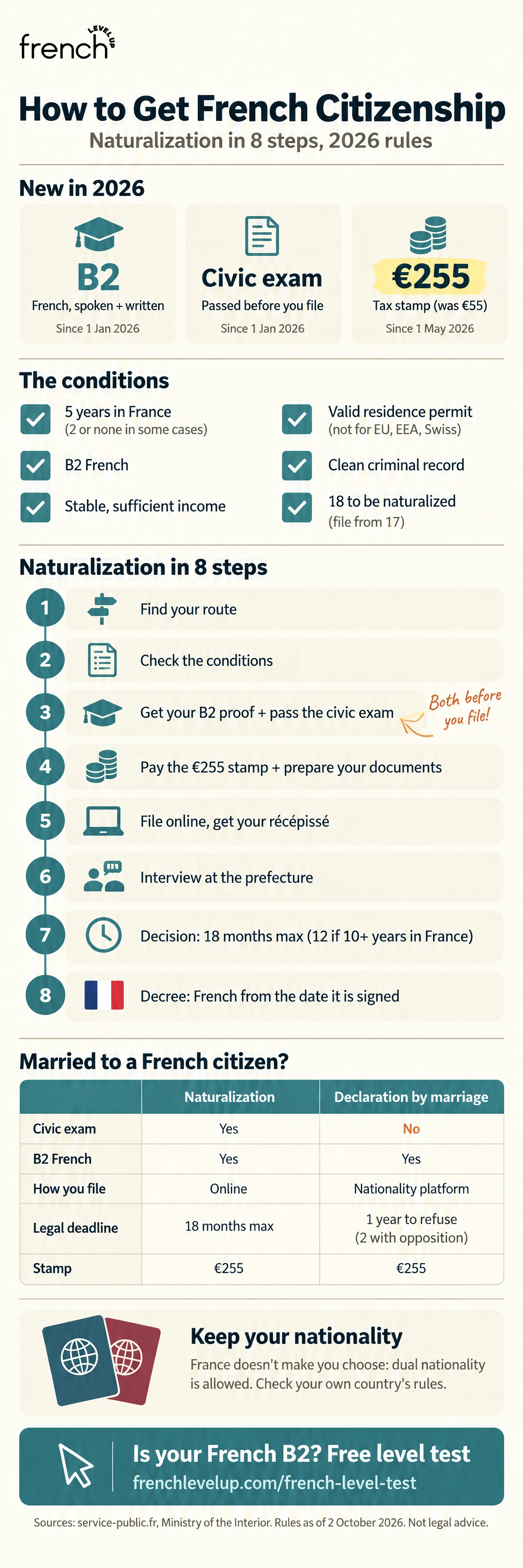
Three things also changed in 2026, so a lot of older advice is now out of date. Naturalization applications and marriage declarations made since 1 January 2026 need French at B2 level, spoken and written. Since the same date, people applying for naturalization have to pass a civic exam before they file. And since 1 May 2026 the tax stamp for the application costs €255 instead of €55.
Below you will find a route chooser, then the naturalization steps in the order you have to do them, and a separate section for spouses. I am a French coach who prepares people for the B2 proof, not a lawyer, so check your own situation with service-public and your prefecture.
Step 1: Find your route to French nationality
There are two main ways to become French. Naturalization by decree is a request, so you apply and the State decides, and it can refuse or postpone a file even when the legal conditions are met. A declaration works the other way round, because you declare a right the law gives you, for example as the spouse of a French citizen, and the administration checks the conditions before it registers your declaration.
| Route | Who it is for | Main conditions | Civic exam? | How you apply |
|---|---|---|---|---|
| Naturalization by decree | Adults living in France | 5 years’ residence (2 years or none in some cases), B2 French, stable income, good character, valid residence permit | Yes, passed before you file | Online, then an interview at the prefecture |
| Declaration by marriage | Spouses of French citizens | 4 or 5 years of marriage, a shared life, B2 French, valid residence permit | No | File lodged with the nationality platform for your area, at the counter or by post |
| French parent | People with at least one French parent | You may already be French and only need to prove it | No | Certificate of French nationality, which is free |
| Born in France to foreign parents | People born in France who grew up there | Residence in France during childhood and at 18 | No | Automatic at 18 if the conditions are met, or an earlier declaration |
| Ascendant or sibling of a French citizen | Parents, grandparents or great-grandparents aged 65 and over, some siblings | Long, regular residence in France with a valid permit | No | Declaration, with the €255 stamp |
If you moved to France as an adult and you are not married to a French citizen, you are on the first row, and steps 2 to 8 follow that route in order. If you are married to a French citizen, read step 3 for the language part and then go to the marriage section, because the filing and the deadlines are different.
If you are an EU, EEA or Swiss national, the same conditions apply to you on both main routes, including B2 and, for naturalization, the civic exam. The one difference is that you do not need a residence permit to file.
Step 2: Check the conditions for naturalization
The conditions below come from the service-public page on naturalization by decree. Tick them before you pay for tests or translations, because a file that misses a legal condition is inadmissible.
- Age. You must be 18 to be naturalized, but you can file from the age of 17.
- Length of residence. The rule is 5 years in France. It drops to 2 years if you obtained a diploma from a French higher-education institution after two years of study there, if you have rendered important services to France through your abilities or talents, or if you have followed an exceptional integration path. What counts is two years of study in France, not holding a Master’s, so a Master’s earned elsewhere does not shorten anything. Some people need no minimum at all, including refugees, nationals of French-speaking countries whose mother tongue is French or who had at least 5 years of schooling in French, and people who did French military service.
- Where you live when the decree is signed. You must still live in France on the day the decree is signed, with your work and your family ties centered here. If your spouse or children live abroad, nationality may be refused, so a long posting abroad while your file is open puts this condition at risk.
- Residence permit. You need a valid permit on the day you file, unless you are an EU, EEA or Swiss national, and you must not be under an expulsion order or a ban from French territory.
- Income. Your income must be stable and sufficient for you and your foyer fiscal, which is the household on your tax return.
- Good character. A prison sentence in France of 6 months or more without suspension bars you, and so does a conviction for terrorism or for an offense against the fundamental interests of the Nation, unless you have been rehabilitated or the conviction has been removed from bulletin n°2 of your criminal record.
- Assimilation. This is checked through your French, which must be at B2, the civic exam and an interview at the prefecture.
Step 3: Get your B2 proof and pass the civic exam before you file
These two come first because the online file asks for both documents, and the civic exam has to be passed before you lodge the application. A file without them is incomplete, and you only get a récépissé once every document is in.
The B2 proof
You need French at B2, spoken and written. Service-public accepts a French diploma (the brevet, a State diploma at level 3 or above, or an RNCP qualification at level 3 or above), any diploma that attests B2 or higher, such as the DELF B2, or a TCF or TEF attestation issued less than two years ago. The tests are taken in person in an exam center, and our guide to which tests count as B2 proof goes through each option. People with a health condition or disability can be exempted with a medical certificate, and so can refugees and stateless people over 70 who have lived in France for 15 years.
This is the one part of the procedure where I can speak from my own work. For someone at A2 or B1, B2 is usually the condition that takes the most months, because it asks you to explain and defend a point of view in speech and in writing, which is a step above getting by in daily life. So I would find out where you stand before you plan anything else. My Bilan B2 is a 60-minute one-to-one assessment with a written debrief and a study plan. It gives you an estimated score on a DELF-style scale, which tells you how far you are from B2, but it is an estimate and not a TCF or TEF result, so it cannot go in your naturalization file.
The civic exam
The civic exam has applied to naturalization since 1 January 2026, and it does not apply to the declaration routes (marriage, ascendant, sibling). It is a digital test of 40 multiple-choice questions in French, it lasts 45 minutes, and you need 32 correct answers to pass. The questions cover five themes set by the arrêté of 10 October 2025: the principles and values of the Republic, the institutional and political system, rights and duties, history, geography and culture, and living in French society. Our guide to the French citizenship test explains each theme, the official question list and how to practice, with sample questions.
You register with a center approved by CCI Paris Île-de-France or France Éducation International, and the center sets its own fee. Medical exemptions and adjustments exist, and fraud leads to a two-year ban from the exam.
In which order
Your civic exam certificate has no time limit and the DELF B2 is valid for life, but a TCF or TEF attestation is only accepted if it was issued less than two years ago, and service-public does not say whether those two years are counted at filing or later. So you can sit the civic exam whenever you are ready, and if you are not using a diploma, it is safer to take the TCF or TEF when the rest of your file is nearly ready than two years ahead.
Step 4: Pay the €255 stamp and prepare your documents
The application costs €255 (€127.50 in French Guiana), paid with a timbre fiscal, the tax stamp. The amount went up from €55 on 1 May 2026, so any page that still quotes €55 was written before the change. You can buy the electronic stamp online or at a tabac, or pay it during the online application. It is valid for one year and can be refunded on request within 18 months. You pay it when you file, not when the decree is signed.
Apart from the stamp, acquiring French nationality is free. Service-public warns about private websites that charge for help, for example to get a prefecture appointment. Your own costs, such as sworn translations and the test center’s fees, come on top.
The exact list of documents depends on your situation, so build yours from the official page. The core of it is:
- the €255 stamp, and your residence permit unless you are an EU, EEA or Swiss national
- ID, civil-status documents and proof of your nationality
- proof of address, income and tax
- your B2 diploma or attestation, and your civic exam pass certificate
- documents on your couple, any previous marriage and your children
- a criminal record from your country if you have lived in France for less than 10 years
- your passports, if you made short entries into the Schengen area in the last 5 years
Civil-status documents must be full copies in their original language. French ones must be less than 3 months old, foreign ones need a sworn translation, and some need legalization or an apostille. Keep the originals, because you will bring them to the interview. If you and your partner both apply, you each make a separate file.
Step 5: File online and get your récépissé
You file the naturalization application online, through the ANEF service for foreigners linked from the service-public page. If you get stuck, the ANTS Centre de Contact Citoyens answers on 0806 001 620, and prefectures have digital help points. A paper file is accepted only if you can show that filing online was impossible.
Once you have sent every document, you receive a récépissé, a receipt that starts the legal clock for the decision. If the prefecture asks for missing documents and you do not send them by the deadline, your file can be closed without a decision (classement sans suite), so wait until every document is ready before you send it.
Step 6: The interview at the prefecture
If your application is admissible, you are called to an interview at the prefecture. It checks your assimilation and your adherence to the principles and values of the Republic, which are set out in the charte des droits et devoirs du citoyen français, and you sign that charter at the end of the interview. Service-public points you to the livret du citoyen to prepare, and a new version was approved in July 2026, so use the current one rather than an old download.
Bring the originals of your documents, because if you do not turn up and have no valid reason, your file can be closed. Alongside the interview there is an enquiry into your civic behavior, such as paying your taxes, and into your judicial history in France and abroad.
Step 7: The decision, and what to do if it is negative
The administration has 18 months from the date of your récépissé to answer. That drops to 12 months if you have lived habitually in France for 10 years or more on the date of the récépissé, and either deadline can be extended once by 3 months with a reasoned decision. These are legal maximums, not a forecast of how long your own file will take. More delays have been observed since the circulaire Retailleau of 2 May 2025.
Take a hypothetical case. Say you are a British engineer who has lived in Lyon since 2014 and you receive your récépissé in March 2027. You have more than 10 years of residence on that date, so the administration has until March 2028 to answer, or June 2028 if it uses the extension. If you had arrived in 2020 instead, the same récépissé would give it 18 months, until September 2028, or December 2028 with the extension.
A negative decision takes one of two forms. The file is irrecevable (inadmissible) when a legal condition is not met. It is inopportune when the legal conditions are met but the State decides not to grant nationality, and then the file is either refused or adjourned, which means postponed with a delay, for example so that you can improve your professional integration. If you apply again within 5 years of a refusal, the new file may be closed without a decision.
To challenge a decision on an online file, you must first make a recours hiérarchique through your online account within 2 months, and only after that can you go to the tribunal administratif de Nantes. Because this first step is compulsory, note its deadline on the day the decision arrives.
Step 8: After the decree
You are told by email once the decree is published in the Journal officiel, and the publication date also appears in your online account. You then download the decree on Légifrance. You are French from the date the decree was signed, and your unmarried minor children who live with you become French too if they are named in it.
What to do next:
- Apply for a French national ID card and passport, for yourself and for any children who became French with you.
- If you or a child are between 16 and 25, register for the recensement (the national service census) within a month.
- Wait for your invitation to the citizenship welcome ceremony, which the prefect organizes in principle within 6 months of the decree’s publication. If you are an employee, you and your spouse are entitled to at least half a day off to attend.
The decree can still be withdrawn within 2 years of its publication if the conditions were not met, or within 2 years of the discovery of fraud, which is one more reason to keep your file accurate.
If you are married to a French citizen
The declaration by marriage has its own service-public page, and it differs from naturalization in ways that change your plan. The summary below covers the essentials, and our guide to French citizenship by marriage goes through the declaration step by step.
Your spouse must have been French on the day of your wedding and ever since. You need 4 years of marriage on the day of the declaration if you have lived in France continuously since the wedding, or for at least 3 years. If you have lived in France for less than 3 years, it is still 4 years when your French spouse was registered on the consular register while you lived abroad, and 5 years otherwise. A marriage celebrated abroad must be transcribed into the French civil registers. You must have a continuous shared life, which means living together both materially and emotionally, a valid residence permit unless you are an EU, EEA or Swiss national, and the same clean record as for naturalization.
You need B2 French, and the only exemption is for health or disability. You do not take the civic exam, because it concerns only naturalization and reintegration. Some guides suggest that spouses must pass it too, so do not let that delay your file.
You pay the same €255 stamp and fill in form cerfa 15277 in two copies, signed by both of you. The file is lodged with the nationality platform for your area, at the counter or by recorded post depending on the platform, and service-public describes no online service for this route. If you live abroad, you pay the €255 at the consulate when you file.
Both spouses are called to an interview, which checks your shared life and your assimilation. You sign a sworn statement that your shared life has not ended, and you receive the récépissé at the end of the interview.
The ministry then has 1 year from the récépissé to refuse registration, or 2 years if it opens an opposition procedure, which it can do for indignity or for lack of assimilation other than language. Once the declaration is registered, you are French from the date you subscribed it. A refusal can be contested within 6 months before the tribunal judiciaire, and a lawyer is compulsory there. The welcome ceremony is held in principle within 6 months of registration.
Other routes in brief
These routes are less common for adults who moved to France, so check service-public’s overview of all the ways to obtain French nationality for your case.
A French parent. A child with at least one French parent is French, so if one of your parents was French when you were born you may already be French without knowing it. You prove it with a certificat de nationalité française, a certificate of French nationality, which is free. If you never held French nationality, you have to acquire it by declaration or naturalization like anyone else.
Born in France to foreign parents. A child born in France to foreign parents becomes French automatically at 18 if they live in France at that age and have lived there habitually for at least 5 years since the age of 11, and earlier declarations are possible from 13 or 16. The conditions depend on age, so read the service-public page on this route before you rely on it.
Ascendant of a French citizen. If you are 65 or over, have a French child, grandchild or great-grandchild, and have lived in France habitually and regularly for at least 25 years with a valid permit, you can make a declaration. It costs €255 and there is no civic exam.
Sibling of a French citizen. An adult who has lived in France since the age of 6 with a valid permit, did their compulsory schooling in France, and has a brother or sister who was born in France to foreign parents and became French under the born-in-France rules can make a declaration. There is no civic exam, but several conditions depend on your sibling’s situation, so check the official page before you file.
Reintegration and exceptional grants. If you were French and lost your nationality, there is a reintegration procedure, which goes through a decree and includes the civic exam. Separately, the foreign affairs minister can propose nationality for a French-speaking person whose activity contributes to France’s international influence, and that process starts with the minister’s proposal rather than with an application.
Will you keep your current nationality?
France does not make you choose. French law allows multiple nationalities and does not require a foreigner who becomes French to give up their nationality, and service-public’s own example is a British person who becomes French and stays British. In your application you state which nationality or nationalities you keep. Once you are French, you cannot rely on your other nationality while you live in France, and you cannot get French diplomatic protection while you live in your other country.
The other half of the answer belongs to your own country.
- United Kingdom. GOV.UK confirms that you can take another citizenship and keep your British citizenship. As a British and French dual national, you cannot get UK diplomatic help in France.
- United States. US citizens, dual nationals included, must use a US passport to enter and leave the United States. Whether becoming French has any effect on your US citizenship is a question of US law, so read the State Department’s guidance on dual nationality or ask a US consulate before you file.
- Other countries. France will not ask you to renounce anything, but your country of origin may have its own rules, so check with its government or consulate.
FAQ
How long does it take to get French citizenship?
Only the legal deadlines are reliable. For naturalization, the administration has 18 months from your récépissé, or 12 months if you have lived in France for 10 years or more, plus one possible 3-month extension (see step 7). For the marriage route, the ministry has 1 year to refuse registration, or 2 years with an opposition. Add the months you need to get the B2 proof and, for naturalization, the civic exam certificate, because your file is not complete without them.
Is it hard to get French citizenship?
The conditions are clear and published, so the procedure itself is mostly a question of order and paperwork. In my view as a language coach, the hard part is the preparation, because B2 French and the civic exam both take real work, and naturalization stays a decision the State can refuse or postpone even when you meet the conditions.
Can I apply for naturalization from abroad?
Only in narrow cases, for example if you work for the French State or for certain bodies of particular interest to France, if you live in Monaco, or if you did French military service or training or served as a national service volunteer. Otherwise naturalization is for people who live in France. Spouses of French citizens can make the marriage declaration from abroad through the consulate.
I am an EU citizen. Is the process different?
It is only slightly different. You follow the same conditions and steps, but you do not need a residence permit to file. Living in France freely as an EU citizen does not make you French, so you still have to apply.
Do I need a lawyer?
The procedure does not require one, and service-public describes a file you prepare and send yourself. The exception is on the marriage route, where a lawyer is compulsory if you contest a refusal before the tribunal judiciaire. If your situation is unusual, for example a past conviction or a complicated family history, a lawyer is the right person to give an opinion on your own case.
This guide explains the official rules as they stood on 2 October 2026. It is not legal advice, and service-public and your prefecture remain the reference for your own file.