
In this article
- Who can declare French nationality by marriage
- Step 1: Start with your B2 proof
- Step 2: Build your file
- Step 3: Lodge the declaration
- Step 4: The interview
- Step 5: The instruction and the legal deadlines
- Step 6: Registration and your first French documents
- If something goes wrong
- After registration: separation, divorce and the fraud rule
- Declaration or naturalization?
- FAQ
Rules checked on 3 October 2026.
If you have been married to a French citizen for a few years and started reading about nationality, you have probably found pages that disagree with each other. One says you need B1 French where another says B2, and the fee is €55 on one page and €255 on the next. Only some of them say whether spouses have to sit the new civic exam. Much of that confusion comes from rules that changed in 2026 and pages that were written before the change.
The first thing to get straight is the nature of the procedure. By marriage, you do not apply for naturalization, which the government grants by decree. You make a declaration of nationality (déclaration de nationalité), which means you claim a right that the law gives to spouses of French citizens, and the administration checks the conditions within legal deadlines. So the conditions and the deadlines are not the same as for naturalization, and neither is the date from which you are French.
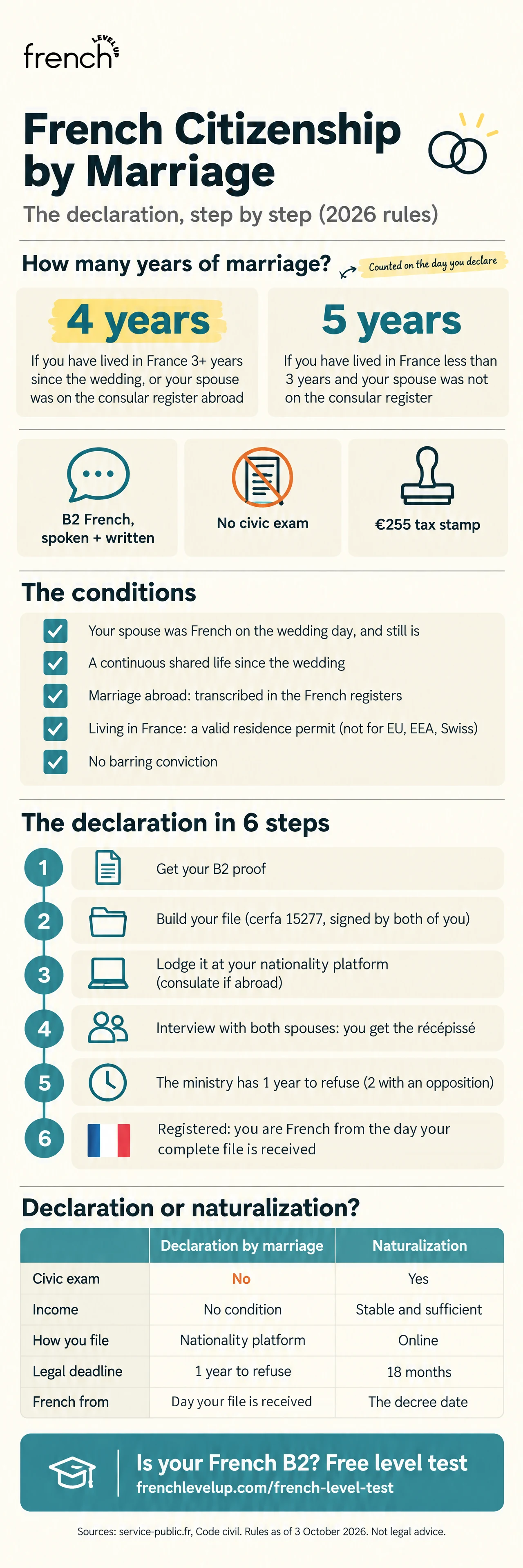
As of October 2026, the short answer is that you can declare French nationality after 4 years of marriage, or 5 in some cases where you have spent less than 3 years in France since the wedding, provided you and your spouse have shared your life continuously ever since and you can prove B2 French. Spouses do not take the civic exam, the stamp costs €255, and the file goes to the nationality platform for your area, or to the French consulate if you live abroad, before an interview to which both spouses are summoned.
I am a language coach, not a lawyer. I prepare English speakers for the B2 proof, and every legal rule below comes from service-public and the French Civil Code (Code civil) as they stood on 3 October 2026.
Who can declare French nationality by marriage
Article 21-1 of the Civil Code says that marriage has no automatic effect on nationality. What the marriage gives you is the right to declare French nationality once the conditions on the service-public page on the declaration by marriage are met, and they are assessed on the day you make the declaration.
Your spouse must have been French on the day of the wedding and must have kept French nationality ever since. If you married abroad, the marriage must already have been transcribed into the French civil registers, which means it has a French civil-status record of its own.
The number of years of marriage depends on where you have lived since the wedding.
| Your situation since the wedding | Years of marriage needed on the day you declare |
|---|---|
| You have lived in France legally and without interruption for at least 3 years since the wedding | 4 years |
| You have lived in France for less than 3 years, and your French spouse was on the consular register while you lived abroad | 4 years |
| You have lived in France for less than 3 years, and your spouse was not on the consular register | 5 years |
The consular register (registre des Français établis hors de France) is the list of French citizens living abroad that French consulates keep. If you have spent most of your marriage outside France, ask your spouse whether they were registered during those years, because that registration is what keeps the requirement at 4 years instead of 5.
You must also have a continuous community of life (communauté de vie) since the wedding. Service-public defines it as living together materially and emotionally, and its glossary adds that each spouse can have their own residence, with a common address for official documents. So working in different cities does not by itself rule the condition out, but you will need documents that show the shared life is real.
If you live in France, you need a valid residence permit (titre de séjour) when you file, unless you are a national of an EEA country, which includes the EU, or of Switzerland. If you live abroad, service-public lists no permit condition. In both cases you must not be under an expulsion order or a ban from French territory (interdiction du territoire français) that is still in force.
Some convictions bar the declaration. They are a prison sentence in France of 6 months or more without suspension, and a conviction for a crime or offense against the fundamental interests of the Nation or for terrorism, unless you have been rehabilitated or the conviction has been removed from bulletin n° 2 of your criminal record. If you have any conviction at all, ask a lawyer before you file.
Because the conditions are assessed on the day of the declaration, and your marriage certificate must prove at least 4 years of marriage, you cannot lodge the declaration early and let the anniversary pass while it is being processed. You can prepare everything else in advance, though, starting with the language proof.
Step 1: Start with your B2 proof
A spouse who declares French nationality on or after 1 January 2026 must prove French at least at level B2 of the Common European Framework of Reference (CEFR), in speaking and in writing. B2 replaced the old B1 level, which is why several English-language pages still say B1. The residence cards add to the confusion, because the ten-year carte de résident asks for B1, and that level has nothing to do with nationality.
The only exemption on the marriage route is for a disability or a health condition that makes the assessment of your French impossible, and you prove it with a medical certificate. A condition that does not rule the test out can still justify accommodations at the test, also on a medical certificate, and in both cases the administration can order a new medical assessment. There is no age exemption for spouses.
You do not take the civic exam. Service-public’s page on the civic exam states that it concerns only acquisition by decree, meaning naturalization and reintegration, and that declarations such as the one by marriage are not concerned. If someone tells you to book it before you file, they are applying the naturalization rules to your case.
The proof itself can be a TCF IRN or TEF IRN attestation issued less than 2 years earlier, a DELF B2 or another diploma attesting at least B2, or certain French diplomas such as the brevet or a State diploma at level 3 or above. I explain each option, how B2 is scored on the TCF and the TEF, and when a result stops counting in my guide to the French citizenship language requirement.
For a spouse, the choice depends mostly on when you will file.
- If your filing date is still far off, for example because your fourth anniversary is two years away, a DELF B2 is the safer proof, because the diploma is valid for life and you can take it as soon as you are ready. My guide to the DELF B2 explains the four papers.
- If you will file soon, a TCF IRN or TEF IRN makes sense, but book it close to your filing date, because the attestation must have been issued less than 2 years earlier. The texts do not say explicitly on which date that is assessed, so the safe reading is that it must still be under 2 years old on the day your complete file is received.
I put the language first because it is the one condition whose timing depends on you, since the years of marriage and the shared life simply accumulate. In my view as a coach, a B2 that is not there yet takes months of regular work to build, not a few weeks. B2 also asks for French that you produce, and not only French that you understand. If English is the language of your home, or your spouse switches to English whenever the conversation gets complicated, you may follow everything at a family dinner and still write and argue at B1, and that gap between understanding and producing is what the speaking and writing tests measure.
If you have no idea where you stand, the free French level test gives you a first estimate between A1 and C1. If you want to know precisely how far you are from B2 and which skill is holding you back before you plan the rest of the file, that is what I built the Bilan B2 for, a one-hour, one-to-one assessment on Zoom or Google Meet followed by a written debrief and a study plan. Neither one can go in a nationality file, because only the official proofs above count there. If you are already at a solid B1 and want structured preparation, I also run Objectif B2, an eight-week course for the DELF B2 and the TCF in groups of four at most, which works as a waiting list until the next group is scheduled.
Step 2: Build your file
The file is built around the declaration form, cerfa 15277, which you complete in two copies, then date and sign together with your spouse. You glue a recent photo on each copy. The core documents service-public lists for a declaration from France are these.
- Your identity and residence. A copy of your passport or residence permit and a recent proof of address. If you are not an EU national and entered the Schengen area from outside it for stays of less than 3 months during the last 5 years, you also provide the passports or visas you used, and those of your minor children.
- Your civil status. Your original birth certificate showing your parents’ details, and the original marriage certificate, or for a marriage abroad a copy of its transcription, issued less than 3 months earlier and proving at least 4 years of marriage. Add the documents on any previous marriage and its dissolution, and the birth certificates of all your children.
- Your spouse’s French nationality. One of the documents service-public accepts, such as a certificate of French nationality (certificat de nationalité française).
- Your shared life. Documents that show your material and emotional community of life, such as a joint tax notice or your children’s birth certificates, and recent documents in both your names at your current address, such as bills or a joint account statement.
- Your residence, if you have been married for less than 5 years. Proof of 3 years of legal and uninterrupted residence in France since the wedding, or your spouse’s consular registration certificate.
- Your French level. The diploma or attestation from step 1.
- Foreign criminal records. An extract from the criminal record of every country where you lived for 6 months or more during the last 10 years. Refugees and stateless people protected by OFPRA do not provide one for their country of origin.
- Your children, if they can become French with you. For foreign minor children who live with you, including in alternating residence, the documents proving filiation and that they live with you.
If you file from abroad, the list is the same without the stamp, because you pay at the consulate.
The documents also have to follow presentation rules. Civil-status records must be full copies, originals, in their original language, and French records must be less than 3 months old. Other documents can be copies, but keep the originals to show if you are asked. A document in a foreign language needs a sworn translation, provided in the original, unless it is a plurilingual extract that includes French (which an adult does not need to have translated) or an EU multilingual standard form. Some foreign documents also need an apostille or a legalization.
Read the full list on the French version of the service-public page before you assemble anything, because it covers cases this summary leaves out and links to a simulator that lists the documents for your situation. The English version is a machine translation, and in several places it translates the déclaration as a “return”.
The declaration costs €255 as of October 2026 (€127.50 in French Guiana), paid with a tax stamp (timbre fiscal), and apart from that stamp the procedure is free, so be wary of private sites that charge for things such as appointments. The price went up from €55 on 1 May 2026 under the 2026 finance law, as service-public announced in April 2026. In France the stamp is electronic. You buy it online on timbres.impots.gouv.fr or at a tobacco shop equipped to sell it, it is valid for 1 year from purchase, and you can request a refund online within 18 months. Abroad, you pay the €255 at the consulate when you file, as consular fees (droits de chancellerie), so check which means of payment your consulate accepts.
Step 3: Lodge the declaration
In France, you lodge the file with the nationality platform for your place of residence. Depending on the platform, you hand it in at the counter or send it by recorded post with acknowledgment of receipt, and service-public has an interactive map that shows which platform is yours and how it accepts files. If you send it by post, add a stamped return envelope and a blank 500 g tracked-letter envelope (lettre suivie). Service-public describes only these two channels for the marriage declaration, while the decree that governs the file also provides for an online service, so follow the instructions of your own platform.
Some guides say that spouses apply “at the prefecture”, but the official channel is the nationality platform, and the prefecture comes back at the end, when it hands you the registered declaration. If you live abroad, you lodge the declaration at the French consulate and pay the €255 there.
The date on which the administration receives your complete file, meaning the declaration with all its supporting documents, is the date of souscription (for a filing through an online service, it is the date you file). It matters because if your declaration is registered, you are French from that day and not from the day of the decision.
If your file is incomplete, you receive a formal notice with a deadline to complete it. If you miss that deadline, the file is closed without being examined (classement sans suite). You can contest the closure within 6 months before the tribunal judiciaire, and a new declaration remains possible.
Once your file is lodged, you must report any change in your situation, such as a new address or a divorce, to the prefecture if you live in France or to the consulate if you live abroad.
Step 4: The interview
You and your spouse are then summoned to an interview. It checks the reality of your community of life and your assimilation into French society, and you bring the originals of your identity documents. As service-public describes it, assimilation implies agreeing with the essential principles and values of the Republic, and elements that reveal a discriminatory attitude, notably based on sex, race, religion or nationality, count as a lack of assimilation.
During the interview you sign a sworn statement that your emotional and material community of life has not ceased since the marriage. At the end you are handed the récépissé, the official receipt for your declaration. Keep it carefully, because the legal deadlines in the next step run from that date.
The official pages I checked say nothing about how long the interview lasts or which questions are asked, and I do not prepare people for it, so treat the lists of “interview questions” you find online with caution. Your French level is established by the proof in your file, and the law excludes language from the grounds on which the government can oppose a declaration for lack of assimilation.
Step 5: The instruction and the legal deadlines
If all the conditions are met, the declaration is registered. If they are not, the file goes to the ministry of the Interior with a reasoned opinion within 6 months of the souscription date, and from abroad the consulate also transmits the file within 6 months. The ministry can order further inquiries. To follow the progress of your file or send a further document, service-public directs you to the ministry’s nationality department (SDANF) by email, at sdanf-accueil@interieur.gouv.fr.
The ministry has 1 year to refuse registration, counted from the récépissé you received at the interview. If it opens an opposition procedure, that deadline becomes 2 years.
These are legal maximums, not average processing times, and none of the official pages I checked publishes an average, so be wary of any precise “it takes 12 months” figure.
Step 6: Registration and your first French documents
Under article 26-4 of the Civil Code, if no refusal comes within the legal deadline, you receive a copy of the declaration with a mention of its registration. The prefecture hands it to you, or the consulate if you live abroad. That copy is your proof of French nationality, so keep it safe, and receiving it is the sign that the procedure is complete. There is no naturalization decree on this route.
Check the copy carefully. An error on the declaration itself is corrected by writing to the ministry of the Interior, and an error on a civil-status record by writing to the ministry of Foreign Affairs.
You can then apply for a French identity card and passport, for yourself and for the children who became French with you. If you became French between the ages of 16 and 25, you must also complete the recensement, the registration of young French citizens, within a month. A welcome ceremony is held in principle within 6 months of registration, organized by the prefect in France or by the consulate abroad.
Service-public also notes that, when you file, you can ask for the francisation of your surname and first names, which means adopting a French form of them, or for a French first name if you have none, and for the francisation of your children’s first names.
If something goes wrong
Three outcomes can stop the declaration, each with its own deadline and court. These are the moments to see a lawyer, and for a refusal or an opposition a lawyer is compulsory anyway.
| What happens | Why | Deadline to contest | Where |
|---|---|---|---|
| Closure without examination (classement sans suite) | The file was incomplete and not completed after the formal notice | 6 months (a new declaration also remains possible) | Tribunal judiciaire |
| Refusal of registration | A legal condition is not met, and you receive a reasoned decision | 6 months | Tribunal judiciaire of your place of residence, lawyer compulsory |
| Opposition by the government | Indignity, or lack of assimilation other than linguistic | 2 months | Conseil d’État, lawyer compulsory |
An opposition is a decree adopted after review by the Conseil d’État, within 2 years of the récépissé. Article 21-4 of the Civil Code names two situations that constitute a lack of assimilation, an effective situation of polygamy and a conviction for violence causing mutilation or permanent disability committed against a child under 15. If the government opposes your declaration, you are deemed never to have acquired French nationality, and because the 2-month deadline is short, contact a lawyer as soon as you receive the decision.
After registration: separation, divorce and the fraud rule
A registered declaration can still be challenged. Under article 26-4 of the Civil Code, the public prosecutor can contest the registration within 2 years if the legal conditions were not met, or within 2 years of discovering a lie or a fraud. The same article adds that if you and your spouse stop living together within 12 months of the registration, that separation is a presumption of fraud. In its decision 2012-227 QPC of 30 March 2012, the Conseil constitutionnel ruled that this presumption can only be used in proceedings brought within 2 years of the registration, and that after that period the prosecutor has to prove the lie or the fraud.
If your marriage is later annulled, the declaration is not void for a spouse who married in good faith (article 21-5).
Separation before registration raises different questions. Before you declare, a shared life that has ended means the condition is not met. After you have filed, you must report a divorce, and neither service-public nor the other official texts I checked say what happens next. If your marriage is ending at any point, before or after registration, see a lawyer before you make any decision about the declaration.
Declaration or naturalization?
If you have lived in France for several years, you may qualify for both routes. Both require B2 French and the €255 stamp, but the declaration has fewer conditions.
| Declaration by marriage | Naturalization | |
|---|---|---|
| Residence in France | Not required, but you need a permit if you live in France, and residence decides between 4 and 5 years of marriage | Usually 5 years, with some exceptions |
| Income | No condition | Stable and sufficient income |
| Civic exam | No | Yes, passed before you file |
| How you file | File lodged with the nationality platform (at the counter or by post), or with the consulate abroad | Online file (ANEF) |
| Decision deadline | 1 year from the récépissé to refuse registration, 2 years with an opposition | 18 months, or 12 months after 10 years of residence, extendable once by 3 months |
| You are French from | The souscription date | The date the decree is signed |
This compares official conditions and says nothing about outcomes. Naturalization remains the route to look at if a marriage condition fails, for example if your shared life has ended before you could declare, or if you already meet the naturalization conditions but have not yet reached 4 years of marriage. The naturalization steps are in my guide to getting French citizenship.
FAQ
Does marrying a French citizen make you French?
Not by itself. Marriage has no automatic effect on nationality, but it gives you the right to declare French nationality after 4 or 5 years of marriage, once the other conditions are met.
How long after marriage can I apply for French citizenship?
You need 4 years of marriage on the day you declare, or 5 if you have lived in France for less than 3 years since the wedding and your spouse was not on the consular register abroad. You can pass your language test before then.
Can I apply for French citizenship by marriage from abroad?
You can. You lodge the declaration and pay the €255 at the French consulate, and no French residence permit is required.
Do spouses need to pass the French civic exam?
They do not, because the civic exam concerns only naturalization and reintegration. The interview still checks your assimilation, but that is a different thing from the exam.
What level of French do I need for citizenship by marriage?
You need B2 in speaking and writing for declarations made since 1 January 2026, where the level used to be B1. Step 1 above explains which proof to choose depending on when you will file.
Will I keep my current nationality?
France allows multiple nationalities and does not ask you to give up yours, and service-public’s own example is a British person who becomes French and stays British, since the UK also allows dual citizenship. For the US, the State Department says that citizens who also hold another nationality must still use a US passport to enter and leave the United States, and any other effect on your US citizenship is a question of US law to check with the State Department or a US consulate. My guide to getting French citizenship covers dual nationality in more detail.
This guide explains the declaration by marriage as it stood on 3 October 2026 and is not legal advice. For your own case, the service-public page on the declaration by marriage remains the reference, and a lawyer is the right person whenever a decision is at stake.