
In this article
- What the French civic exam is
- Who has to take it, and who doesn’t
- The three versions and the five themes
- The official questions and the livret du citoyen
- How to register and take the exam
- Results, certificate and retakes
- How much the civic exam costs
- The civic exam for residence cards
- The civic exam vs the prefecture interview
- How to prepare for the civic exam
- French civic exam practice questions
- FAQ
Rules checked on 4 October 2026.
Everyone calls it “the French citizenship test”, but pages disagree on the basics. Some say spouses of French citizens must take it and others say they do not, one page quotes a price as if the State had set it, and a few still describe a B1 interview with no exam at all. Part of that confusion comes from a test that only became compulsory on 1 January 2026, and from pages written before the official question lists and the new livret du citoyen came out.
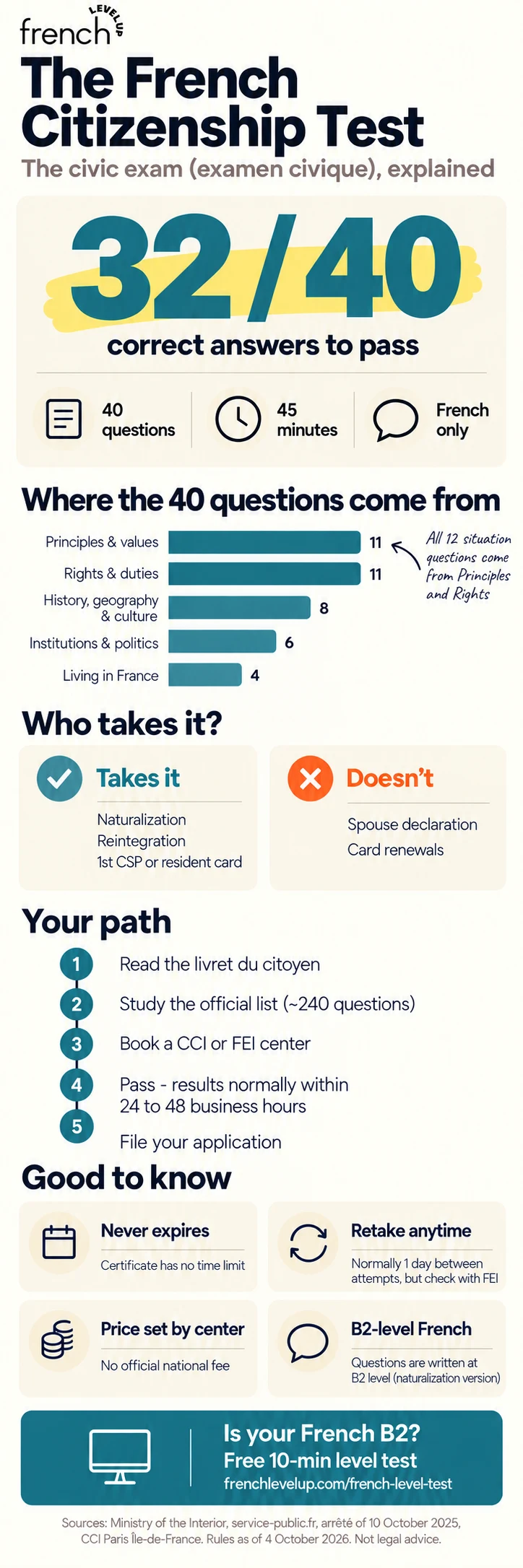
The short answer is that the French civic exam (examen civique) is a 45-minute multiple-choice test in French, with 40 questions, and you pass with 32 correct answers. You take it in an approved test center before you file your naturalization application, and the certificate never expires. It is a separate step from the B2 language proof and from the interview at the prefecture, and it exists in three versions, one for naturalization and one each for a first multi-year residence card and a first resident card. Spouses who declare French nationality by marriage do not take it.
I am a language coach, not a lawyer. I prepare English speakers for the B2 proof, and every rule below comes from the Ministry of the Interior, service-public and the official texts as they stood on 4 October 2026, with practical details from the approved test operator CCI Paris Île-de-France. The guide ends with twelve practice questions whose answers are checked against the livret du citoyen.
What the French civic exam is
The immigration law of 26 January 2024 (loi n° 2024-42) created the civic exam, and from 1 January 2026 passing it became a condition for naturalization and for a first multi-year residence card or resident card. For naturalization, the rule applies to applications filed from that date. It checks your knowledge of the principles of the Republic, its institutions and daily life in France.
The service-public announcement of the exam sets out the format:
| Feature | Rule |
|---|---|
| Number of questions | 40 multiple-choice questions |
| Types of questions | 28 knowledge questions and 12 situation questions (mises en situation) |
| Answers | 4 options per question, only one correct |
| Language | French only |
| Format | Digital, in an approved test center |
| Time | 45 minutes at most, longer only with a medical adjustment |
| Pass mark | 32 correct answers out of 40 (80%) |
| When | Before you file your naturalization application |
| Validity of the certificate | No time limit |
A knowledge question asks for a fact, such as the length of the President’s term. A situation question puts you in an everyday situation and asks for the right reaction, and the Ministry does not publish these questions.
The pass mark is more demanding than it sounds, because 32 out of 40 leaves room for at most 8 wrong or blank answers across the whole test. CCI Paris Île-de-France, one of the two approved operators, explains that a correct answer earns 1 point and that a wrong or blank answer earns 0, so a wrong answer costs you nothing more than a blank one and you should answer every question, even when you have to guess.
Who has to take it, and who doesn’t
The exam concerns acquisition of French nationality by decree, which means naturalization and reintegration (réintégration, for people who once had French nationality and lost it). Service-public’s page on the civic exam for naturalization names the three declarations that are not concerned, and the Ministry’s flyer on the exam says it plainly: if you apply for French nationality by declaration, you do not need to sit the civic exam.
| Your procedure | Civic exam? | Version |
|---|---|---|
| Naturalization by decree | Yes | Naturalization (naturalisation) |
| Reintegration by decree | Yes | Naturalization |
| Declaration by marriage to a French citizen | No | None |
| Declaration as an ascendant (parent or grandparent) of a French citizen | No | None |
| Declaration as a brother or sister of a French citizen | No | None |
| First multi-year residence card (carte de séjour pluriannuelle, CSP) | Yes, with exemptions | CSP |
| First resident card (carte de résident, CR) | Yes, with exemptions | CR |
| Renewal of a CSP or a CR | No | None |
So if you declare nationality as the spouse of a French citizen, the civic exam is not part of your file, although you still need the B2 proof, and my guide to French citizenship by marriage covers that route. You may still meet the exam elsewhere, because a spouse who applies for a first resident card takes the CR version.
For naturalization, the only exemptions that service-public lists are for health and disability. If a disability or a health problem requires it, you can get adjustments for the exam on the basis of a medical certificate, and if your health makes any evaluation impossible, you can be exempted from the pass certificate, again with a medical certificate. In both cases the authority handling your file can ask for a new medical assessment.
Two points that you will see stated as facts elsewhere are not established in the official sources checked for this article.
- An age exemption for naturalization. People over 65 are exempt from the civic exam for residence cards, under the CESEDA (the French code on the entry and residence of foreigners). CCI’s registration page mentions the over-65 rule without saying which versions it covers, while the official naturalization pages mention only the health and disability routes. That does not prove that no age exemption exists, but do not count on one without checking with your prefecture.
- A residence-card pass that counts for naturalization. The exam has three versions with separate labels, and the one equivalence stated in the official sources is that a CR certificate is also valid for a CSP. Nothing says that a CSP or CR certificate replaces the naturalization version, so if you hold one, check with your prefecture before you decide not to sit the naturalization version.
The three versions and the five themes
The arrêté of 10 October 2025 defines three versions of the exam, each with its own label (mention): carte de séjour pluriannuelle, carte de résident or naturalisation, and a naturalization or reintegration file needs the last one. All three share the same structure of 40 questions on the same five themes, but CCI Paris Île-de-France says that the three versions have different difficulty levels, and the Ministry’s civic training site says the same about the two residence-card versions.
The arrêté splits the 40 questions between the five themes as follows, down to the subtopics, which CCI repeats on its own presentation page.
| Theme | Questions | Knowledge | Situations | Subtopics |
|---|---|---|---|---|
| Principles and values of the Republic (Principes et valeurs de la République) | 11 | 5 | 6 | Motto and symbols (3), laïcité (2), situations (6) |
| Institutional and political system (Système institutionnel et politique) | 6 | 6 | 0 | Democracy and voting (3), organization of the Republic (2), the European Union (1) |
| Rights and duties (Droits et devoirs) | 11 | 5 | 6 | Fundamental rights (2), obligations and duties (3), situations (6) |
| History, geography and culture (Histoire, géographie et culture) | 8 | 8 | 0 | Historical periods and figures (3), territory and geography (3), heritage (2) |
| Living in French society (Vivre dans la société française) | 4 | 4 | 0 | Settling in France (1), health (1), work (1), parental authority and school (1) |
| Total | 40 | 28 | 12 |
All 12 situation questions come from the first and third themes, which together account for 22 of the 40 questions, while history, geography and culture, the largest part of the official question list, gives you only 8.
The version also changes the French you have to read. CCI Paris Île-de-France says that the Ministry of the Interior adapts the language level of the items to the procedure, with A2 for the CSP version, B1 for the CR version and B2 for the naturalization version. No Ministry page checked for this article says so, so treat it as the operator’s statement.
Service-public’s naturalization page still describes the program in four domains, but the arrêté, the Ministry’s nationality page and both operators use the five themes above, so study those.
The official questions and the livret du citoyen
The Ministry of the Interior publishes the knowledge questions in advance. For naturalization, the official list of knowledge questions is a PDF dated December 2025, published on the Ministry’s immigration site on 12 January 2026. A count of that PDF made for this article gives about 240 questions (245 stems in a raw count, including at least one duplicate), and history, geography and culture is the largest block with 77. Other sites quote anything from about 200 to 300 questions, and at least one of those lists contains questions that are not in the official PDF, so check any list you use against the Ministry’s own.
The list gives the questions only, with no answer options and no answers, so every answer you find online was written by whoever published it, not by the Ministry. The lists for residence cards are separate, and the civic training site publishes a CSP list of 191 knowledge questions and a CR list of 209, so make sure you study the list for your own version.
The answers live in the livret du citoyen, the citizen’s booklet that the Ministry publishes for naturalization candidates. The current edition is dated May 2026, runs to 83 pages and was approved by an arrêté of 3 July 2026 that replaced the 2022 version, so if you downloaded the booklet before July 2026, download it again. Its foreword tells you to study it before both the civic exam and the interview. Service-public also lists the exam’s reference program (référentiel), and the Ministry’s nationality page adds the charter of rights and duties (charte des droits et devoirs), which you sign at the end of your interview.
The Ministry’s civic training site has theme sheets for more depth and links to a free 50-question quiz by the association France Fraternité, while warning that its format may differ from the real exam. The same page says that you can prepare entirely for free and that paid sites are not run by the Ministry, carry a risk of fraud and may contain false information, which is worth remembering when an app promises “the real questions with answers”.
How to register and take the exam
Two operators are approved to run the civic exam: CCI Paris Île-de-France, through its brand Le français des affaires, and France Éducation International (FEI). Both work through networks of test centers.
- Pick the naturalization version. CCI asks you to select the version that matches your procedure when you register, so for a naturalization or reintegration file choose naturalisation, not CSP or CR.
- Have your AGDREF number ready. This is your foreign national number (numéro étranger AGDREF), which appears on your residence permit or on the OFII sticker in your visa, and both operators ask for it at registration (service-public’s FEI guide says European nationals do not need it).
- Find a center and a session. Service-public offers a map of CCI centers by city and session date and a map of FEI centers for the naturalization version.
- Register. For a CCI center, you register for a session from the map. For FEI, you pre-register on test-civique.fr, and service-public’s FEI pre-registration guide describes the five steps: create your space, choose a center, validate, confirm by email and set a password. The center you chose then tells you how to pay.
If you live abroad, service-public says to ask an Institut français, an Alliance française or the French consulate. CCI adds that a naturalization application filed from abroad is an exceptional case that goes through the consular services.
Your center sends you the exam rules before the day, and CCI’s page on the exam day describes the following routine:
- An identity check with your residence permit, or your passport or ID card if you are an EU national.
- A photo and a signature on a tablet.
- Phones switched off, and no dictionary, reference material or scratch paper.
- No entry for latecomers, and if you leave the room, you cannot come back.
Service-public warns that breaking the rules can void your exam and that fraud, or an attempt at it, brings a 2-year ban.
You must pass the exam before you file your naturalization application, because the pass certificate is one of the documents the online application asks for. The B2 language proof is a separate requirement with its own tests, which I cover in the French citizenship language requirement, and if you are not sure where you stand against B2, my paid Bilan B2 assessment checks your level against it. The full order of the steps, from the documents to the decision, is in my guide on how to get French citizenship.
Results, certificate and retakes
The details below come from CCI Paris Île-de-France, because FEI’s own pages could not be checked for this article, so ask an FEI center for its rules. CCI sends results within 24 to 48 business hours, by email, with a link to a digital vault where your certificate is stored, and there is no paper certificate. Service-public and the Ministry both state that the pass certificate has no time limit, but CCI keeps it for only 10 years, so download your copy and keep it with your naturalization documents.
If you fail, CCI says you can retake the exam as many times as you wish, with one day between attempts. The Ministry’s civic training site says, in its section on residence cards, that you can sit the exam at any time and as often as necessary. Each attempt is a new registration, so expect to pay the fee again.
CCI also accepts an appeal within 30 days of the certificate, but only for an anomaly or a serious malfunction that you reported on the day, so it is not a way to contest a question you found unfair.
How much the civic exam costs
No official source sets a national price. Service-public says that each center sets its fees, and CCI adds that centers follow recommendations from the Ministry of the Interior. As examples only, two language schools that offer the exam listed a price of €70 on 4 October 2026, IS Aix-en-Provence and CAVILAM in Vichy. Neither figure is an official price, and your center’s price is the one that counts.
CCI adds that registration is final and fees are not refunded, although after a justified absence it may offer you a new registration at no extra cost.
The civic exam for residence cards
For a residence card, the exam has the same format, but the rules on who takes it and which version are different, and service-public’s page on the civic exam for residence cards sets them out.
Who is concerned. The exam concerns non-EU adults who signed the republican integration contract (contrat d’intégration républicaine, CIR) and apply for a first multi-year residence card or a first resident card. Renewals of a CSP or a CR are not concerned, and CCI adds that a first temporary residence card (carte de séjour temporaire, CST) does not require the exam either. Service-public’s announcement says that candidates for these cards take the exam at the end of the civic training, which lasts 24 hours over 4 days and must now be followed before the card is issued.
The CSP version. For a first multi-year card, the official list has 191 knowledge questions, and CCI says the items are written at A2 level.
The CR version. For a first resident card, service-public lists the cards concerned, and they include the resident card for a spouse of a French citizen, for a parent of a French child and after family reunification, the first long-term EU resident card (including after five years on a talent passport or an EU Blue Card) and the permanent resident card. The official CR list has 209 knowledge questions, and CCI puts the items at B1 level.
Exemptions. The following people are not concerned by the residence-card exam:
- People over 65, for both the CSP and the CR.
- For the CSP, holders of cards that do not fall under the CIR, beneficiaries of subsidiary protection and their families, and stateless persons and their families.
- Beneficiaries of international protection and some nationals covered by bilateral agreements, according to the civic training site and the service-public announcement. Service-public’s residence-card page also lists a first long-term EU resident card obtained after a refugee or subsidiary protection card among the cards concerned, so check the rule for your own card.
The official naturalization pages do not list these exemptions, so do not assume that one you had for your card carries over to a nationality application.
One certificate for two cards. A CR certificate is also valid for a CSP, but nothing in the official sources says that either certificate counts for naturalization. The rest is shared with the naturalization version, with the same two operators (and separate center maps for the CSP and CR versions), no time limit on the certificate and the same 2-year fraud ban.
The civic exam vs the prefecture interview
The civic exam and the interview are two different checks of the same condition, which French law calls assimilation, as service-public’s naturalization page explains. The order is fixed, because you pass the exam before you file and the interview only comes if your file is admissible. The livret du citoyen says the interview takes place at the prefecture, the sub-prefecture or the consulate.
The interview checks your adherence to the principles of the Republic, and you sign the charter of rights and duties at the end. Service-public recommends preparing for it with the livret du citoyen, so the work you do for the exam also serves the interview, and missing it without a valid reason can lead to your file being closed. The official pages give no figure for the length of the interview or the number of questions, so be careful with pages that give one.
How to prepare for the civic exam
Start with the livret du citoyen. Read it once from start to finish before you touch a question list, because the situation questions are unpublished and the booklet covers the principles, rights and duties they draw on.
Work through the official list for your version. Answer each question from memory, then check your answer in the booklet or on the theme sheets of the civic training site. Because the list gives no options, this forces you to know the answer rather than recognize it.
Practice against the clock. With 45 minutes for 40 questions, you have about 67 seconds per question on average, with no dictionary and no scratch paper. That is enough time if you read French comfortably, but it goes quickly if every question takes two readings.
As a language coach, this last point is the one I would insist on. The civic exam is a test of knowledge, but you take it entirely in French, at the B2 level that CCI describes. Several official items are not even questions, for example Déclarer ses revenus aux services fiscaux est :, which asks you to complete a sentence with the right option. Another ends with Quelle proposition est correcte ?, which means you cannot answer before you have read all four options carefully. If phrasings like these slow you down, the exam measures your reading speed as much as your knowledge, so the work you do for the B2 proof also serves the civic exam. My free French level test gives you an estimate of your level before you register, and you can also book a free call with me to talk about your timing.
French civic exam practice questions
The twelve questions below follow the format of the exam, with four options and one correct answer. Ten use the exact wording of official knowledge questions from the naturalization list dated December 2025, with options written for this article because the Ministry publishes none, and the last two are written in the style of the unpublished situation questions. Every answer is checked against the May 2026 livret du citoyen, and the answer key gives the page.
1. Quelle est la devise de la République française ? (official question, Principes et valeurs de la République)
What is the motto of the French Republic?
- a) Liberté, sécurité, solidarité
- b) Unité, travail, progrès
- c) Liberté, égalité, fraternité
- d) Paix, justice, liberté
2. Que porte Marianne sur la tête ? (official question, Principes et valeurs de la République)
What does Marianne wear on her head?
- a) Un bonnet phrygien
- b) Une couronne de laurier
- c) Un casque de soldat
- d) Une couronne royale
3. Que commémore la fête nationale ? (official question, Principes et valeurs de la République)
What does the national day commemorate?
- a) La fin de la Première Guerre mondiale en 1918
- b) La libération de Paris en août 1944
- c) L’adoption de la Constitution le 4 octobre 1958
- d) La prise de la Bastille en 1789 et la fête de la Fédération en 1790
4. En quelle année la loi de séparation des Églises et de l’État a-t-elle été votée ? (official question, Principes et valeurs de la République)
In what year was the law separating the Churches and the State passed?
- a) 1789
- b) 1905
- c) 1945
- d) 1958
5. Quel jour célèbre-t-on officiellement la laïcité en France ? (official question, Principes et valeurs de la République)
On what day is laïcité officially celebrated in France?
- a) Le 9 décembre
- b) Le 8 mai
- c) Le 4 octobre
- d) Le 1er janvier
6. Quelle est la durée du mandat du Président de la République française ? (official question, Système institutionnel et politique)
How long is the term of the President of the French Republic?
- a) Sept ans, non renouvelable
- b) Quatre ans, renouvelable deux fois
- c) Dix ans
- d) Cinq ans, renouvelable une fois
7. À quel âge peut-on devenir électeur ? (official question, Système institutionnel et politique)
At what age can you become a voter?
- a) 16 ans
- b) 21 ans
- c) 18 ans
- d) 25 ans
8. En France, est-ce obligatoire de voter ? (official question, Système institutionnel et politique)
Is voting compulsory in France?
- a) Oui, sinon on doit payer une amende
- b) Non, mais voter est un devoir civique important
- c) Oui, mais seulement pour l’élection présidentielle
- d) Non, et seules les personnes nées en France peuvent voter
9. Combien y a-t-il de départements en France ? (official question, Système institutionnel et politique)
How many departments are there in France?
- a) 101
- b) 96
- c) 95
- d) 110
10. À quel âge commence l’instruction obligatoire des enfants ? (official question, Vivre dans la société française)
At what age does compulsory education begin for children?
- a) 6 ans
- b) 5 ans
- c) 2 ans
- d) 3 ans
11. Vous dirigez une petite entreprise et vous recrutez un vendeur. Deux candidats ont la même expérience. Sur quoi devez-vous fonder votre choix ? (written for this article in the style of the official situation questions)
You run a small business and are hiring a salesperson. Two candidates have the same experience. What must you base your choice on?
- a) Sur la religion des candidats
- b) Sur leurs compétences et leurs qualités professionnelles
- c) Sur le pays d’origine de leurs parents
- d) Sur leurs opinions politiques
12. Votre fils de 7 ans a classe lundi. Vous voulez partir en week-end prolongé parce que les billets de train sont moins chers ce jour-là. Que faites-vous ? (written for this article in the style of the official situation questions)
Your 7-year-old son has school on Monday. You want to take a long weekend because train tickets are cheaper that day. What do you do?
- a) Je le garde à la maison, parce que l’école n’est pas obligatoire avant 10 ans.
- b) Je le garde à la maison, parce qu’il suffit de prévenir l’enseignant la veille.
- c) Je l’envoie à l’école, parce qu’une absence doit avoir un motif accepté, comme la santé ou un événement familial.
- d) Je le garde à la maison, parce que chaque famille choisit librement les jours d’école.
Answer key
| Question | Answer | Explanation | Livret du citoyen (May 2026) |
|---|---|---|---|
| 1 | c | Liberté, égalité, fraternité, written on the front of public buildings such as town halls and prefectures | Page 6 |
| 2 | a | A Phrygian cap (bonnet phrygien), the symbol of liberty | Page 8 |
| 3 | d | The 14th of July commemorates both the storming of the Bastille on 14 July 1789 and the Fête de la Fédération on 14 July 1790 | Page 8 |
| 4 | b | 1905, the law of 9 December 1905 | Pages 11 and 43 |
| 5 | a | 9 December, which is also the date of the 1905 law | Pages 10 and 43 |
| 6 | d | Five years, renewable once, by direct universal suffrage | Page 16 |
| 7 | c | 18, with French nationality and registration on the electoral roll | Page 17 |
| 8 | b | Voting is not compulsory, but it is an important civic duty | Page 34 |
| 9 | a | 101 departments, 96 in mainland France and 5 overseas | Page 19 |
| 10 | d | Schooling is compulsory from 3 to 16 | Pages 36 and 75 |
| 11 | b | Hiring decisions must rest on professional reasons, and discrimination based on religion, origin or political opinion is punished by law | Pages 6 and 7 |
| 12 | c | Schools accept absences only for health or family reasons, such as a wedding or a funeral | Page 75 |
Ten or more right puts you above 80% on this set, but the real exam draws from a list of about 240 and adds 12 unpublished situation questions, so treat it as a check of the format rather than a forecast. Question 9 shows why careful reading matters, because 96 is a real number from the booklet, but it only counts mainland France.
FAQ
Is the French citizenship test in English?
No, the civic exam is only in French, with no dictionary, and CCI says the naturalization items are written at B2 level.
Can I take the French civic exam online?
No, you take it on a computer or tablet in an approved test center, under supervision. From abroad, ask an Institut français, an Alliance française or the French consulate.
How many questions are there?
There are 40, with 28 knowledge questions drawn from an official naturalization list of about 240 and 12 unpublished situation questions, and you need 32 right.
Do spouses of French citizens have to take the civic exam?
Not for a declaration of nationality by marriage, but a spouse who applies for a first resident card takes the CR version.
How long is the civic exam certificate valid?
It has no time limit, but CCI keeps it in its digital vault for 10 years, so save your own copy.
What happens if I fail the civic exam?
You register again, and CCI allows as many attempts as you need with one day between them, but your naturalization file waits until you pass.
This guide explains the French civic exam as it stood on 4 October 2026 and is not legal advice. For your own case, service-public and the Ministry of the Interior remain the reference, and your prefecture is the place to confirm any point this guide marks as not established.