
In this article
Rules checked against official sources in October 2026.
You need to prove B2 French, most likely for a naturalization file or a declaration of nationality through marriage, and two names keep coming up, the DELF B2 and the TCF. Both are accepted and neither is better in itself, so the choice depends on your weakest skill and on your timing, meaning how soon you will file and how long the proof has to stay valid.
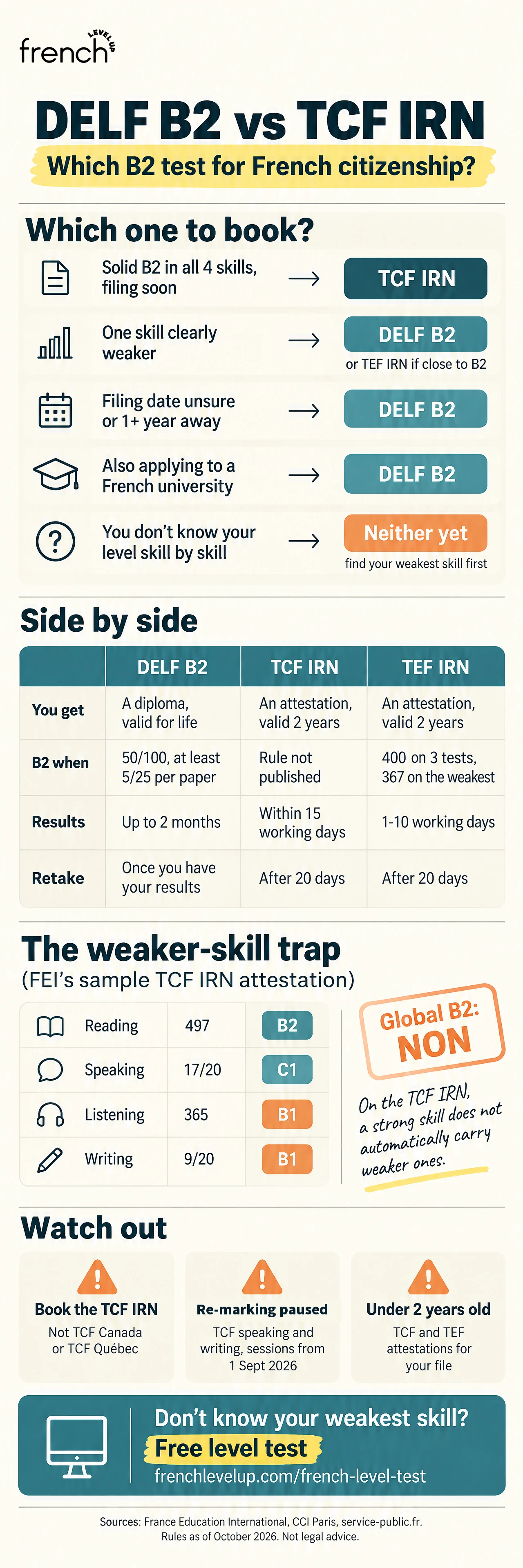
If you are already solidly B2 in all four skills and plan to file within a few months, book the TCF IRN, because results come within weeks and a two-year attestation will still be valid when you file. If one skill lags behind the others or your filing date is uncertain, the DELF B2 is the safer choice, because the diploma is valid for life and its pass rule lets a strong paper make up for a weaker one. And if you book a TCF for citizenship, make it the TCF IRN, the version designed for nationality and residence files, and not TCF Canada.
This guide covers the DELF B2 tout public and the TCF IRN under the rules in force in October 2026, plus the TEF IRN, the third accepted test. I prepare English speakers for both the DELF B2 and the TCF, and in 2026 five of my individually coached students sat the DELF B2 and all five passed. I have not yet followed a student through a nationality file, so the procedure below comes from the official texts.
Which test to book, by situation
| Your situation | What to book | Why |
|---|---|---|
| Solid B2 in listening, reading, speaking and writing, and you will file within the next few months | TCF IRN (or TEF IRN) | Fast results, a retake after 20 days, and two years of validity is enough if you file soon |
| One skill clearly weaker than the others | DELF B2, or the TEF IRN if the weak skill is close to B2 | Both publish a pass rule that tolerates one weaker skill above a floor, and the TCF IRN does not publish its rule |
| Filing date uncertain or more than a year away | DELF B2 | The diploma never expires, while a TCF or TEF attestation must be less than two years old |
| You may also apply to a French university | DELF B2 | It exempts you from the TCF in the university admission procedure, and the IRN tests are built for residence and nationality files |
| You do not know your level skill by skill | Neither yet | Your weakest skill decides every other row, so find it first |
What each test is, for a citizenship file
As of October 2026, naturalization by decree and the declaration of nationality after marriage both require spoken and written French at B2 or above, for applications lodged and declarations made from 1 January 2026. The service-public page on proving your level of French lists the accepted proofs, which include any diploma attesting at least B2, such as the DELF B2, and a TCF or TEF attestation issued less than two years ago. The tests must cover all four skills and be taken in person at an exam center, in one session on the same day. The other diplomas that count and the exemptions are in the guide to the French citizenship language requirement.
The DELF B2 is a diploma. France Education International (FEI), which runs both the DELF and the TCF, states that the DELF diploma is valid for life, so once you have passed it you never sit it again for a nationality file. Adults sit the tout public version, and the DELF B2 exam guide explains its four papers and their marking.
The TCF IRN is a test that gives you an attestation. IRN stands for Intégration, Résidence et Nationalité, and FEI designs this version for foreigners over 16 who apply for French nationality, a long-term resident card or a multi-year residence card. The TCF IRN attestation is valid for two years from the date the results are issued, with the expiry date printed on it, and the test assesses up to B2.
Other TCF versions are where a booking can go wrong. TCF Canada and TCF Québec are built for immigration to Canada and are not the IRN. The arrêté listing the accepted tests names “the TCF” without a version, and no official text checked for this article says whether the general TCF tout public is accepted, so the IRN is the safe booking. Some exam-center pages, and one paragraph on CCI Paris’s own TEF IRN pages, also still say B1 for naturalization, so when pages disagree, trust service-public for the rule and FEI or CCI Paris for their own tests.
DELF B2, TCF IRN and TEF IRN side by side
| DELF B2 | TCF IRN | TEF IRN | |
|---|---|---|---|
| What you get | A diploma, valid for life | An attestation, valid two years from the date results are issued | An attestation, valid two years from the date it is issued |
| Format | Group papers of 2 h 30 (listening, reading, and an argued text of at least 250 words), then a 20-minute oral after 30 minutes of preparation | Four tests in 1 h 35, listening and reading (25 multiple-choice questions each), writing (three tasks in 30 minutes) and speaking (three tasks in 10 minutes, face to face) | Four tests on the same day, reading and listening (20 questions each), writing (two tasks in 30 minutes) and speaking (two role plays in 10 minutes) |
| How B2 is decided | 50 out of 100 overall, with at least 5 out of 25 on each paper | The attestation shows whether global B2 is reached, but the rule behind it is not published | At least 400 on three tests and at least 367 on the weakest |
| Results | Up to two months | Within 15 working days of FEI receiving the session material | 1 to 10 working days, digital only |
| Retakes | As often as you like, once you have your results | As often as you like, with 20 days between sittings | As often as you like, with 20 days between sittings |
| Contesting a result | Jury decisions cannot be contested | Re-marking of speaking and writing suspended for sessions from 1 September 2026, with a return planned around autumn 2027 | Not stated in the pages checked |
| Sessions | In France, ten national B2 dates a year. Abroad, dates are set country by country | Throughout the year, on dates set by each center | Dates set by each center |
| Cost | Set by each center (examples below) | Set by each center (examples below) | Set by each center, no figure checked |
DELF and TCF rows come from FEI and TEF rows from CCI Paris, as published in October 2026.
On format, the DELF B2 asks for more sustained argument, in writing and in its oral debate with the examiner, but that does not make it harder for everyone. If fast multiple-choice listening is your weak point, the TCF IRN or the TEF IRN may feel harder. No pass rates for any of the three tests appear in the official documents checked for this article, so no data settles which one is easier.
How each test treats a weaker skill
If you read French comfortably but write it slowly, or speak easily but lose the thread of a radio interview, your profile is uneven. A level does not have to be the same in every skill, as the page on what B2 French means skill by skill explains, and the three tests handle that very differently.
The DELF B2 adds up your four papers, so a strong oral can make up for a weaker written paper, provided the weaker paper stays at 5 out of 25 or above. The TEF IRN is just as clear. According to the TEF IRN page of CCI Paris, you reach B2 with at least 400 on three tests and at least 367 on the fourth, so one skill can sit in the B1 band, which runs from 300 to 399, as long as it reaches 367.
The TCF IRN works differently. Listening and reading are scored up to 499 and mapped to a level, speaking and writing are marked out of 20, and the attestation then shows a table saying whether you reach A1, A2, B1 and B2 overall. The rule that turns the four results into that global line is not set out in the FEI pages for TCF IRN candidates checked in October 2026, and third-party sites that quote one contradict each other.
What FEI does publish is a sample TCF IRN attestation. The sample candidate scores 497 in reading (B2) and 17 out of 20 in speaking (C1), but 365 in listening (B1) and 9 out of 20 in writing (B1), and the global line for B2 says NON. It is one sample and it does not reveal the rule, but it shows that on the TCF IRN a strong skill does not automatically carry two weaker ones.
As a coach, and going only on the published rules, I would advise a candidate with one skill clearly behind to choose a test whose rule they can read in advance, the DELF B2 or the TEF IRN, and to keep the TCF IRN for when all four skills are at B2.
Timing and validity
The TCF IRN and the TEF IRN give you a result much sooner than the DELF, but the printed document can take longer. At the Institut français in London, the TCF IRN certificate takes 3 to 4 weeks and the DELF diploma can take 3 to 4 months, so ask your center when you will have the document your file needs.
The quick retake has a price, because each TCF IRN or TEF IRN attempt costs the full fee, and some centers ask for more than 20 days between sittings, a month at L’Alliance New York for example. A failed DELF B2 costs time instead, because you must have your results before you register for the next session your center runs, and the Alliance Française de Paris requires 45 days between two sittings of the same level.
Do not count on a re-mark to rescue a borderline result. FEI does not accept re-marking requests for TCF speaking and writing for sessions from 1 September 2026, for about a year, and DELF jury decisions cannot be contested at all, so with either test it is safer to sit when you are clearly at the level.
Validity is the biggest difference. Service-public asks for a TCF or TEF attestation issued less than two years ago, but no official text checked for this article says when those two years are counted, on the day you lodge your file or later. From the date of the récépissé, the receipt for a naturalization file, the administration has up to 18 months to answer (12 if you have lived in France for more than ten years), extendable once by three months. A TCF IRN taken a year before you file would expire a year after you file, well inside that window. So the prudent plan, as risk management rather than a legal rule, is to sit the TCF IRN or the TEF IRN close to the date you are ready to file and to ask your prefecture if in doubt. A DELF B2 removes the question because it does not expire.
Cost and availability
FEI and CCI Paris leave the price to each exam center, so a comparison only means something at the same center. Two examples, checked in October 2026:
- At L’Alliance New York, the TCF IRN costs $350 for members or $399 for non-members, plus a $15 admin fee, and the DELF B2 costs $190 plus a $50 admin fee.
- At the Institut français in London, the TCF IRN costs £215 from 1 July 2026, and the DELF B2 costs £170 under its 2027 fees.
At these two centers, one sitting of the DELF B2 costs less than one sitting of the TCF IRN, but these are only two centers. No TEF IRN fee was checked for this article, and CCI Paris keeps the fee if you cancel, except for serious reasons. If you live and work in France, FEI lists the TCF IRN as eligible for funding through your compte personnel de formation (CPF).
Frequency depends on where you sit. Abroad, the TCF IRN can be easier to schedule, since L’Alliance New York lists nine TCF IRN dates in 2026 against two DELF sessions, and the London institute runs the TCF IRN roughly once a month into 2027. In France, FEI’s national calendar has ten DELF B2 dates a year, with 4 November and 2 December left in 2026, so the TCF has no clear advantage there, although a given center may not run every date.
The TEF IRN, briefly
The TEF IRN, run by CCI Paris, works much like the TCF IRN on results, retakes and validity. Its writing tasks are short, at least 40 and 100 words, and its listening and reading parts are taken on a computer and adapt to your answers. Its advantage over the TCF IRN is the published B2 rule. I would not build a plan on the weakest skill staying just above 367, but if you need a fast result and your profile is close to even, compare the TEF IRN and the TCF IRN at the centers near you.
Other reasons you might need B2
For a French university, the DELF B2 is the more useful document. FEI says it gives access to French universities, and DELF B2 holders are exempt from the TCF in the DAP, the admission procedure for a first year at a French university. CCI Paris, for its part, says the TEF IRN is not appropriate for higher education. The TCF IRN also serves residence cards, at B1 for the long-term resident card and A2 for the multi-year card. If an employer asks for B2, check which proof it accepts before booking.
The verdict, by situation
You are solid B2 in all four skills and ready to file soon. Either test works, and the TCF IRN gets you a result faster, so sit it close to the date you lodge your file. The guide on how to get French citizenship sets out the other steps, including the separate French civic exam for naturalization by decree.
One of your skills is clearly weaker. Book the DELF B2, whose rule lets stronger papers make up for a weaker one above 5 out of 25, or the TEF IRN if the weak skill is close to B2 and you need a result quickly. Either way, work on that skill before you book.
Your filing date is uncertain or more than a year away. Book the DELF B2, because it never expires.
You are declaring nationality through marriage. The B2 rule has applied to declarations since 1 January 2026, with the same two-year limit on test attestations, so the same choice applies, and the guide to French citizenship by marriage covers the rest of the declaration.
You are not sure of your level yet. Find your weakest skill first, because it decides everything above. The free French level test takes about ten minutes and gives a first, unofficial indication. For a closer answer, the Bilan B2 is a 60-minute one-to-one assessment (€95) that estimates your score in each skill on a DELF-style scale and comes with a written debrief and a study plan, so you can decide which test to book and when. It is an estimate, not an official result or a TCF or TEF score.
Questions people also ask
Can I sit the DELF B2 without passing the DELF B1 first?
Yes. FEI lets you register directly for any DELF level without holding the one below it.
Is a TCF I took in 2024 still valid for my file?
Check the expiry date printed on the attestation. A TCF IRN is valid for two years from the date the results were issued, so a result issued in 2024 expires at some point in 2026. It must also show global B2, because an attestation at B1 does not meet the rule in force since 1 January 2026.
This article compares the language tests for a French nationality file and is not legal advice. Rules are as of October 2026. For your own file, the service-public page on proving your level of French and your prefecture remain the reference.