
In this article
Rules checked against official sources in October 2026.
The TCF (test de connaissance du français) is the French test of France Education International (FEI), the public body under the Ministry of Education that also runs the DELF. You don’t pass or fail it. You get a dated attestation that shows your level in each skill, and it stays valid for two years. The TCF comes in several versions, and the one you book decides whether the attestation fits your file.
The short answer. For French citizenship or a residence card, book the TCF IRN (Intégration, Résidence et Nationalité). It has four compulsory tests taken on the same day in 1 h 35, and it measures your level up to B2. Results come within 15 working days of FEI receiving the session papers from your center, the attestation is valid for two years from the date the results are issued, and you can sit the test again after 20 days. For first-year university admission or a general certificate of your level, book the TCF tout public, with the writing test if you apply through the DAP. TCF Canada and TCF Québec are built for Canada.
I coach English-speaking adults who need B2 for French citizenship or a residence card, and I prepare them for both the DELF B2 and the TCF. This page covers the TCF for France: which version to book, what happens on the day, how the attestation is read, the timing rules, registration and preparation. For every official option side by side, including the TEF and the DCL, see French proficiency exams explained.
Which TCF do you need?
FEI’s current list of tests has four TCF versions: TCF Canada, TCF Québec, TCF IRN and TCF tout public (the same list has Ev@lang, a placement test for schools and employers). The version follows from your goal, and so does the level you need, which for the residence cards and nationality is read on the attestation’s overall line (explained further down).
| Your goal in France | TCF to book | Level you need |
|---|---|---|
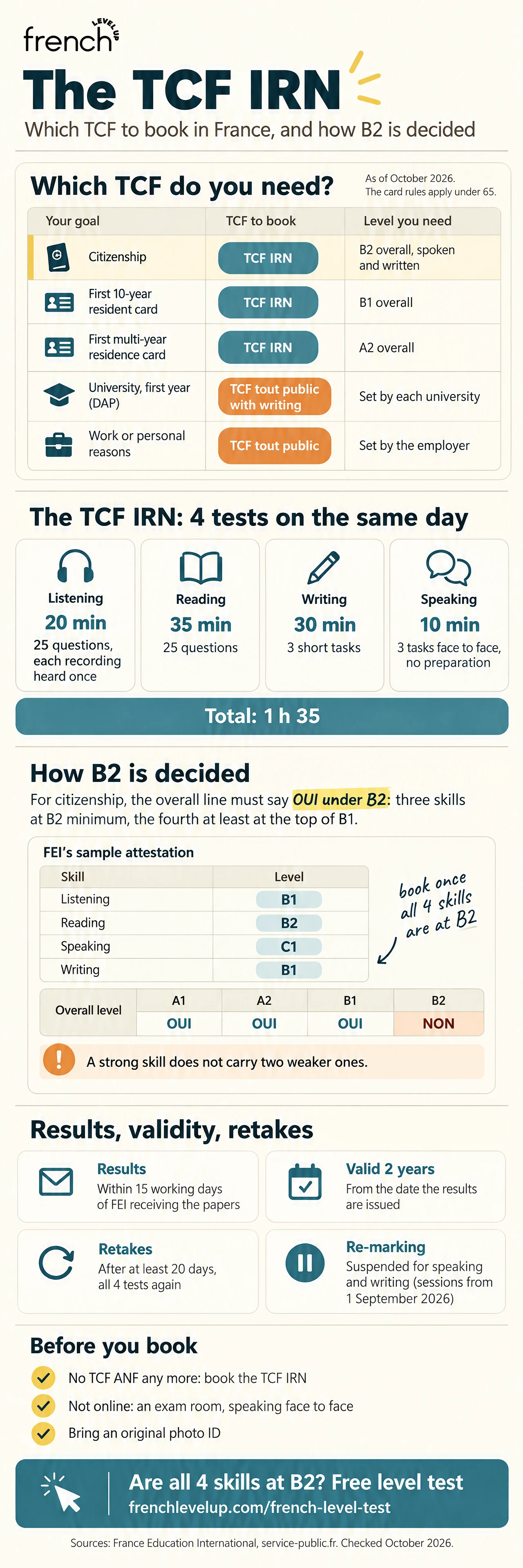
| French nationality (naturalization or declaration by marriage) | TCF IRN | B2 overall, spoken and written |
| First 10-year resident card (under 65, listed cards only) | TCF IRN | B1 overall |
| First multi-year residence card (under 65, cards subject to the CIR) | TCF IRN | A2 overall |
| A1 validation in the OFII integration path | TCF IRN | A1 |
| First-year university admission through the DAP | TCF tout public with writing | Set by each university |
| Work, training or personal reasons | TCF tout public | Set by the employer, or nothing |
Levels as of October 2026, from service-public for the cards and nationality and from FEI for the IRN and the DAP.
The nationality rule comes from the service-public page on proving your French, which accepts a TCF attestation from FEI “issued less than 2 years ago”, alongside a TEF attestation and diplomas such as the DELF B2. For the cards, the service-public page on the language requirement names the TCF and the TEF as the only recognized tests, with four separate tests taken in person at a center on the same day. The A2 rule only concerns cards subject to the CIR (contrat d’intégration républicaine), and holders of visitor, student and talent cards don’t sign the CIR, as the service-public CIR page shows. The full list of accepted proofs and exemptions is in the guide to the French citizenship language requirement.
Two more points before you book. FEI’s list has no TCF ANF, so a page that tells you to book one is out of date (the FAQ at the end explains). And FEI’s candidate manual, in its September 2026 version, says a complete TCF tout public with all five tests can also be used for a nationality or resident card application. I would still book the IRN for these files, because it is the version FEI designs for them, its global rule for B2 is the one the manual explains, and the complete tout public adds up to 2 h 37 of tests.
The TCF IRN tests your French only, not your knowledge of French history or society. Naturalization by decree and the residence cards also require a separate civic exam since January 2026, and the guide on how to get French citizenship sets out that step and the rest of the procedure.
The TCF IRN, test by test
The TCF IRN is for anyone over 16 who is not French. It has four compulsory tests, all taken on the same day.
| Test | Format | Time |
|---|---|---|
| Listening | 25 multiple-choice questions, each recording played once | 20 minutes |
| Reading | 25 multiple-choice questions of increasing difficulty | 35 minutes |
| Writing | 3 short tasks | 30 minutes |
| Speaking | 3 tasks face to face with an examiner, with no preparation time | 10 minutes |
| Total | 1 h 35 |
Some exam center pages still describe an older format, with 20 questions in each comprehension test and 1 h 15 in total. FEI’s TCF IRN page and its September 2026 candidate manual both give 25 questions and 1 h 35, so go by those.
Each center decides whether you take the test on paper or on computer. On computer it is not an online test, because FEI’s software runs on the center’s machines and you sit in the exam room with headphones for the listening test. The speaking test is always face to face.
Listening and reading
Each question has four answers and only one is right. Only correct answers score, and a wrong answer or a blank counts zero, so answer every question. In listening you hear each recording once and the question comes after it. FEI’s own advice is not to lose time taking notes in the multiple-choice tests, and once listening has started, latecomers are not admitted and nobody can leave the room.
Writing: three short texts in 30 minutes
FEI’s candidate manual sets a word range for each task:
- Task 1, 30 to 60 words. Describe a person, a group, a place or an object in reply to a short message.
- Task 2, 40 to 90 words. Give an account of daily activities or an experience to one or more readers.
- Task 3, 40 to 90 words. Give your opinion about a place, an object or a person.
You do the tasks in order. FEI warns that a text can be marked “A1 not reached” (A1 non atteint) if the handwriting is illegible, if a task misses its word count or is not done, if the text is off topic, or if you copy sentences from the subject. Two FEI markers assess each text independently, without seeing each other’s mark, and a third marks it when they disagree widely. On computer, the first marking may be done by FIDELIA, FEI’s automated marking aid, and the second is always human.
Speaking: ten minutes with no preparation
The speaking test is a recorded interview in three parts:
- Guided interview, 3 minutes. The examiner asks about you, your family and your work.
- Interaction, 3 minutes 30. You ask questions to get information in an everyday situation, with roles set in the instructions. In the IRN there is no preparation time for this task, while the other TCF versions give two minutes.
- Point of view, 3 minutes 30. You answer a question the examiner chooses, and the examiner can interrupt to ask about your arguments.
You can ask the examiner to repeat or rephrase a word or a question at any time. The examiner gives a first mark on the spot and a second marker at FEI listens to the recording without knowing it. FEI also warns that reciting a text learned by heart can be treated as fraud, and the examiner is told to interrupt a candidate who seems to recite.
My view as a coach is that the IRN’s short format hides its difficulty. Nobody asks you for the 250-word argued text of the DELF B2, but each 40 to 90 words has to read as B2, and you speak for ten minutes with no time to plan.
How the TCF IRN is scored
Listening and reading are scored out of 499 on the IRN (out of 699 on the other versions), so they can show at most B2. Speaking and writing are marked out of 20 and can show up to C2. FEI’s level grid turns each result into a CEFR level.
| Level | Listening and reading | Speaking and writing | What it serves for in France |
|---|---|---|---|
| A1 | 101 to 199 points | 1 out of 20 | A1 in the OFII integration path |
| A2 | 200 to 299 points | 2 to 5 out of 20 | First multi-year card |
| B1 | 300 to 399 points | 6 to 9 out of 20 | First resident card |
| B2 | 400 to 499 points | 10 to 13 out of 20 | Nationality |
| C1 | Not on the IRN | 14 to 17 out of 20 | Shown per skill only |
| C2 | Not on the IRN | 18 to 20 out of 20 | Shown per skill only |
The levels for each goal apply to the overall line described below, not to one skill.
The overall line: how global B2 is decided
Below the four results, the TCF IRN attestation has a table headed Pour l’ensemble des épreuves : niveau(x) atteint(s), with OUI or NON under A1, A2, B1 and B2. FEI’s candidate manual says that for a naturalization file the level required is global B2, so that line has to say OUI under B2.
The rule behind that line appears in the FAQ of FEI’s candidate manual (version of September 2026), in its answer on how the global level of the TCF IRN is calculated. For naturalization, it says the Ministry of the Interior wanted three skills at B2 minimum and the fourth at least at “the top of B1” (le haut du niveau B1). The same pattern applies one level down for the resident card (three skills at B1, the fourth at the top of A2) and for the multi-year card (three at A2, the fourth at the top of A1).
Read it with two caveats. FEI does not say where “the top of B1” starts in points or marks, and the passage has a visible copy error, since each of its three lines speaks of “global level B1”. Many websites still say no rule is published, or quote rules that contradict each other, so the manual is the source to rely on.
FEI’s sample TCF IRN attestation shows the rule at work:
| Test | Result | Level |
|---|---|---|
| Listening | 365 out of 499 | B1 |
| Reading | 497 out of 499 | B2 |
| Speaking | 17 out of 20 | C1 |
| Writing | 9 out of 20 | B1 |
The overall line reads OUI for A1, A2 and B1 and NON for B2. Reading and speaking are excellent, but two skills sit at B1, so this candidate cannot use the attestation for a nationality file. A strong skill does not carry two weaker ones, and since listening and reading stop at 499, a very strong reader cannot build up a margin there either.
In practice, the margin is one skill slightly below B2, and nobody can tell you in advance how slightly. My advice is to book the TCF IRN once all four skills are at B2.
Results, validity and retakes
Results. FEI publishes them within 15 working days of receiving the session material from your center, so the clock starts when the papers reach FEI and not on the day of the test. You see them in your TCF-Candidat online account, where you download the attestation, and your center receives them too. Centers give their own estimates: the Institut français in London says results come 15 working days after the test and the certificate 3 to 4 weeks after it, and L’Alliance New York asks candidates to allow 3 to 4 weeks.
The attestation. It is a digital document with your photo taken on the day, the session date, an expiry date and two QR codes, one to authenticate the results and one to explain them. France’s nationality directorate (DIAN) can check TCF attestations on an authentication platform, according to the candidate manual.
Validity. The attestation is valid for two years from the date the results are issued, and the expiry date is printed on it. For nationality, service-public asks for an attestation issued less than two years ago but does not say at which stage of the application that is checked. The safe reading is that it must be under two years old on the day you file, so count back from your filing date before you book, and ask your prefecture if your timing is tight.
Retakes. You can sit the TCF IRN as often as you like, with at least 20 days between two sittings of the same version. Some centers ask for more, a month at L’Alliance New York for example. Each sitting costs the full fee, and FEI describes no way to resit one IRN test alone, so plan for all four.
Contesting a result. For sessions from 1 September 2026, FEI has suspended re-marking requests for speaking and writing for about a year, with the service planned to resume in autumn 2027. FEI’s rights and duties page also says no appeal is accepted once the attestation is issued, so if something goes wrong during the test, a noisy room or a recording problem, report it to the center the same day, as soon as the test ends.
How to register, and what it costs
You register with an approved center, not with FEI. FEI publishes a map of TCF centers, and each center sets its own dates, deadlines, price and test format (paper or computer). FEI says IRN sessions run throughout the year. Deadlines vary a lot. L’Alliance New York closes registration 11 days before each test, while the Institut français in London closes it in the month before.
If you need accommodations for a disability or a health condition, send your center a recent medical certificate at least two months before the session. Extra time (a third more) is only possible on a paper session.
On the day, bring a valid, original photo ID, because FEI does not accept digital documents. For a card file, service-public expects the identity on the attestation to be checked against a residence permit or a passport, so bring one of those. You will be photographed for the attestation, and FEI says you get no attestation if you refuse. Late candidates are not admitted and are not refunded, except for the cases FEI lists (illness, a public transport problem, a strike, a death in the family or a work obligation), with proof sent to the center within the deadline in FEI’s candidate rights page.
Prices are set by each center. These are the prices four centers listed on their own pages on 31 October 2026:
| Center | Test | Price |
|---|---|---|
| CAVILAM, Vichy | TCF IRN | €174 |
| Institut français, London | TCF IRN | £215 (from 1 July 2026) |
| L’Alliance New York | TCF IRN | $350 for members, $399 for non-members, plus a $15 admin fee |
| CCFS Sorbonne, Paris | TCF tout public on computer | €110 multiple choice only, €150 with writing, €170 with speaking, €210 complete |
CCFS Sorbonne’s TCF IRN page listed no date or price that day, which is common, so call two or three centers near you before you plan.
If you work in France, you can pay with your compte personnel de formation (CPF) through moncompteformation.gouv.fr, for a session at a center in France. FEI lists the TCF IRN (RS6643) and the TCF tout public (RS6460) as eligible, the tout public only when you register for all five tests.
The TCF tout public, for university and work
The TCF tout public is for anyone aged 16 or over whose first language is not French. It measures all six levels, from A1 to C2, and it is built in two parts.
| Test | Format | Time |
|---|---|---|
| Listening | 29 multiple-choice questions, compulsory | 25 minutes |
| Language structures | 18 multiple-choice questions, compulsory | 15 minutes |
| Reading | 29 multiple-choice questions, compulsory | 45 minutes |
| Writing | 3 tasks, optional | 60 minutes |
| Speaking | 3 tasks, optional | 12 minutes |
Speaking includes 2 minutes of preparation. On computer, the multiple-choice part has 15 extra unscored items.
With the writing test, the TCF tout public is the official test for the DAP (demande d’admission préalable), the admission procedure for a first year at a French university. The writing tasks are longer than on the IRN, from 60 to 120 words for the first and up to 180 words for the third.
The attestation shows a score for each multiple-choice test and a weighted overall score, plus a mark out of 20 for each optional test you take. It shows an overall level only if you take all five tests in the same session. You can add the writing or speaking test later, within 18 months of the multiple-choice tests, but the attestation keeps its original expiry date. Results come within 15 working days, or 10 working days from the end of the session if you take only the multiple-choice tests on computer, and the attestation is valid for two years. The 20-day gap between sittings and the re-marking suspension apply here too.
TCF, DELF or TEF?
All three are accepted for a citizenship file, and they differ more than their names suggest. The DELF is a diploma that never expires, with a pass rule of 50 out of 100 and at least 5 out of 25 on each paper, and results that can take up to two months. The TCF IRN gives you a two-year attestation within weeks, with the overall rule described above.
The TEF IRN, run by CCI Paris, is the other recognized test. According to CCI Paris’s TEF IRN pages, it covers A1 to B2, gives B2 with at least 400 points on three tests and at least 367 on the weakest, sends results within 1 to 10 working days and is valid for two years, with 20 days between sittings. Unlike the TCF for now, it lets you appeal within 30 days of the attestation date. The Alliance Française de Paris listed it at €205 on 31 October 2026.
A fourth option is the DCL FLE, a Ministry of Education diploma for adults. Registration costs €100, the diploma has no time limit, it is named on the service-public list for the cards, and the Ministry of Education says it covers the B2 needed for French nationality.
As a coach, I don’t think any of these tests is better in itself. What decides is your weakest skill, and then how far your filing date is from the day you could sit the test, given that the TCF and the TEF last two years and a diploma doesn’t expire. The DELF vs TCF comparison works through those choices profile by profile.
Preparing for the TCF IRN
FEI’s TCF IRN page says the test is not based on a course syllabus, so the best preparation is your French itself plus a good knowledge of the format. The free official material is a good start:
- FEI’s sample TCF questions for listening and reading, and its IRN sample subjects for speaking and writing.
- RFI’s Le français facile, which has free TCF listening practice sessions.
- TV5Monde’s free TCF practice, which FEI recommends for the compulsory multiple-choice tests. It follows the general TCF, so it includes a language-structures section that the IRN doesn’t have.
Beyond the format, my advice is to find your weakest skill early, because the overall line depends on it. Write the three IRN tasks against the clock and count your words, practice answering unseen questions aloud without notes, and don’t memorize a presentation. The description of what B2 French means skill by skill shows what the markers expect at that level.
To see where you stand, the free French level test gives a first estimate of your level in about 15 minutes. The B2 French test goes further, with a writing and a speaking task and a verdict for each skill. For a closer answer before you pay a center, the Bilan B2 is a 60-minute one-to-one assessment (€95) that estimates your score in each skill and comes with a study plan, so you can decide which test to book and when. It is a coaching estimate, not an official result or a TCF score.
Frequently asked questions
Does the TCF ANF still exist?
No. The TCF ANF was an older version for nationality files, and FEI’s current list of tests no longer includes it, while its old page on FEI’s site now returns an access error. Many websites and videos still mention it, some with B1 as the level for nationality, which has been B2 since January 2026. For a nationality file today, book the TCF IRN.
Can I fail the TCF?
Not in the usual sense. FEI says there is no pass or fail on the TCF, because the attestation is a snapshot of your level at one moment. The authority that receives it decides whether that level is enough, so for a nationality file the attestation fails you in practice if its overall line says NON under B2. FEI also notes that a candidate at the edge of a level can score 304 (B1) on one sitting and 295 (A2) a few weeks later, or the reverse.
Is TCF Canada accepted in France?
Not as far as the official pages go. TCF Canada is built for Canadian immigration, service-public names the TCF without saying which versions it accepts, and the TCF Canada attestation gives a level per skill with no overall line. Book the TCF IRN for a French file.
How long is the TCF valid for French citizenship?
Two years from the date the results are issued, with the expiry date printed on the attestation. Service-public asks for an attestation issued less than two years ago without saying when that is checked, so make sure it is still valid on the day you file.
Can I take the TCF IRN online?
No. The computer version runs on the center’s machines in an exam room, and the speaking test is always face to face. Service-public also requires the four tests to be taken in person on the same day for the residence cards.
This article explains the TCF for French residence and nationality files as of October 2026, from the FEI and service-public pages linked above, and is not legal advice. For anything beyond the language requirement, ask your prefecture or an immigration lawyer.