
In this article
- DELF, DALF and DILF: which diploma and which version
- How the DELF works: format and pass rule
- Which DELF level do you need in France?
- Can you take the DELF B2 directly?
- DELF vs DALF (and where the TCF fits)
- How to register for the DELF, and when
- How much does the DELF cost?
- Results, diploma and retakes
- Where to start
- Frequently asked questions
Checked against France Education International in October 2026.
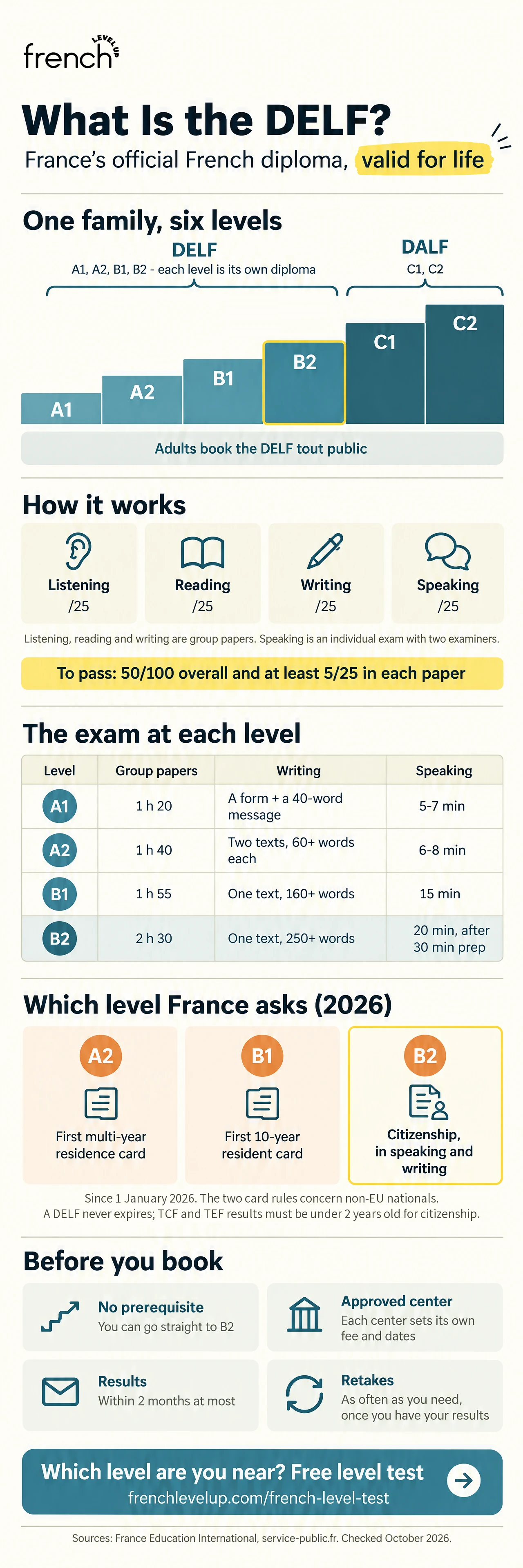
The DELF is an official diploma of the French Ministry of Education that certifies your French at one of four levels, A1, A2, B1 or B2. It is designed and managed by France Education International (FEI), the public body under the ministry that runs its French certifications, and each of the four diplomas is independent and valid for life. Above B2 the same family continues as the DALF, which covers C1 and C2, and there is also a beginner diploma called the DILF that you can only take in France.
If you have been asked for a DELF for a French residence card or for citizenship, the level depends on the application. As of October 2026, France asks for A2 for a first multi-year residence card and B1 for a first 10-year resident card (both rules apply to non-EU nationals, with exceptions), and it asks for B2 for naturalization. A DELF at the right level is one of the accepted proofs.
I coach English-speaking adults for the DELF B2 and the TCF, and this page covers what you need to know before you book any level. If you already know B2 is your target, my DELF B2 guide goes through each paper and its official marking grid, along with what I see in my students’ preparation.
DELF, DALF and DILF: which diploma and which version
The six CEFR levels run from A1 for a beginner to C2 for a near-native user, and if those letters are new to you, this guide to French language levels explains what each one means in practice. FEI’s current catalog splits those levels across five diplomas, and every one of them is valid for life.
| Diploma | Levels | Who it is for |
|---|---|---|
| DELF tout public | A1, A2, B1, B2 | Adults and older teenagers, French or foreign |
| DELF junior/scolaire | A1, A2, B1, B2 | Teenagers, with topics chosen for younger candidates |
| DELF Prim | A1.1, A1, A2 | Children |
| DALF | C1, C2 | Adults and older teenagers |
| DILF | A1.1 | Complete beginners and newcomers to France, from age 16, offered only in France |
As an adult, you book the DELF tout public, or the DALF if you are aiming above B2. The junior and Prim versions are built for school-age candidates, and the DILF is a first step for people who are just starting French in France, often with little previous schooling.
How the DELF works: format and pass rule
Every DELF level from A1 to B2 tests the same four skills, and each paper is scored out of 25. You take listening, reading and writing together in one room as group papers, and the speaking paper is an individual exam in front of two examiners. To pass, you need 50 out of 100 overall and at least 5 out of 25 in each paper. A score under 5 in any one paper is eliminatory, so a strong total cannot make up for a very weak skill.
The DALF C1 follows the same model. The DALF C2 is the exception, with two papers scored out of 50 and a minimum of 10 out of 50 in each, and the DILF has its own scoring, which needs 50 out of 100 with at least 35 out of 70 on the oral papers.
This table shows how long each DELF level takes, from the tables on FEI’s level pages as read in October 2026.
| Level | Group papers in total | Writing task | Speaking exam |
|---|---|---|---|
| A1 | 1 h 20 min | A form and a 40-word message | 5 to 7 min, after 10 min of preparation |
| A2 | 1 h 40 min | Two texts of at least 60 words | 6 to 8 min, after 10 min of preparation |
| B1 | 1 h 55 min | One text of at least 160 words | 15 min, after 10 min of preparation |
| B2 | 2 h 30 min | One text of at least 250 words | 20 min, after 30 min of preparation |
The group-paper totals add up FEI’s times for listening, reading and writing. The speaking exam is a separate, short appointment, and it can fall on another day. Abroad, some centers schedule it before or after the written papers, and in France it comes after them. A center’s own timetable can differ slightly from FEI’s, so go by the one your center sends you. At B2, FEI’s July 2026 candidate manual also describes two official formats for the listening and reading papers, with two or three exercises depending on the format, and the B2 guide covers that detail.
Which DELF level do you need in France?
These are the levels on service-public.fr, the French government’s official information site, as of October 2026. They have applied since January 1, 2026, and the two residence card rules concern non-EU nationals.
- A2 for a first multi-year residence card (carte de séjour pluriannuelle), where the card is concerned, because not every card is (service-public F34501).
- B1 for a first 10-year resident card (carte de résident), unless you are over 65 (service-public F2208).
- B2, in both speaking and writing, for naturalization and for a declaration of nationality by marriage (service-public F11926).
There is one exception to check before you book anything. The A2 requirement is tied to the republican integration contract (contrat d’intégration républicaine, or CIR), and holders of visitor, student and talent cards do not sign it, so the A2 obligation does not apply to them (service-public F17048).
A DELF at the required level or higher counts as a diploma, and it does not expire. TCF and TEF results are attestations, and for a citizenship application they must be less than two years old. A first multi-year card, a first resident card and naturalization also require a separate civic exam since January 2026. The citizenship level was B1 before 2026, so a page that still says B1 is enough for nationality is out of date. The guide to the French citizenship language requirement covers the accepted proofs and exemptions in more detail, and this explainer of what B2 French means describes the level itself.
For university, each institution sets its own level. FEI says the DELF B2, and increasingly the DALF C1, can give access to French, European and French-speaking universities and to some grandes écoles.
Can you take the DELF B2 directly?
Yes. FEI’s DELF-DALF FAQ says anyone can sit a DELF or DALF session without any prerequisite, and the four DELF diplomas are independent, so you can take the B2 without holding the A2 or the B1. FEI’s candidate manual also lets you register for several levels in the same session, and you can even sit a level you have already passed.
The rule tells you what you are allowed to book, but it does not tell you which level you are ready for. The free level test in the “Where to start” section below gives you an estimate before you pay a center.
DELF vs DALF (and where the TCF fits)
The DELF stops at B2. The DALF covers the two experienced-user levels, C1 and C2, and it is also a Ministry of Education diploma for adults and older teenagers, with two independent levels that are valid for life.
The DALF C1 keeps the DELF structure, with three group papers and an individual oral, each out of 25, and the same pass rule. The group papers take 4 hours in total, because the writing paper alone lasts 2 h 30 min. In it you write a synthesis of several documents in 220 to 240 words, then an argued text of at least 250 words. The oral lasts 30 minutes after 1 hour of preparation, with a monologue followed by a discussion.
The DALF C2 changes the model. Its group paper combines reading and writing in 3 h 30 min, and you write a structured text such as an article, an editorial or a report from a file of documents of about 2,000 words. The individual paper combines listening and speaking, and you report on an audio document heard twice, develop your own view and then debate with the jury, in 30 minutes after 1 hour of preparation. Each paper is out of 50, you pass with 50 out of 100, and anything under 10 out of 50 on either paper is eliminatory.
The TCF is the other French test accepted for these applications. It gives you an attestation that must be under two years old for a citizenship application, while the DELF is a diploma that never expires. My DELF vs TCF comparison covers the rest, and the TEF follows the same two-year rule as the TCF for citizenship. For every official French test side by side, including the TEF and the DCL, see French proficiency exams explained.
How to register for the DELF, and when
You register with an approved exam center, not with FEI, and the center tells you its fee, its dates and where the exam takes place. FEI publishes a list of DELF-DALF exam centers in France and abroad, and it says it has more than 1,200 exam centers for its certifications. You can choose any approved center.
In France, FEI sets a national calendar for the group papers. For the DELF B2 tout public there are ten dates a year, on Wednesdays at 2 p.m., and the last two in 2026 are November 4 and December 2. The 2027 France calendar lists January 13, February 3, March 17, May 26, June 16, July 7, August 4, October 6, November 17 and December 8 for the B2. Each center then sets its own oral dates within 30 days of the group papers, and a center does not have to run every session.
Abroad, FEI says calendars differ from one country to another, so the center near you is the only reliable source. As one example, L’Alliance New York’s December 2026 session runs from December 7 to 11, and its registration deadline, as listed in October 2026, is November 12, almost four weeks before the exam. Alliance Française de Chicago listed the same December week and a March 1 to 5, 2027 session. Check your center’s deadline early, because registration can close weeks before exam day.
If you need accommodations for a disability, you send a medical certificate on FEI’s form to your center at least two months before the session. FEI also mentions training tests that centers run in listening and reading under real exam conditions, so ask yours, and if you want to see the papers first, my DELF B2 practice tests page gathers sample papers to work through.
How much does the DELF cost?
Each approved center sets its own DELF fee, so the figure that counts is the one on your center’s page. For a sense of scale, here is what four centers listed in October 2026, each in its own currency.
| Exam center | DELF A2 | DELF B1 | DELF B2 |
|---|---|---|---|
| L’Alliance New York (US) | $145 | $155 | $190 |
| Alliance Française de Chicago (US) | $145 | $155 | $190 |
| Institut français du Royaume-Uni, London (UK) | £110 | £155 | £170 |
| Alliance Française Strasbourg Europe (France) | €160 | €180 | €200 |
L’Alliance New York adds a $50 administrative fee, Alliance Française de Chicago’s fees are non-refundable, the London figures are its 2027 fees, and the Strasbourg list is undated (read in October 2026). At each of these centers the price rises with the level, and the DALF costs more again. It is $245 for C1 or C2 in New York and Chicago, £215 for C1 and £245 for C2 in London, and €240 in Strasbourg. Cancellation terms vary too, and L’Alliance New York, for example, refunds a cancellation made before the deadline minus $80.
Results, diploma and retakes
FEI’s candidate manual says results arrive within two months at most, and some centers are quicker. Alliance Française de Chicago, for example, says its digital results attestation comes within four to five weeks. The printed diploma takes longer, with Chicago quoting three to six months and the Institut français in London saying it can take three to four months.
The jury’s decisions are final, and you cannot contest your marks, but you can ask your center to see your paper. If you pass, you receive a diploma that is valid for life. If you don’t, the center can give you a transcript of your marks.
You can retake a DELF as many times as you need, as long as you have received your results before you register again. Alliance Française de Chicago states that partial scores are not carried over, so a retake there means sitting all four papers again. Centers can also add their own booking conditions, so read the terms on your center’s page before you register.
Where to start
If you don’t yet know which level you are near, take the free French level test. It gives you an estimate of your level. It isn’t an official certification, but it helps you decide which DELF to book.
If B2 is your target, start with the DELF B2 guide linked near the top of this page. In 2026, five of my individually coached students sat the DELF B2, and all five passed. If you want to know where you stand before you book, the Bilan B2 gives you a DELF-style estimate of your current level, which is a coaching assessment and not an official result.
Frequently asked questions
How long is the DELF valid?
A DELF diploma is valid for life, and so is a DALF. That is one practical difference from the TCF and the TEF, whose attestations must be under two years old for a French citizenship application.
Which DELF level do I need for French citizenship?
As of October 2026, you need B2 in both speaking and writing for naturalization and for a declaration of nationality by marriage, so the DELF B2 or a higher diploma such as the DALF C1 meets the language rule. The requirement was B1 before January 1, 2026.
How much does the DELF cost?
It depends on the center, because each one sets its own fee. The fee table above shows what four centers in the US, the UK and France listed in October 2026, so use it as a guide and check your own center’s page before you plan a budget.
This page describes French residence and citizenship rules as of October 2026, based on the service-public.fr pages linked above. It is not legal advice, and these rules can change, so check the official pages for your own situation before you apply.