
In this article
- The six French language levels at a glance
- How the CEFR scale works
- A1 and A2: the basic user
- B1 French: the first independent level
- B2: the level France now asks for citizenship
- C1 and C2: the proficient user
- One level per skill, not one letter for you
- How exams report your French level
- Which French level France asks for (as of October 2026)
- How long does each French level take?
- How to find your French level
- Frequently asked questions
Checked against the Council of Europe, France Education International and service-public.fr on 3 October 2026.
Once you live in France or plan to, people start talking to you in letters. The prefecture asks for A2 or B1 depending on the residence card, and citizenship has needed B2 since 1 January 2026. Friends describe themselves as “a solid B1” as if that settled the matter. A list of the six levels is easy to find, but it won’t tell you what matters most to an adult learner, which is that a level describes a profile across several skills. That is why the letter on a certificate can feel wrong in a real conversation.
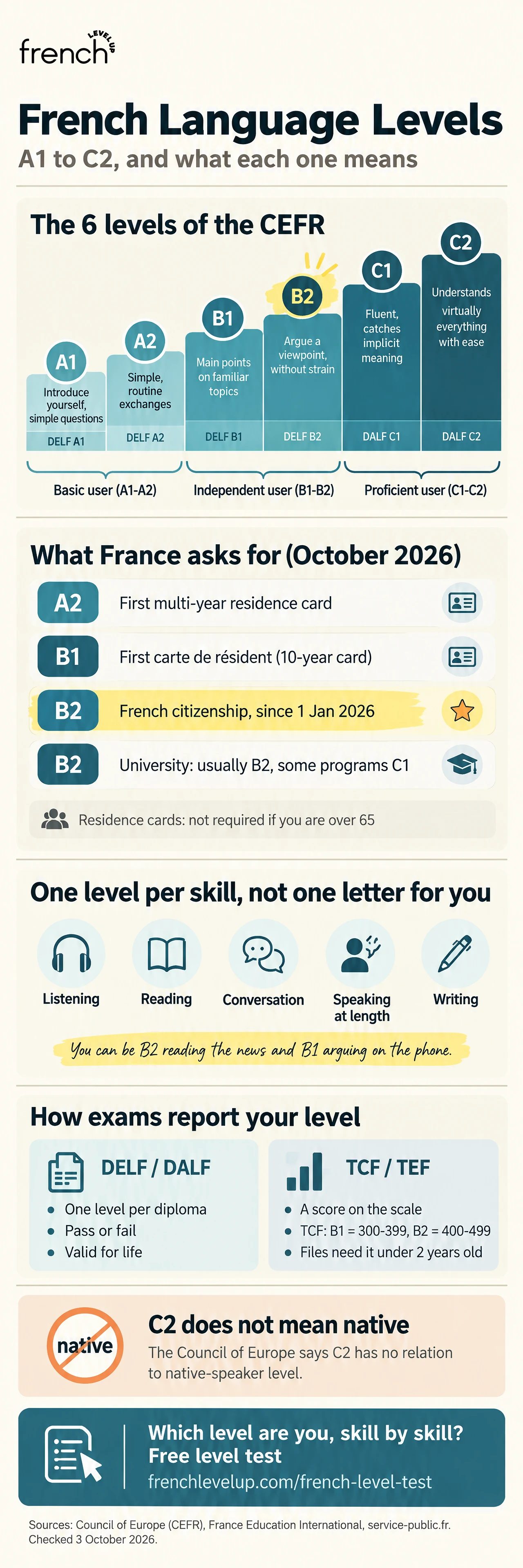
The short answer is that French levels follow the CEFR, a six-level scale published by the Council of Europe. The levels come in three groups: A1 and A2 for the basic user, B1 and B2 for the independent user, and C1 and C2 for the proficient user. The Council of Europe’s descriptions define what each level means, and in France you prove your level with a diploma (the DELF for A1 to B2, the DALF for C1 and C2) or a test result (the TCF or the TEF).
I coach English-speaking adults from A2 to C1 and prepare candidates for the DELF B2, the TCF and the DALF C1, so for each level I add what it looks like in my sessions, next to the official description and what France asks for as of October 2026.
The six French language levels at a glance
The descriptions in this table paraphrase the Council of Europe’s global scale of the CEFR (© Council of Europe). The France column reflects the rules in force on 3 October 2026.
| Level | Group | What you can do, in plain English | Diploma | Where France asks for it |
|---|---|---|---|---|
| A1 | Basic user | Use familiar everyday expressions, introduce yourself and answer simple personal questions, as long as the other person speaks slowly and helps you | DELF A1 | No residence or citizenship requirement |
| A2 | Basic user | Handle simple, routine exchanges about shopping, family, work and your surroundings, and describe your background in simple terms | DELF A2 | First multi-year residence card |
| B1 | Independent user | Follow the main points of clear standard speech on familiar topics, manage most travel situations, and talk about experiences and plans with brief reasons | DELF B1 | First carte de résident (10-year card) |
| B2 | Independent user | Understand the main ideas of complex texts, interact without strain for either side, and explain a viewpoint with its pros and cons in clear, detailed language | DELF B2 | French citizenship since 1 January 2026, and the usual minimum for university |
| C1 | Proficient user | Understand long, demanding texts and implicit meaning, and speak fluently and spontaneously for social, academic and professional purposes | DALF C1 | Some university programs |
| C2 | Proficient user | Understand virtually everything with ease and express yourself very precisely, with finer shades of meaning | DALF C2 | No general requirement |
The TCF can report any of the six levels, while the TCF and TEF versions built for residence and nationality files give an overall level only up to B2. I come back to how each exam reports a level further down.
How the CEFR scale works
CEFR stands for the Common European Framework of Reference for Languages. The Council of Europe published it in 2001 and expanded it in 2020 with a long update called the CEFR Companion Volume. The framework is written to work for any language, so the same six levels apply to French as to English or Spanish.
Each level is defined through “can-do” descriptors, which are short statements of what a learner can do with the language, such as following the main points of a radio program or writing a simple letter about an experience. They describe ability in use, so they don’t list grammar points or say how many words you should know.
The Companion Volume is also careful about what the levels are. It says the six levels are “not intended to be absolute” and compares proficiency to the colors of a rainbow, a continuum that we cut into bands so that we can talk about it. There is no sharp line where B1 ends and B2 begins, and two people with the same letter can sound quite different.
Plus levels, Pre-A1 and school codes
The Companion Volume describes three plus levels: A2+, B1+ and B2+. A plus level is “a very strong competence” at one level that does not yet reach the minimum of the next, with features of the level above starting to appear. It describes no plus level at A1, C1 or C2, so a “C1+” on a certificate or a CV has no Companion Volume definition behind it.
Below A1, the Companion Volume labels a band called Pre-A1, developed mainly for young learners at school. It covers very basic tasks such as greetings, simple purchases helped by pointing, and filling in a simple form.
You will also come across codes such as A0, B1.1 to B1.5 or B2.1 to B2.4 on school websites. The CEFR allows schools and countries to subdivide the levels for their own needs, and the Companion Volume itself writes A2 and A2+ as A2.1 and A2.2, so these codes are not wrong. They are a school’s own steps, though, so a B1.3 at one school has no reason to match a B1.3 at another, and the exams adults take for residence or citizenship don’t report them.
The names change, the codes don’t
The letters are stable, but the words attached to them are not. In English, “intermediate” usually means B1 and B2. The French government’s page on language levels calls A2 niveau intermédiaire ou usuel, B1 niveau seuil (threshold level) and B2 niveau avancé ou indépendant, while the official TCF grid calls B1 Intermédiaire and B2 Intermédiaire avancé. When a document gives you a name without a code, look for the code, because it is the only label that means the same thing everywhere.
A1 and A2: the basic user
A1 is the first level where you build sentences of your own rather than relying only on memorized phrases. The Council of Europe describes someone who can use familiar everyday expressions and very basic phrases, introduce themselves and others, and ask and answer questions about personal details such as where they live and people they know, provided the other person talks slowly and clearly and is prepared to help. France Education International (FEI), the public body that runs the DELF, DALF and TCF, turns this into a checklist on its DELF A1 page, which includes filling in a form, writing a short postcard, asking and answering simple questions, and buying something and paying for it.
A2 moves from survival to routine. The global scale describes a learner who understands frequent expressions about personal and family information, shopping, local geography and work, and who can handle simple, routine tasks that need a direct exchange of information. The Companion Volume links A2 to social functions such as greeting people, making and accepting invitations and arranging to meet, and to “getting out and about”, which means simple transactions in shops, post offices and banks, public transport, directions and tickets.
The self-assessment grid is frank about A2 conversation. You can handle very short social exchanges, “even though I can’t usually understand enough to keep the conversation going myself.” A2+ is where that starts to change, because you can now start, keep going and close a simple face-to-face conversation, although the Companion Volume adds that you “will generally have to compromise the message and search for words.” FEI’s DELF A2 checklist adds telling a past event and linking sentences with et, mais and parce que.
A2 matters in France because it is the level required for a first multi-year residence card (details in the requirements section below).
In my sessions, A2 French is still a bit school-like, and that is normal at this stage, because the basic verbs, the auxiliaries être and avoir and the passé composé are not always mastered yet.
B1 French: the first independent level
B1 opens the “independent user” group, and it is the level where French starts to work for you outside a classroom. It is also the level France asks for a first 10-year residence card.
What B1 means in the Council of Europe’s words
The global scale describes a B1 learner who can understand the main points of clear standard input on familiar matters met at work, school or leisure, deal with most situations likely to come up while traveling, and produce simple connected text on familiar topics. They can describe experiences, events, dreams, hopes and ambitions, and briefly give reasons for opinions and plans.
The self-assessment grid adds detail skill by skill. At B1 you can follow the main point of many radio or TV programs when the delivery is relatively slow and clear, enter “unprepared into conversation” on familiar topics, tell the story of a book or a film, and write personal letters about your experiences and impressions.
The Companion Volume picks out two features that define B1. The first is keeping an interaction going and getting across what you want in a range of contexts, for example giving your views in an informal discussion or following the main points of a longer discussion when the speech is clear. The second is coping flexibly with everyday problems, such as a less routine situation on public transport, making a complaint, joining a conversation on a familiar topic without preparation, or asking someone to clarify what they meant.
People often ask whether B1 is “fluent”. The CEFR doesn’t use that word as a level name, because its fluency scale has descriptors at every level from A1 to C2. Its B1 descriptor is refreshingly honest: you “keep going comprehensibly, even though pausing for grammatical and lexical planning and repair is very evident.” So a B1 speaker keeps going, but the words don’t come without effort yet.
B1+: the strong B1
The Companion Volume calls B1+ a “strong Threshold” level. You can do everything a B1 learner does, and you can now exchange larger quantities of information. Its examples are concrete: taking messages, describing symptoms to a doctor “with limited precision”, explaining why something is a problem, giving detailed instructions, and summarizing and giving your opinion on a short story, an article, a talk or a documentary.
What the DELF B1 asks you to do
FEI’s DELF B1 page opens with a checklist headed Je choisis le DELF B1 si je peux (“I choose the DELF B1 if I can”). It includes giving and justifying an opinion, understanding the key points of the news in a newspaper or on TV or radio, convincing someone, and coping with unexpected situations in daily life and travel.
The exam has four papers. The written paper asks for one text of at least 160 words in 45 minutes, and the speaking paper lasts 15 minutes after 10 minutes of preparation, in three parts: a guided interview, the expression of a point of view, and an interaction. The pass mark is the same as for the other DELF levels, which I explain in the exams section below.
B1 in France: the 10-year card, not citizenship
B1 is the level required for a first carte de résident, the 10-year residence card, unless you are over 65. It is no longer enough for French citizenship, because naturalization applications and marriage declarations filed since 1 January 2026 need B2 in both speaking and writing. If a school website, a forum or a search summary tells you that a DELF B1 is enough for nationality, that information predates the 2026 change.
B1 vs B2 French
The step from B1 to B2 is the one my coaching focuses on, and the official descriptions show where it lies. B1 deals with familiar matters in clear standard language, while B2 adds complex texts, abstract topics and interaction “without strain” for either side. The Companion Volume places B2 as far above B1 as A2 is below it, so the step is bigger than the letters suggest. The DELF marking criteria make the difference concrete, because a B1 text can present ideas as a sequence of points, while a B2 text has to build an argument around a problématique (the question the text answers) and handle concession.
I’ve written a full comparison, with the same exam task answered at both levels, in what B2 French means in practice.
What B1 looks like in my sessions
At B1, there is already more freedom than at A2, and mistakes are less of a barrier. This is the stage where students really start to spread their wings. At B1+, their storytelling gets richer and they want to go further. The mistakes are easy to fix at that point, and with connectors they start building more complex sentences.
If you are at B1 and want material to read and listen to that pushes you toward B2, my guide to intermediate French resources is organized around that step.
B2: the level France now asks for citizenship
B2 is the upper independent level. The global scale describes a learner who understands the main ideas of complex text on concrete and abstract topics, including technical discussions in their own field, interacts with enough fluency and spontaneity for regular exchanges with “users of the target language” (the Companion Volume’s wording) without strain for either side, and writes clear, detailed text that explains a viewpoint with the advantages and disadvantages of different options.
B2 is a tricky level in my experience. Some of my students understand everyday spoken French perfectly well but struggle with official formats like the DELF. Others reach B2 by ear, and when I look at their structured written work, I can see where they struggle.
Because B2 is now the citizenship level and the usual minimum for French universities, it has its own guide on this site. What is B2 French? covers it skill by skill, and my DELF B2 guide takes the exam paper by paper.
C1 and C2: the proficient user
At C1, French rarely gets in your way. The global scale describes someone who understands a wide range of demanding, longer texts and recognizes implicit meaning, expresses themselves fluently and spontaneously “without much obvious searching for expressions”, and uses the language flexibly for social, academic and professional purposes. The Companion Volume adds that at C1 “only a conceptually difficult subject can hinder a natural, smooth flow of language”, and that gaps in vocabulary are bridged by circumlocution, which means talking your way around the missing word.
C2 is the top of the scale. The global scale describes understanding “with ease virtually everything heard or read” and expressing yourself spontaneously, very fluently and precisely, “differentiating finer shades of meaning”. The Companion Volume adds a good command of idiomatic expressions and colloquialisms, and the ability to restructure a sentence so smoothly that the listener hardly notices. Even at C2, the self-assessment grid allows time to adjust, since its listening descriptor covers fast native speech “provided I have some time to get familiar with the accent”. The diplomas for these levels are the DALF C1 and the DALF C2.
C2 does not mean native
You may have read that C1 or C2 means “near-native”. The Council of Europe says the opposite. The Companion Volume (p. 37) states that C2 “has no relation whatsoever” with the idea of a native speaker, a well-educated native speaker or a near-native speaker. The top level describes the precision, appropriateness and ease of highly successful learners, which is a different thing.
The same page notes that ability does not stop at C2. When the scale was designed, a seventh level above C2 was proposed and left out because it lies beyond mainstream education, and the Companion Volume points out that simultaneous interpreters and professional translators work well above C2.
What C1 looks like in my sessions, and how I prepare DALF C1 candidates
My C1 students are almost at the level of the French people I talk to every day. The areas for improvement show up in their writing, and sometimes in fine-tuned listening comprehension.
When I prepare someone for the DALF C1, I first identify which exam skill is their weak point, and we focus on that one. The pitfall I watch for is the real gap between B2 and C1, especially in the two comprehension papers, which are demanding and can bring very specialized topics, and students are not always ready for that. So I start with authentic, current documents on topics they already know, with questions in the DALF C1 format, and I see how they handle them before we move on to past papers.
One level per skill, not one letter for you
The self-assessment grid splits language ability into five skills: listening, reading, spoken interaction (conversation), spoken production (speaking at length) and writing. Listening and reading are receptive skills, because you take language in, and the other three are productive skills, because you put language out. The grid was built to help learners profile their skills one by one, and the Companion Volume (p. 38) says plainly that any simple answer such as “B2”, or even “B2 receptive, B1 productive”, still hides a complex profile.
In practice, your level is closer to five letters than one. You can be B2 when you read the news and B1 when you have to argue with a landlord on the phone, and that is perfectly normal.
In my experience, the gap between understanding and speaking can go either way. Some students speak well but, strangely, don’t understand very well. Others are very attached to structure, so they understand sentences built with the structures they know and have trouble adapting to the variation of spoken French. Mostly, the cause is a lack of application and practice, and the gap shows in students who speak in their comfort zone, telling me about their week or their morning.
Comprehension improves when you listen to things a bit out of the ordinary and catch words and phrases on the fly. Take short breaks to note an expression, with a memo such as “I heard this at this point in this podcast”, and then reuse it. I love it when a student reuses in a session something we saw in the previous one, because that is when I see progress.
Learners misjudge their level too. In my sessions they often underestimate themselves, especially their speaking, and that is mostly a confidence issue, because with the right tools and focus, good everyday spoken French is within reach. They also underestimate how hard writing is. Not everyone needs to write in French, but writing involves a lot of reading, and I mean old-school reading on paper rather than on a screen, along with real composition.
My trick for writing is a journal. Spend a little time each day writing sentences with the new expressions you have collected. It warms up your writing muscles, so that when the DELF requirements come in, you are ready for them.
How exams report your French level
There are two kinds of official proof in France. Diplomas (the DELF and the DALF) certify one level for life. Tests (the TCF and the TEF) place you on the scale on a given day, and their results are attestations rather than diplomas.
DELF and DALF: one diploma per level, valid for life
The DELF tout public, the general version for adults, has four diplomas, one each for A1, A2, B1 and B2, and the DALF has two, for C1 and C2. All six are official diplomas of the French Ministry of Education, independent of each other and valid for life, so you register directly for the level you want without passing the ones below it.
Each one is a pass or fail at the level you chose. From A1 to C1, there are four papers marked out of 25, and you need 50 out of 100 overall with at least 5 out of 25 in each paper. The DALF C2 has two papers marked out of 50, with the same 50 out of 100 overall and at least 10 out of 50 per paper. My DELF B2 guide covers the B2 exam in full.
TCF: a score on the full scale
The TCF, also run by France Education International, gives you a score that maps to a level. On the official TCF grid, A1 sits below 200 points, A2 runs from 200 to 299, B1 from 300 to 399, B2 from 400 to 499, C1 from 500 to 599 and C2 from 600 to 699.
How the level is reported depends on the version, as FEI explains on its page about understanding TCF results. The TCF tout public scores listening, language structures and reading, with optional speaking and writing papers, and it gives you an overall level only if you take every test, including speaking and writing, in a single session. The TCF IRN, the version built for residence and nationality files, reports listening and reading up to B2, and its overall level also stops at B2. The TCF Canada and TCF Québec report each skill separately, from “A1 not reached” to C2.
TEF IRN: a threshold on every test
The TEF is run by the Paris Chamber of Commerce and Industry. Its TEF IRN, the version for residence and nationality, certifies A1 to B2, and it uses a rule that trips people up. To get A2 overall, you need at least 200 points on three of the tests and at least 167 on the weakest one. B1 needs 300 on three tests and 267 on the weakest, and B2 needs 400 on three and 367 on the weakest. A1 needs at least 100 on each test. So one bad paper can pull your overall level down even if the others are strong. The TEF IRN attestation is valid for two years, and its page says this version is not suitable for higher education.
What each exam asks you to produce
This table shows how the writing and speaking demands grow from A1 to C2 in the general versions of the DELF and DALF, from France Education International’s exam pages.
| Level | Writing | Speaking |
|---|---|---|
| DELF A1 | Fill in a form and write a message of at least 40 words (30 minutes) | 5 to 7 minutes after 10 minutes of preparation |
| DELF A2 | Two short texts of at least 60 words each (45 minutes) | 6 to 8 minutes after 10 minutes of preparation |
| DELF B1 | One text of at least 160 words (45 minutes) | 15 minutes after 10 minutes of preparation |
| DELF B2 | One argued text of at least 250 words (1 hour) | 20 minutes after 30 minutes of preparation |
| DALF C1 | A synthesis of 220 to 240 words plus an argued text of at least 250 words (2 hours 30 minutes) | 30 minutes after 1 hour of preparation |
| DALF C2 | One structured text (article, editorial, report, speech) built from a dossier of about 2,000 words, in a combined reading and writing paper of 3 hours 30 minutes | 30 minutes after 1 hour of preparation: report on an audio document, develop the issue, debate with the jury |
The word counts tell only part of the story. At A1 and A2, the speaking paper checks that you can handle personal, everyday exchanges. From B1, you have to give and defend a point of view, and from C1, you have to work from documents you didn’t choose, on topics that can be far from your own.
Which French level France asks for (as of October 2026)
These are the requirements on service-public.fr, the French government’s official information site, checked on 3 October 2026. Immigration rules change, so check the page for your own situation before you book an exam.
| What you are applying for | Level required | Notes |
|---|---|---|
| First multi-year residence card (carte de séjour pluriannuelle) | A2 | Not required if you are over 65. A civic exam is also required, with the same age exemption |
| First carte de résident (10-year card) | B1 | Not required if you are over 65. A civic exam is also required, with the same age exemption |
| French citizenship by naturalization or by marriage declaration | B2, spoken and written | For applications and declarations filed since 1 January 2026 |
| University study | Usually B2, some programs C1 | Set by each institution. DELF B2 and DALF holders are exempt from the TCF in the demande d’admission préalable (DAP) procedure |
For the two residence cards, the service-public page on proving your level lists what counts. The only tests accepted are the TCF and the TEF, taken in person with written and oral parts on the same day, and the attestation is valid for two years. Accepted diplomas include the DELF and the DALF, along with a few other French diplomas, but foreign diplomas are not accepted, “even francophone” ones. Some permit categories are exempt, and medical exemptions exist, so read the page for your case.
For citizenship, the service-public naturalization page sets the level at B2 at least, both spoken and written. My article on the French citizenship language requirement explains which tests and diplomas count as proof, how the IRN tests are scored for this purpose and how recent the result has to be. If you need the whole process, the steps are in how to get French citizenship.
How long does each French level take?
There is no honest number, and I’d rather explain why than give you one.
The Council of Europe gives no learning hours in the Companion Volume, and I found none on France Education International’s DELF, DALF and TCF pages. The scale describes what you can do, not how long it takes, and the time depends on where you start, how intensively you study, how much French you hear and use outside lessons, your age and the other languages you already speak.
The hour counts you see online come from elsewhere. One set of figures that circulates for French, on a language school’s levels guide that Google quotes in its search panels, is identical, level for level, to the guided learning hours guideline that Cambridge English publishes for people learning English and preparing its exams. Cambridge presents those numbers as a guideline only and lists similar factors, such as background, intensity, age and exposure. They were written for learners of English, and other schools publish their own figures for French that don’t agree with them.
There is also the profile problem. Because your level is really a set of levels across five skills, “how long to B1” depends on which B1 you mean. Someone who reads a lot can reach B1 in reading long before they reach it in conversation, and the reverse is just as possible.
How to find your French level
You can get a useful first answer in an evening, and the most useful answer will give you more than one letter.
- Read the self-assessment grid one skill at a time. For each of the five skills, pick the highest box where you can honestly say “yes, I can do that most of the time”. Expect different answers for listening, reading, conversation, speaking at length and writing.
- Check the FEI checklist for the level you think you are at. France Education International’s page for each DELF and DALF level includes a checklist of what you should be able to do, headed Je choisis le DELF B1 si je peux on the B1 page, for example. If most of the list describes what you already do in French, the exam at that level is a realistic target.
- Take the free French level test. It takes about ten minutes, needs no email, adapts to your answers from A1 to C1, and gives you two results: your level in understanding, and a separate self-estimate for speaking and writing. It is not an official certification, but it shows you whether your profile is even or uneven.
- Have someone assess your speaking and writing if you are B1 or above. In my sessions, speaking and writing are where students misjudge themselves, and they are hard to judge on your own. The Bilan B2 is a one-hour assessment with me, in which I listen to you speak, look at your writing and give you a DELF-style estimate and a plan. It is designed for people who are already around B1 or higher.
Then, if your goal is an exam rather than a diagnosis, book the official one for your target level. If that target is B2 for citizenship, Objectif B2 is my eight-week DELF B2 and TCF preparation program, currently open as a waitlist.
Frequently asked questions
How many levels are there in French?
There are six official levels, A1, A2, B1, B2, C1 and C2, grouped in pairs as basic, independent and proficient user. The Companion Volume also describes a Pre-A1 band below A1, mainly for young learners, and three plus levels (A2+, B1+, B2+) that sit inside the main levels rather than adding new ones.
Is B1 enough to live in France?
For paperwork, B1 meets the language requirement for a first carte de résident, and people over 65 are exempt, but it is not enough for citizenship, which has required B2 since 1 January 2026. In daily life, B1 covers most practical situations, but its descriptors still assume clear, standard speech, so fast conversation among French speakers can remain hard work.
What is the difference between B1 and B2 French?
B1 handles familiar topics in clear standard French, while B2 handles complex and abstract topics and argues a point of view without strain for either side. The Companion Volume puts B2 as far above B1 as A2 is below it.
Is C2 the same as a native speaker?
No, the Council of Europe states that C2 has nothing to do with native or near-native competence. It describes the precision, appropriateness and ease of a very successful learner.
Does a DELF or DALF expire?
No, both are valid for life. TCF and TEF results are attestations, and French residence and citizenship files accept them only when they are less than two years old.
Is there a level above C2?
There is no official level above C2. A seventh level was proposed when the scale was designed and left out because it lies beyond mainstream education. The Companion Volume notes that simultaneous interpreters and professional translators work well above C2, but the CEFR scale, like the DALF and the TCF, stops at C2.