
In this article
- What “intermediate” means in French
- How I chose these resources
- The short version: my picks by level
- Intermediate French podcasts
- News and video in easier French
- Intermediate French books and graded readers
- Textbooks and grammar books for intermediate French
- From learner material to native media
- How to turn listening and reading into speaking
- Speaking practice that moves you to B2
- Where I fit
- FAQ
Resources checked on 3 October 2026.
If you have reached B1 in French, you are probably not short of material. Most of the intermediate learners I work with already follow a podcast or two, own a grammar book and watch French videos, and all that input has made their comprehension grow while their speaking stayed where it was, because almost none of it asked them to say anything back.
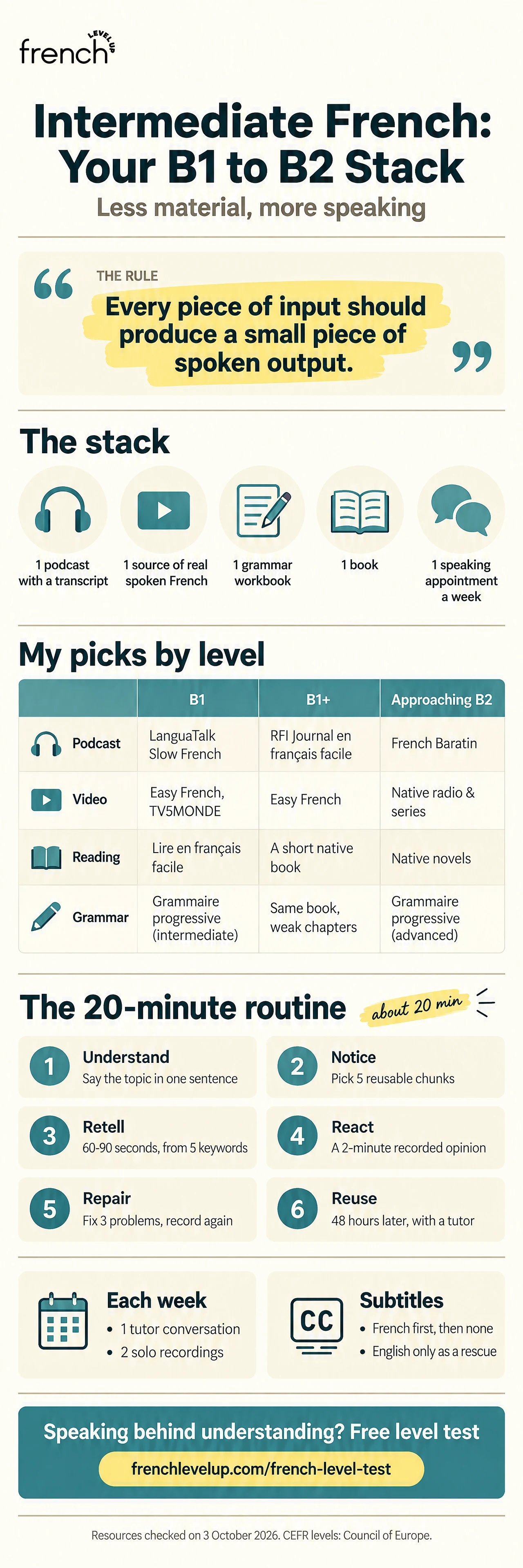
What I give an English-speaking B1 who wants to reach B2 is a small stack instead of a long list. It holds one podcast with a transcript, one source of real spoken French, one grammar workbook, one book and one speaking appointment every week. It comes with a rule that matters more than any title on this page, which is that every substantial piece of input should generate a small piece of spoken output.
What “intermediate” means in French
On the Common European Framework of Reference for Languages (CEFR), the scale that French courses and exams such as the DELF use, intermediate French covers B1 and B2, which the Council of Europe calls the “independent user” levels. At B1 you follow the main points of clear, standard French on familiar subjects and you can talk about them in simple connected sentences. At B2 you can take an active part in a discussion, explain and defend a point of view, and follow most TV news and films in standard French. I explain B2 skill by skill in what B2 French means, so I will keep this part short.
Two points from the CEFR matter before you choose resources. The framework profiles each skill separately, so you can understand at B2 and speak at B1, and in my coaching that uneven profile is the usual picture of a stuck intermediate learner. The CEFR also places good familiarity with idiomatic expressions and colloquialisms at C2, the top of the scale, so if you still miss jokes and wordplay at B1 or B2 you are not behind, and you do not need a resource that promises to fix it.
If you are not sure whether you are B1 or B2, my free French level test takes about 10 minutes and gives you two results, one for what you understand and one for what you can say.
How I chose these resources
Every resource on this page was checked on 3 October 2026 on the same fields.
- Still active. The latest episode, upload or edition was checked. A podcast that has stopped is either left out or marked as an archive.
- Level stated by the publisher. Where the publisher gives a level, I quote it. Where it does not, I say so, and any placement I add is my own judgment.
- Support. Transcripts, subtitles, answers and exercises.
- Free or paid. I say “free”, “paid” or “free with paid extras” without amounts, because prices change and some vary by country.
- Best for and who should skip it. These are resources I place in my coaching of English-speaking adults between B1 and B2, so each verdict is mine.
No resource on this list pays for inclusion, and none of the links is an affiliate link. The only commercial interest on this page is mine: the level test, the Bilan B2 and Objectif B2 are my own, and I say so where they appear.
The short version: my picks by level
| B1 | B1+ | Approaching B2 | |
|---|---|---|---|
| Podcast | LanguaTalk Slow French or Ta vie en français | Journal en français facile (RFI), Passerelles, Easy French podcast | French Baratin, Choses à Savoir |
| Video and news | Easy French on YouTube, TV5MONDE | Easy French on YouTube | Selected native radio and series |
| Reading | One Lire en français facile graded reader with audio | A short, accessible native book | Native novels and longer reports |
| Grammar | Grammaire progressive du français, intermediate volume | Same book, used to target weak chapters | Grammaire progressive du français, advanced volume |
| Speaking | One weekly conversation built on retelling, plus two solo recordings | Retelling plus a short opinion each week | Weekly argumentative conversation |
You do not need everything in a column. One podcast, one video or news source, one book and, if you want one, one grammar book are enough, as long as each of them produces some speaking.
Intermediate French podcasts
Podcasts are the easiest resource to collect, so this is where I am strictest. “Latest episode” is the most recent one found on 3 October 2026.
| Podcast | Level stated by publisher | Transcripts and support | Free or paid | Latest episode | Best for |
|---|---|---|---|---|---|
| LanguaTalk Slow French | A2 to B1 | Interactive transcripts on LanguaTalk’s site | Free | Oct 1, 2026 | Early B1 confidence |
| Ta vie en français | “Intermediate” | Free PDF transcripts and vocabulary flashcards | Free | Sep 30, 2026 | Independent learners, life in France |
| Français Authentique | No level stated | Not confirmed | Free podcast, paid academy | Sep 30, 2026 | Repeated exposure, confidence |
| Easy French podcast | No level stated | Full transcripts for paying members | Free with paid extras | Oct 1, 2026 | Conversational rhythm |
| Passerelles | “From intermediate level” | Transcripts on the host’s Patreon, some of them paid | Free with paid extras | Sep 30, 2026 | Reflective summaries |
| Journal en français facile (RFI) | None for the bulletin, linked exercises labeled B1 and B2 | Full transcript with every edition, two extra exercises each week | Free | Oct 2, 2026 | News at B1+ |
| Choses à Savoir | None (native show) | None designed for learners | Free | Oct 3, 2026 | First regular native listening |
| French Baratin | “Accessible from an intermediate level (B2)”, also suits C1 | Interactive transcript and exercises for Patreon supporters | Free with paid extras | Sep 30, 2026 | Debate, nuance, several voices |
| Coffee Break French | Season 2 “Intermediate”, Season 3 “Upper Intermediate” (no CEFR level) | Lessons explained largely in English | Free podcast, paid courses | Sep 8, 2026 | Occasional grammar review |
| innerFrench (archive) | Not confirmed | Not confirmed | Free to listen | Ended Sep 14, 2026 | Archive listening |
You do not need all of these. The progression I use is LanguaTalk Slow French or Ta vie en français first, then Easy French or Passerelles, then RFI and Choses à Savoir, and finally French Baratin and native radio. Move on when the current show no longer makes you work, not when you have finished every episode.
LanguaTalk Slow French
Gaëlle, a French teacher, speaks slowly, and the publisher describes the show as 99% in French. I find it one of the best confidence builders at early B1, because you understand enough to relax and the transcript lets you check what you missed. The slow pace that makes it comfortable is also its limit, so phase it out when normal speed no longer feels difficult.
Skip it if you already follow French at normal speed without strain.
Ta vie en français
Jonathan Soreau, a teacher and coach, talks about French behavior, integration and life in France. I recommend it especially to learners who work alone, because the free transcript and flashcards make it easy to turn an episode into structured practice, and expats will recognize the situations he describes.
Skip it if you want news or debate rather than everyday life and culture.
Français Authentique
Johan Tekfak’s long-running podcast covers daily life, mindset and French culture in clear monologues, and his stated mission is to move learners from understanding French to speaking it. I keep it selectively, for repeated exposure and confidence between learner material and native media, but one voice for a whole episode can become tiring, so rotate it with a show that has more than one speaker.
Skip it if you need a transcript for every episode or you lose focus with a single speaker.
Easy French podcast
Hélène and Judith chat about cultural and everyday topics, with expressions and slang along the way. I keep it because it is unscripted but accessible, which makes it especially useful for discourse markers, reactions and the rhythm of a real conversation. Their October 1, 2026 episode is about exactly the problem this page deals with, understanding French without speaking it.
Skip it if you need a free transcript to work with the audio.
Passerelles
Emilie, a teacher of French as a foreign language, explores cultural and social questions for learners from intermediate level upward. I find it strong for reflective summaries and personal reactions, because each episode turns around a question you can answer yourself afterwards. The transcripts sit on her Patreon and some are paid, so it is less convenient if you want to work closely with text and audio together.
Skip it if free transcripts matter more to you than the topics.
Journal en français facile (RFI)
RFI’s Journal is a real international news bulletin, broadcast Monday to Friday, and it is the best news resource I know for the B1 to B2 step, with excellent practice in picking out facts, points of view and reformulations. In my experience, despite the title, it feels much harder than slow learner podcasts, so do not try to work through the whole bulletin. Take one short story from it and use that.
Skip it if you are at early B1 and slow podcasts still take effort, and come back to it later.
Choses à Savoir
This native general-knowledge podcast publishes every day, and each episode usually answers one clear question, while its sister show Choses à Savoir ACTU explains the news in under seven minutes, Monday to Friday. I keep the main show as the first regular native listening for a strong B1, because the episodes are short enough to replay and then retell, but there is no learner support and the difficulty varies from one episode to the next.
Skip it if you are not yet comfortable with normal-speed French on a familiar topic.
French Baratin
Three friends, Cécile, Rafael and Sibylle, discuss and debate French society at normal speed. I recommend it at high B1 and B2, not at early B1, because it is excellent preparation for disagreement, nuance and following several voices, which is what B2 asks of you.
Skip it if you are at early B1, because you will spend the episode decoding rather than listening.
Coffee Break French
I use Seasons 2 and 3 of Coffee Break French as an occasional reference to review a grammar point or clear up something confusing, but it is not a core B1 to B2 podcast, because there is too much English and too much explicit teaching for sustained listening practice.
Skip it if you want listening practice, and use it only when a specific point needs explaining.
innerFrench (archive)
innerFrench published its 200th and final episode on September 14, 2026, after nine years, and the feed describes the episodes as getting progressively harder. I still count it as an archive pick for B1 listening, but it will not add new episodes, so do not build a long-term plan around it.
Skip it if you want a show that keeps up with current topics.
I have left out the Duolingo French Podcast, which you may see recommended elsewhere, because it has had no new episode since February 2024.
News and video in easier French
Video shows you the speakers and the situation, which is why it often feels easier than audio alone at B1.
| Resource | Level stated | Support | Free or paid | Still active | Best for | Skip it if |
|---|---|---|---|---|---|---|
| Easy French (YouTube) | None for the street interviews, a separate “Super Easy French” series for beginners | French and English subtitles on every video | Free, paid membership for vocabulary lists and exercises | Yes, upload on Sep 26, 2026 | The move toward real conversation | You only want scripted, slow French for now |
| TV5MONDE (TV5MONDE EDU app and apprendre.tv5monde.com) | Exercises from A1 (beginner) to B2 (advanced) | Subtitles and a French transcript with each video, comprehension exercises | Free | Yes, new exercises every week, app updated Aug 20, 2026 | Targeted listening practice with a clear level | Quizzes are the only thing you would do with it |
| 1jour1actu (Bayard) | None, written for children from about 8 | Short videos and articles, each built around one question | Free online, paid print edition | Yes, new article on Oct 2, 2026 | An overwhelmed B1 or a first retelling exercise | You need it to be your main resource |
Easy French is the most useful video resource I know for this step, because the street interviews expose you to different voices, hesitations and everyday phrasing. The way you watch matters more than the channel. Watch once with French subtitles, then a second time without them, and keep the English subtitles as a rescue tool for a passage you really cannot follow, never as the default.
TV5MONDE builds its exercises around real TV reports and programs from across the French-speaking world, and in my view it is the best structured listening platform available. Its B1 and B2 material is what I use most, but add an oral task to every exercise you finish, because completing quizzes does not train spontaneous speaking.
1jour1actu explains one current-affairs question per video, with a single main idea supported by a few secondary points, and that structure makes it excellent for a first retelling. The child-facing tone and simplified content make it too limited as a principal resource for an adult moving toward B2.
Intermediate French books and graded readers
At B1 you do not have to choose between graded readers and real books. A graded reader is a book written or adapted for a given learner level, usually with notes, activities and audio. I suggest using one to build reading speed and confidence while you test a short, accessible native book alongside it.
| Resource | Level stated | Support | Free or paid | Still active | Best for | Skip it if |
|---|---|---|---|---|---|---|
| Hachette Lire en français facile | A1, A2, B1 and B2 | Complete text recorded as audio, footnoted definitions, activities, thematic notes and answers | Paid | Yes, listed by the publisher | A first structured book at B1, read and heard at the same time | You already read native fiction without strain |
| Lectures CLE en français facile | Titles listed at A2 and B1 | Book with downloadable audio | Paid | Yes, listed by the publisher | Learners who prefer CLE’s choice of titles | You already use the Hachette collection |
| Olly Richards, Short Stories in French for Intermediate Learners (Teach Yourself) | “Mapped to B1-B2” | Eight original stories with glossaries, plot summaries and comprehension questions, discounted audiobook | Paid | Listed by the publisher, current edition from 2021 | Reading on through unknown words | Native books are already within reach |
The Lire en français facile collection is my first choice among graded readers because it runs all the way to B2 and lets you read and hear the whole text. At B1 it includes adapted classics such as Les Aventures d’Arsène Lupin and Le Comte de Monte-Cristo, and at B2 there are two adapted Simenon novels, Maigret tend un piège and La Tête d’un homme, which suit learners who like crime fiction.
The CLE readers are a valid alternative, but buying both CLE and Hachette creates unnecessary duplication, so pick one collection and read through it.
I place the Olly Richards stories lower than their label, around A2 to B1. They are useful if you want original stories rather than adapted classics and you need to get used to reading on through unknown words, but once native literature becomes accessible the stories can feel bland.
My native-book sequence
These levels are my own placements from coaching, not publisher labels, and all of them are ordinary books you can buy or borrow from a library.
| My placement | Books | Why they work there |
|---|---|---|
| Solid B1 | Le Petit Nicolas by René Goscinny, La Rivière à l’envers by Jean-Claude Mourlevat | Short, self-contained stories and a clear plot |
| B1+ | Le Petit Prince by Antoine de Saint-Exupéry, or a translated novel you have already read in English | A familiar plot lowers the effort of following the story |
| B1+ to B2 | L’Étranger by Albert Camus | The sentences are relatively spare, but the ideas and the second half ask for more interpretation |
| B2 | No et moi by Delphine de Vigan, La Tresse by Laetitia Colombani, Bonjour tristesse by Françoise Sagan, Chanson douce by Leïla Slimani | Contemporary or classic prose with a strong story |
My selection rule is simpler than any level label. Choose a story you genuinely want to finish, read without looking up every unfamiliar word, and put a book aside if it is still laborious after several chapters, because narrative interest will carry you further than literary prestige.
Textbooks and grammar books for intermediate French
If you already take lessons, listen and read regularly, and follow a clear plan, you do not need a general textbook at B1. General coursebooks are designed partly around classroom interaction, mediation and group projects, so learners who use them alone usually skip the speaking tasks and end up using the book as a reading and grammar workbook. If you want one anyway, this is how the current options compare.
| Book | Level stated | Support | Free or paid | Still active | Best for | Skip it if |
|---|---|---|---|---|---|---|
| Édito B1 and B2 (Didier FLE) | B1 and B2 (the collection runs from A1 to C1) | Authentic documents, a mediation workshop in each unit, progressive DELF preparation, transcripts and answers in the B1 activity book | Paid | Yes, 2022-2024 edition | Independent study, with the activity book | You already have a teacher who uses another method |
| Cosmopolite 3 and 4 (Hachette FLE) | 3 is B1, 4 is B2 | Authentic documents, language focus sections, projects and DELF preparation | Paid | Yes, published in 2018 and 2019 and still listed | A class or a learner who works with a teacher | You study alone |
| Mon alter ego 4 (Hachette FLE) | B2 (Mon alter ego 3 is B1) | 120 self-correcting digital activities come with the student book | Paid | Yes, published on August 5, 2026 | A teacher-led group that has adopted it | You study alone and want a proven solo option |
| Grammaire progressive du français (CLE), intermediate and advanced | Intermediate A2/B1 (52 chapters), advanced B1/B2 (72 chapters) | Lesson on the left page, exercises on the right, audio and online exercises, answer key sold separately for both | Paid | Yes, both listed by the publisher | A B1 who wants to fix specific grammar weaknesses | You are not willing to check your answers |
Édito is my first choice of the three coursebooks for a learner working alone, because its documents and guided grammar fit adults and the activity book makes self-correction possible. Use selected units rather than trying to complete every page.
Cosmopolite is a strong classroom sequence, but its interaction and project design loses much of its value when you use it by yourself.
Mon alter ego 4 looks promising, but it is too new for me to recommend confidently for solo study. It came out two months before this check, so there has not been time to see how students get on with it over a full course.
For the grammar workbook, most B1 learners should begin with the intermediate volume and use it to diagnose. Skip the chapters you already control, work through your weak areas, and move to the advanced volume when the intermediate exercises feel mostly easy. Go straight to the advanced volume only if you already control the main tense contrasts, object and relative pronouns, agreement, hypotheses and reported speech, and you need B2 precision. In both cases get the answer key, because a grammar workbook without feedback lets you repeat the same errors with more confidence.
If you are preparing the DELF, no general textbook replaces a dedicated, current exam book plus official sample papers. Édito or Cosmopolite can build the language, but exam materials teach the timing, how to read the task and how the marking works, and my DELF B2 guide explains the papers and the grids.
From learner material to native media
Do not jump from learner podcasts straight into fast panel shows. The rule I use is to pick native content that has at least one feature working in your favor, such as a short format, a clear narrative, a familiar topic, visible context or optional French subtitles.
- High B1: Choses à Savoir, short ARTE reports, selected RFI stories, and dubbed programs you already know in English.
- B1+ to B2: the series Dix pour cent, accessible ARTE documentaries, and narrative podcasts such as Les Pieds sur terre.
- B2: French Baratin, France Inter or France Culture programs chosen by topic, longer documentaries and unscripted interviews.
| Resource | Level stated | Support | Free or paid | Still active | Best for | Skip it if |
|---|---|---|---|---|---|---|
| Les Pieds sur terre (France Culture) | None (native) | None for learners | Free | Yes, episode on Oct 2, 2026 | Real people telling their own stories | You cannot yet follow native narrative |
| ARTE | None (native) | Varies by program | Free, on demand | Yes | Documentaries, films and series in French | You only have time for short formats |
Les Pieds sur terre is especially useful once you can follow native narrative. It airs every weekday, and each episode is half an hour of reporting without commentary, built on true stories told in the first person, so you hear many different speakers rather than one studio voice. ARTE, the European culture channel, streams its documentaries, films and series for free, which makes it the easiest place to find longer French programs on a subject you already care about.
The most important criterion here is not the level label. Follow your interest and your pleasure, because enjoying it is what keeps you going, and a cycling, food, work or social-issues program you find compelling but slightly difficult will usually sustain more practice than an easy resource that bores you.
How to turn listening and reading into speaking
This routine is what makes the stack work. Use it with a podcast episode, a video, an article or a book chapter, and it takes about 20 minutes.
- Understand. Listen or read once for the main idea without pausing, then say the topic in one sentence.
- Notice. Go back to the transcript or text and pick only five reusable chunks, meaning phrases you could use yourself, not a long vocabulary list.
- Retell. Close the source and retell it aloud for 60 to 90 seconds from five keywords. Retelling means explaining what you heard or read in your own words, as if to someone who missed it.
- React. Record a two-minute opinion with a position, two reasons, one precise example and one concession.
- Repair. Listen back, note three problems, check them or ask for corrections, then record a second version.
- Reuse. Forty-eight hours later, explain the same content to a tutor or conversation partner without notes.
The aim is not to memorize a polished script but to retrieve and reorganize the same language a little faster each time, so that it is there when you need it in a real conversation.
Shadowing, done briefly
Shadowing means repeating a recording a fraction of a second behind the speaker, copying their rhythm and intonation. Do it on 20 to 40 seconds of audio, not a whole episode. Listen first, mark the pauses and stressed words, repeat with the transcript, then shadow without reading and record yourself.
There is some research support for it. A systematic review of 44 studies on shadowing for pronunciation, written as an Oxford dissertation, found that it can help comprehensibility, intelligibility and aspects of fluency and prosody, but it also noted that the studies relied heavily on controlled speaking tasks rather than spontaneous speech. That matches how I use it. Shadowing trains rhythm, linking and articulation, but it does not replace retelling, discussion or unscripted conversation.
Speaking practice that moves you to B2
My recommendation is one structured conversation with a tutor every week plus two short solo recordings. Tutor fit matters more than the platform you find them on. A good tutor keeps you speaking, adapts the lesson to you, agrees with you on when to correct and gives feedback you can use, while a poor conversation lesson drifts into English or into generic exercises on a shared screen.
A productive 50-minute lesson looks like this.
| Minutes | What you do |
|---|---|
| 5 | Unscripted personal update |
| 8 | Retell the source you prepared, without reading |
| 20 | Discussion with follow-up questions, disagreement and requests for clarification |
| 10 | Review three recurring errors and reformulate weak sentences |
| 7 | Repeat your opinion or do a short role-play using the corrections |
Ask your tutor to keep most corrections for the end of each speaking turn, unless an error blocks understanding.
If you are working toward an exam, alternate four task types from week to week.
- Personal narrative. A real story with a sequence of events, description and your reaction.
- Information retell. Explain a news item to someone who has not seen it.
- Opinion. Defend a position with reasons, examples and a concession.
- Interaction. Respond to objections, ask follow-up questions, clarify and reformulate.
This mix follows the difference between B1 and B2. A B1 speaker can tell a story and give brief reasons for an opinion, while a B2 speaker develops a point of view with arguments, weighs pros and cons, and keeps it up when someone pushes back. The DELF B2 speaking test asks for exactly that, a point of view defended from a short document and then debated with the examiner, which I cover in the DELF B2 guide.
Where I fit
Everything above works without me. If you want a human read of where you stand, these are the options I run, and they are my own services.
- The free level test linked at the top of this page shows whether your speaking is behind your understanding.
- The Bilan B2 is a paid one-hour session with me, in which I look at how you speak, write and listen and tell you how far you are from B2, and you leave with a written debrief and a plan.
- Objectif B2 is an eight-week small-group preparation for the DELF B2 and the TCF, with four people at most. The next cohort’s dates are not set yet, so there is a waitlist.
FAQ
Is intermediate French B1 or B2?
It covers both. On the CEFR, intermediate French means B1 and B2, the two “independent user” levels, and you can be B2 in listening and B1 in speaking at the same time, which is why a single label can feel wrong.
What is the best podcast for intermediate French?
It depends on where you are. At early B1 I would start with LanguaTalk Slow French or Ta vie en français, at B1+ the Journal en français facile from RFI is my pick for news, and approaching B2, French Baratin is the best preparation I know for debate and several voices.
Can podcasts alone get me to B2?
In my experience they cannot, because podcasts build comprehension and B2 also asks you to take part in discussion and defend a view. Run the 20-minute routine on each episode and bring it to a weekly conversation.
Should I read graded readers or real books?
Read both at the same time. A graded reader such as Lire en français facile builds speed, and a short native book like Le Petit Nicolas alongside it tells you when you are ready for more. Put aside whichever one becomes a chore.
Do I need a textbook at B1?
You do not if you already have lessons, regular input and a clear plan. If you want one for solo study, choose Édito with its activity book, and use Grammaire progressive du français with its answer key for your weak points.
Should I watch French videos with English subtitles?
Use them only as a rescue tool. Watch first with French subtitles, then without them, and switch to English only for a passage you really cannot follow.