
In this article
Figures and rules checked in October 2026.
If you are moving to France, or already spend part of the year there, you have probably heard that residence cards and citizenship now come with a French requirement, and the next question is how long it will take you to get there. The figures you will see most often say roughly 500 to 600 guided learning hours to reach B2. They are the same figures Cambridge English publishes as a guideline for people learning English, and they are widely reused for French. The other number in circulation comes from the US Foreign Service Institute, which plans about 690 class hours for French, but on a different scale and for full-time trainees.
I take all of these hours with a pinch of salt. I have coached more than 460 students, about 7,500 hours of lessons, and the time it takes varies hugely from one person to the next. It depends on the languages you already speak, the hours you put in each week, how much French you hear, whether you actually speak, your age and your confidence. Two of my students, whom I describe below, show how wide the gap can be.
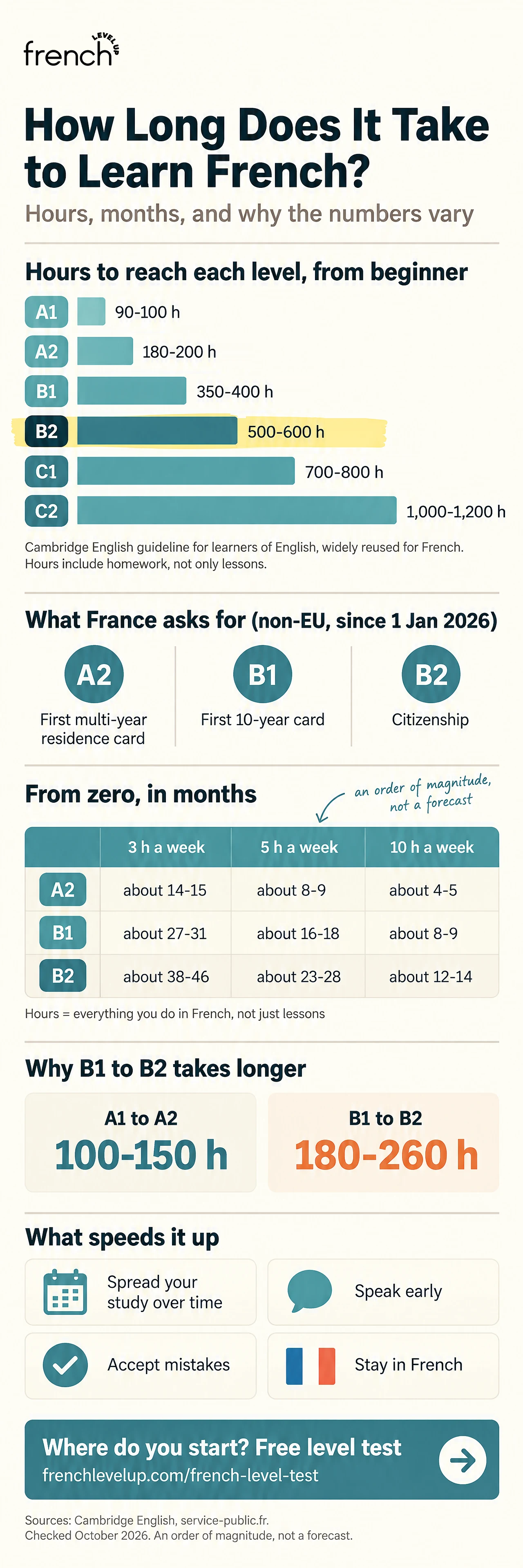
If you are not an EU citizen, France has asked since 1 January 2026 for A2 for a first multi-year residence card, B1 for a first 10-year card and B2 for citizenship, with exceptions I go through below. This article sets out who publishes which hour figure and what it measures, then those rules, then a conversion of the hours into months at three weekly paces. At 5 hours a week, for example, the Cambridge guideline works out to about 8 to 9 months for A2 and about two years for B2, but read that as an order of magnitude rather than a forecast.
The hours you will see, and where they come from
The table that appears on many French school and tutoring sites matches the guideline Cambridge English publishes for learners of English preparing its exams. Cambridge counts guided learning hours, cumulative from beginner.
| CEFR level | Cumulative guided learning hours (Cambridge English guideline, for learners of English) |
|---|---|
| A1 | 90 to 100 |
| A2 | 180 to 200 |
| B1 | 350 to 400 |
| B2 | 500 to 600 |
| C1 | 700 to 800 |
| C2 | 1,000 to 1,200 |
Cambridge defines guided learning as learning in a classroom or as part of a program, including homework and other language learning activities, so these hours are not only lessons. It presents its guided learning hours as a guideline only and says you may need more or less time.
You may also see this table labeled as the CEFR’s own hours. The Council of Europe, which publishes the CEFR, gives no learning hours in its framework, and I found none on the pages of France Education International, the body behind the DELF, DALF and TCF exams. I explain what each level means in my guide to the French language levels, so I won’t repeat the descriptions here.
Schools that teach French publish their own figures. The Alliance Française de Lyon’s 2026 page puts B2 at 600 to 650 hours from beginner and says its estimates come from Preply and the Alliance Française in Vancouver. The Vancouver branch gives course hours per level “in accordance with” its own teaching method, with 84 hours for A1, 140 for A2, 200 for B1 and 230 for B2, which adds up to about 650 hours to reach B2. Those are the hours of one school’s program rather than a general estimate, and other branches quote different figures, so there is no single Alliance Française number.
The FSI figure
The US State Department’s Foreign Service Institute, which trains US government staff in languages, places French in Category I, which it describes as languages close to English. French is listed at 30 weeks, which comes to about 690 class hours because a typical FSI week is 23 hours in class. The same week includes about 17 hours of self-study, so the full program adds up to roughly 1,200 hours of study for French. If you have seen a higher FSI figure quoted elsewhere, the current page gives 552 to 690 class hours for the whole category, with French at the top of that range.
This figure is hard to set beside the Cambridge table. The FSI measures a score of 3 in speaking and listening on the Interagency Language Roundtable scale, a US government scale for which I found no official CEFR equivalent, and its students are full-time trainees. It tells you that French is a serious commitment even for English speakers in a full-time program, but it can’t tell you how long you will take to reach B1.
Why I take these numbers with a pinch of salt
The publishers hedge their own figures. Cambridge lists your language learning background, the intensity of your study, your age and how much you study or hear the language outside lessons. The FSI says the time varies with natural ability, prior language-learning experience and time spent in the classroom. I would add two factors I see in my lessons every week, which are how much you actually speak and how confident you feel doing it. In my experience confidence is not a soft extra, because it decides how often you speak at all, and speaking is where most of the progress I see comes from.
K. is the clearest illustration I have. He started at a strong A2 and passed a C1 exam about 10 months later. I should say straight away that this is not typical, and I don’t present it as a target. He didn’t live in France, or even in Europe, but on the West Coast of North America. He spent at least two hours a day in authentic French, meaning French made for French speakers rather than for learners. He asked a lot of questions, and asked himself a lot of questions too, often without waiting for an answer, and he looked things up on his own and found sides of French he hadn’t suspected. In lessons he insisted that we stay in French. He listened, repeated the sounds he had just heard and accepted his mistakes.
JP, over the same period, stayed between A1+ and an average A2. He has lived in central Paris for six years, but his contact with French was one 50-minute video lesson a week. He built a large set of apps, tools, flashcards and tables as part of a method he considered rigorous. He wanted a precise analysis of every verb and the reason behind every sentence, so he would stop to analyze things that didn’t need it, and he would not accept “that’s how it is” as an answer.
I don’t see JP’s case as a lack of effort, because he put a great deal of work into his system. In my reading, the tools and the analysis kept him away from the part that felt uncomfortable, which is speaking and accepting that you don’t know yet. It is a pattern I see in other careful learners too, and it is close to what I describe in why language apps stop working at B1.
Over those months their confidence in speaking went in opposite directions. Their two cases don’t predict yours, but together they show why a table of hours can only describe an average learner, and why I won’t give you a single number.
Which level you need in France in 2026
As of October 2026, three French levels apply to non-EU nationals making a first application, and they came into force on 1 January 2026. EU, EEA and Swiss citizens are not concerned. For the two residence cards, the language rule applies if you are under 65.
| What you apply for | Level required | Official page |
|---|---|---|
| A first multi-year residence card (carte de séjour pluriannuelle) | A2, written and oral | Service-public: language level for residence cards |
| A first 10-year resident card (carte de résident) | B1 | Service-public: the carte de résident |
| Citizenship by naturalization or reintegration, or by declaration after marriage | B2, spoken and written | Service-public: naturalization |
Not every resident card is concerned by the B1 rule, so check the list for your category. The B2 for citizenship has to be shown in both speaking and writing, and I go through the accepted tests and diplomas in the French citizenship language requirement.
Before you plan around A2, check which card you hold. The A2 rule applies to residence titles that come with the Contrat d’intégration républicaine (CIR), the integration contract new residents sign with the French state. According to service-public’s page on the CIR, holders of a visitor card, a student card or a talent card don’t sign it. If you are in one of those situations, my reading is that the first language threshold you meet may well be the B1 for a 10-year card, if you apply for one, and then the B2 for citizenship.
A civic exam has also been required since 1 January 2026 for a first multi-year card, a first resident card and naturalization.
If you start from zero now
This table converts Cambridge’s guideline into months at three weekly paces, counting about 4.3 weeks in a month. I divided the guided hours by the hours per month and rounded. Guided hours include homework, so “5 hours a week” means everything you do in French, not 5 hours of lessons.
| Level (what it is for) | 3 hours a week | 5 hours a week | 10 hours a week |
|---|---|---|---|
| A2 (first multi-year card) | about 14 to 15 months | about 8 to 9 months | about 4 to 5 months |
| B1 (first 10-year card) | about 27 to 31 months | about 16 to 18 months | about 8 to 9 months |
| B2 (citizenship) | about 38 to 46 months | about 23 to 28 months | about 12 to 14 months |
The table doesn’t include the time it takes to book an exam session and wait for your results, so add that to any date you have in mind. Read every cell through the caveat above, too, because K. and JP would both sit well outside this table, in opposite directions.
On this arithmetic, 3 hours a week still reaches A2 in a little over a year, but the same pace puts B2 more than three years away, which matters if citizenship is your goal. If you already have some French, your real starting level changes every line of the table, which is why the last section points to a free test.
Why B1 to B2 takes longer
The Cambridge table already shows the gaps between levels widening. A 2018 research post from Cambridge by Ben Knight puts numbers on it for learners of English, with 100 to 150 guided hours to go from A1 to A2, against 180 to 260 hours to go from B1 to B2.
That matches what I see with the adults I coach, although the explanation that follows is mine and not Cambridge’s. In my experience, people at B1 can usually get by, and many of them have built habits that protect them from the moments where they would have to improvise. B2 asks for exactly those moments, because you have to find the words yourself and keep going when you get something wrong. Many of the people I coach at that stage understand far more than they can say, so the hours go into closing that gap rather than into learning new material. I go through that step in detail, with the routine I recommend and a realistic frame, in getting from B1 to B2 in French. I describe what B2 French asks for skill by skill in a separate guide.
What actually speeds it up
Some of this has research behind it. Spacing is the best documented. A 2006 meta-analysis by Cepeda and colleagues, covering 317 experiments, found that spreading study over time beats cramming it into one session for remembering verbal material. It is about memory for words, not about reaching a level, but it is a good reason to prefer short regular sessions to one long one. Cambridge’s research post also notes that learners with clear objectives tend to be more focused and make faster progress, and a deadline for a residence card is a very clear objective.
The rest is my view from coaching, not a research finding.
- Talk early. Speaking before you feel ready is what builds the reflexes a B1 or B2 test asks for, and waiting until you know enough tends to mean waiting a long time.
- Accept mistakes. In my experience, the students who move fastest treat a mistake as information, and I write more about this in speaking French with confidence.
- Stay in French. In a lesson, switching to English is quicker in the moment, but staying in French is where the practice happens.
- Practice in small, regular chunks. With one lesson a week, I recommend spending about the same time again on your own, divided into small chunks across the week.
Is French hard for English speakers?
By the FSI’s measure, French sits in its easiest category for English speakers, among the languages close to English, but at the long end of it, with 30 weeks against 24 for Danish, Dutch, Italian and Norwegian. Vocabulary gives you a head start. One classic count of about 80,000 dictionary words, by Finkenstaedt and Wolff in 1973, traced around 28% of them to French and Old Norman, and other estimates go higher depending on how you count. Recognizing a word on the page doesn’t mean you can pronounce it or use it in a sentence, though, so the head start helps your reading more than your speaking. I go through where French really gets hard, and why it isn’t where most lists say, in is French hard to learn for English speakers.
Where to start
Every range in this article depends on where you start, so the most useful first step is to find out. My free French level test measures what you recognize, asks you to estimate what you can say, and shows the two side by side. If your deadline is a residence card, the A2 French test and the B1 French test check each skill against the level that card asks for.
If you have a deadline and you think you are around B1 or above, the Bilan B2 is a one-hour assessment in which I estimate where you stand against B2 and give you a plan for the time you have left.
Frequently asked questions
Can I learn French in 3 months?
Not from zero to the levels France asks for, on the Cambridge guideline. Three months at 10 hours a week is about 130 hours, which is below the 180 to 200 guided hours Cambridge gives for A2. Six months at the same pace is about 260 hours, which falls between its A2 and B1 figures. If you already have a solid base, three focused months can move you a long way, but I can’t tell you how far without knowing where you start.
How long does it take to become fluent in French?
“Fluent” isn’t a CEFR level, and people use it for anything from comfortable conversation to near-native ease. If you mean B2, Cambridge’s guideline says 500 to 600 guided hours from beginner, and 700 to 800 for C1. The FSI’s 690 class hours for French target a professional working level on its own US scale, with self-study on top.
How many hours a day should I study?
I don’t know of a research figure for French that I would trust here, but the spacing research supports regularity, so a little most days does more for remembering words than one long session a week. The 3 and 5 hours a week columns above show what modest paces like that mean in months. K.’s two hours a day were exceptional, and you don’t need them to make progress.
The residence and citizenship rules in this article were checked on service-public.gouv.fr and the French Interior Ministry’s website in October 2026. They are a summary to help you plan, not legal advice, so check the official page for your own situation before you apply.