
In this article
Sources checked in October 2026.
Not at the start, no. French is easier to begin than most English speakers fear, because you already recognize a lot of its words and its basic sentences are built in the same order as English ones. It does get hard later, though, and not where the usual lists say. In my experience the real wall is listening to French at normal speed, because spoken French is quite different from the French you read, and you feel it most once your French is good enough for French speakers to start talking to you normally.
I’m a French coach for English-speaking expats and I have coached more than 460 students since 2022, so my answer is that it depends on the stage you’re at.
Why the start is easier than you fear
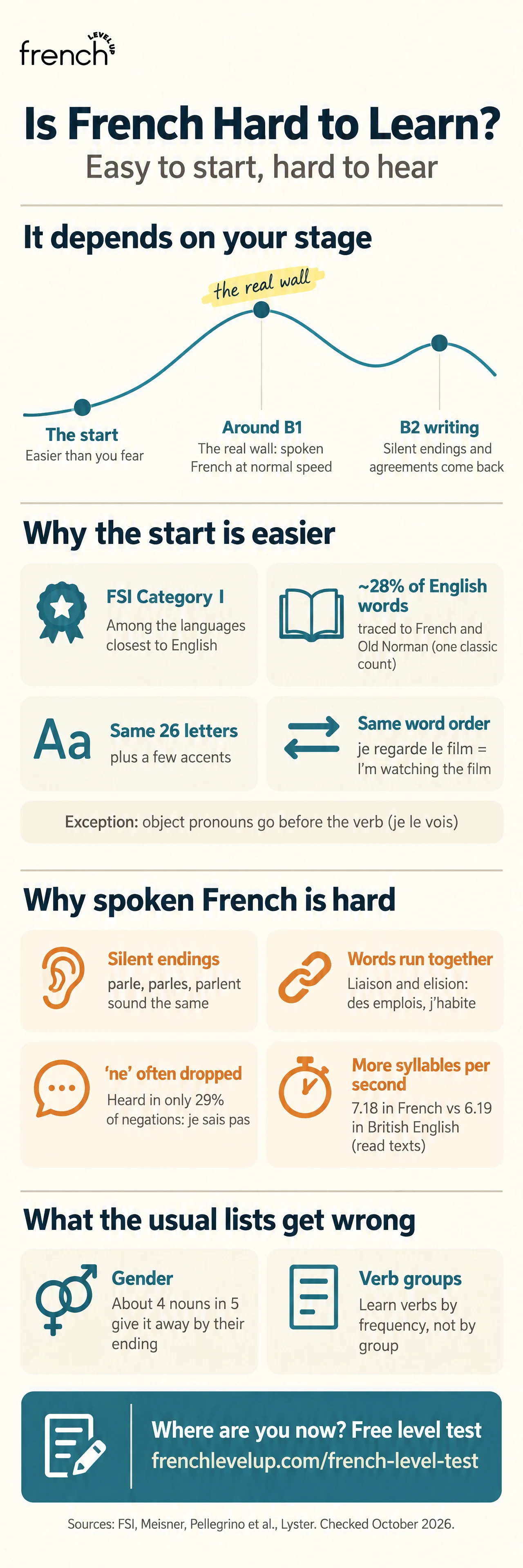
The US Foreign Service Institute, which trains US government staff in languages, puts French in Category I, the group it describes as languages close to English. French sits at the long end of that group, with 30 weeks of training, about 690 class hours, against 24 weeks for Danish, Dutch, Italian and Norwegian. Those are full-time trainees measured on a US government scale, so the figure tells you French is in the easiest group rather than how long it will take you. I go through the hours and what they mean in practice in how long it takes to learn French.
You also start with a lot of vocabulary you already know. One classic count of about 80,000 dictionary words, by Finkenstaedt and Wolff in 1973, traced around 28% of them to French and Old Norman, and other estimates go higher depending on how you count. Recognizing a word on the page doesn’t mean you can pronounce it or use it in a sentence, though, so this head start helps your reading more than your speaking. It is the same gap that explains why language apps stop working at B1.
The written language looks familiar too. French uses the same 26 letters as English, with a few marks added on top, which are the cedilla, the acute, grave and circumflex accents and the diaeresis. Its basic sentences follow the same subject, verb, object order as English, so je regarde le film (I’m watching the film) is built exactly like its translation. The main exception you meet early is object pronouns, which go before the verb. “I see him” becomes je le vois, literally “I him see”, so a word-for-word translation from English puts the pronoun in the wrong place.
Where it really gets hard: spoken French at normal speed
French is written one way and spoken another, and the gap between the two is wide. The differences below are well documented, and together they explain why someone who reads French well can still lose the thread of a conversation.
Many endings are written but never heard. In the present tense of regular -er verbs, the largest group, the endings -e, -es, -e and -ent are all silent, as the University of Texas grammar explains for -er verbs, so parle, parles and parlent (I speak, you speak, they speak) sound exactly the same. The plural -s on nouns has generally disappeared from speech as well, so you often have to rely on the article in front of the noun to know whether there is one or several. That makes speaking a little easier, because you have fewer forms to say, but it makes listening harder, because you have to rely on the small words around the verb and on context to know who is doing what.
Words also change at their edges. With liaison, a final consonant that is normally silent is pronounced and joined to the next word when that word starts with a vowel sound, so in des emplois (some jobs) the s of des is heard as a z at the start of emplois. The University of Texas course on liaison sorts these links into required, forbidden and optional ones. Elision does something similar to short words, so je and habite become j’habite (I live). On the page each word stands on its own, but in speech the boundaries move, and a word you know perfectly well in writing can be hard to pick out.
Some words disappear altogether. Textbooks teach negation as ne… pas, as in je ne sais pas (I don’t know). In a corpus study by Charlotte Meisner of about 440,000 words of recorded French, from formal to very informal speech, ne was pronounced in only 29% of 2,432 negations, and only 15% of the time after je. The corpus mixed formal and informal speech, so relaxed conversation probably drops it even more often. What you mostly hear is je sais pas, and because the unstressed e of je is often dropped in speech too, it can come out sounding like chais pas.
French also sounds fast, and there is a measurable reason for it. In a study by Pellegrino and colleagues, French speakers reading texts aloud at a normal pace produced 7.18 syllables per second, against 6.19 for speakers of British English. Each French syllable carried less information, though, so the two languages delivered the message at about the same rate. French speakers don’t say more than English speakers in a minute, but they spread it over more and shorter syllables, and those come faster than an English-speaking ear is used to. The study measured read texts rather than conversation, so take the figures as an indication of the difference and not as the speed of everyday speech.
The same gap between spelling and sound works in one direction only. A statistical analysis of French one-syllable words found that French is fairly consistent from spelling to sound but highly inconsistent from sound to spelling. Once you know the rules you can usually read a written word aloud, but hearing a word doesn’t tell you how to write it, which matters again when you get to writing.
In my experience this is the real wall for English speakers, and it shows up at a specific moment. Reaching a level around B1, the third of the six French language levels, is a real milestone, because it’s the point where a French speaker thinks they can now talk to you normally. It’s also the moment you realize how far you still are from following a normal conversation.
Speaking without translating, and writing at B2
The other hard stage I see with intermediate learners is speaking without translating from English in your head. The Council of Europe’s guidance on the CEFR, the framework behind the A1 to C2 levels, makes the general point that in any language we can always understand more than we can produce, so it’s normal for what you can say to lag behind what you understand. In my method, the way past it is to chain simple French sentences and ask simple questions on a subject you know, which I describe below. I write about the confidence side of speaking in speaking French with confidence.
Writing at B2 is where French gets hard again, and it comes from the same cause seen from the other side. All the endings you don’t hear when you speak come back when you write, along with the agreements, and that’s where gender mistakes show. This matters if you’re planning to apply for citizenship, because since 1 January 2026 France has asked for B2 in both speaking and writing for naturalization, which I explain in the French citizenship language requirement. I describe what B2 French asks for skill by skill in a separate guide.
What the usual lists get wrong
Lists of reasons French is hard tend to put grammatical gender and verb conjugation near the top, and some say gender has no logic at all. Both are real parts of French, but I think the way they’re usually presented makes them look harder than they are, especially at the start.
Gender
French nouns are masculine or feminine, and you can’t avoid that. The idea that gender follows no logic doesn’t hold up, though. In a corpus analysis by Roy Lyster of 9,961 nouns from a French children’s dictionary, about 81% of feminine nouns and 80% of masculine nouns had an ending that predicts their gender, counting an ending only when it gave the right gender for at least 90% of the nouns that share it. So about four nouns in five give their gender away by the way they end. Gender is also usually marked by the small words around the noun, the article or an adjective, rather than by the noun itself.
That’s why I tell beginners not to worry much about gender. For English speakers, the more useful habit at the start is to put an article in front of nouns at all. Saying le instead of la isn’t serious at that stage, when the goal is to be understood, but leaving the article out is a real beginner’s mistake. Gender does count later, in written French at B2, where agreements show on the page. It just isn’t what should hold you back in your first months.
Verb groups and conjugation tables
Too many methods insist on sorting verbs into the three traditional groups. I’m convinced it’s better to work by frequency, whatever the group, starting with the verbs you’ll actually use. I also never separate the skills while learning. If you learn a verb in the passé composé, the everyday past tense, you should say it, hear it, write it and read it in a sentence that’s useful to you, rather than copy it out by hand in a conjugation list you’ll have forgotten straight away. This fits with the silent endings above, since in speech several present-tense forms of an -er verb sound the same.
How I make French easier for my students
My method starts from conversation and builds it out of simple pieces. I give the student context, with vocabulary chosen for it, on a subject they already know well. Then I get them to chain simple sentences and ask simple questions about that subject. I don’t stop them to correct mistakes at that point, because what matters is that they enjoy it and that they understand the mechanics of verbs and of building a simple sentence.
Enjoyment comes first, then curiosity, and curiosity leads people to ask questions, which is when a real conversation takes place.
Corrections come afterwards. I write them down for the student to read at their own pace, with micro-exercises to fix them, so the conversation keeps going. Once speaking and listening are freed up, the student enjoys the sessions, and reading can then be worked on outside them, whenever it suits the student.
Where to start
Since how hard French feels depends on your stage, the first useful step is to find out where you are now. My free French level test measures what you recognize, asks you to estimate what you can say, and shows the two side by side.
If you have a deadline for a residence card or citizenship and you think you’re around B1 or above, the Bilan B2 is a one-hour assessment in which I estimate where you stand against B2 and give you a plan for the time you have left.
Frequently asked questions
Is French harder than Spanish for English speakers?
Not by the FSI’s measure, which lists French and Spanish together in Category I, both at 30 weeks.
What is the hardest part of learning French?
In my experience it’s following spoken French at normal speed, because many written endings aren’t pronounced and words run into each other, with syllables that come faster than in English. You feel it most around B1, when French speakers start talking to you normally, so it’s worth preparing for well before you get there.
Can I learn French on my own?
You can do a lot alone, especially reading, which is the part I have students work on outside our sessions. Speaking and following real spoken French are harder to build on your own, because what unlocks them in my method is conversation, with someone who answers your questions and asks you theirs. If you study alone, look for someone who will have simple conversations with you on subjects you know, and keep the corrections for afterwards.