
In this article
- Why you freeze when you speak French
- Step 1: Buy time without going silent
- Step 2: Talk around the missing word
- Step 3: Ask for clarification instead of nodding
- Step 4: Correct yourself and keep going
- Phrases to use less
- When French speakers switch to English
- Your English accent: what matters and what doesn’t
- How to get corrected without losing your flow
- How to practice speaking French on your own
- Can you learn to speak French faster?
- Signs your confidence is coming
- Your next step
- FAQ
You know what you want to say and most of the sentence is ready, but one word is missing and everything stops. The other person waits while the silence gets longer, and the sentence you had in your head either disappears or comes out in English.
What triggers that freeze, in my sessions, is the lack of an alternative. You have the answer, but you do not know how to get around the one word you cannot find with a synonym or another phrase, so you stop. It is the block I see most often with the English-speaking adults I coach.
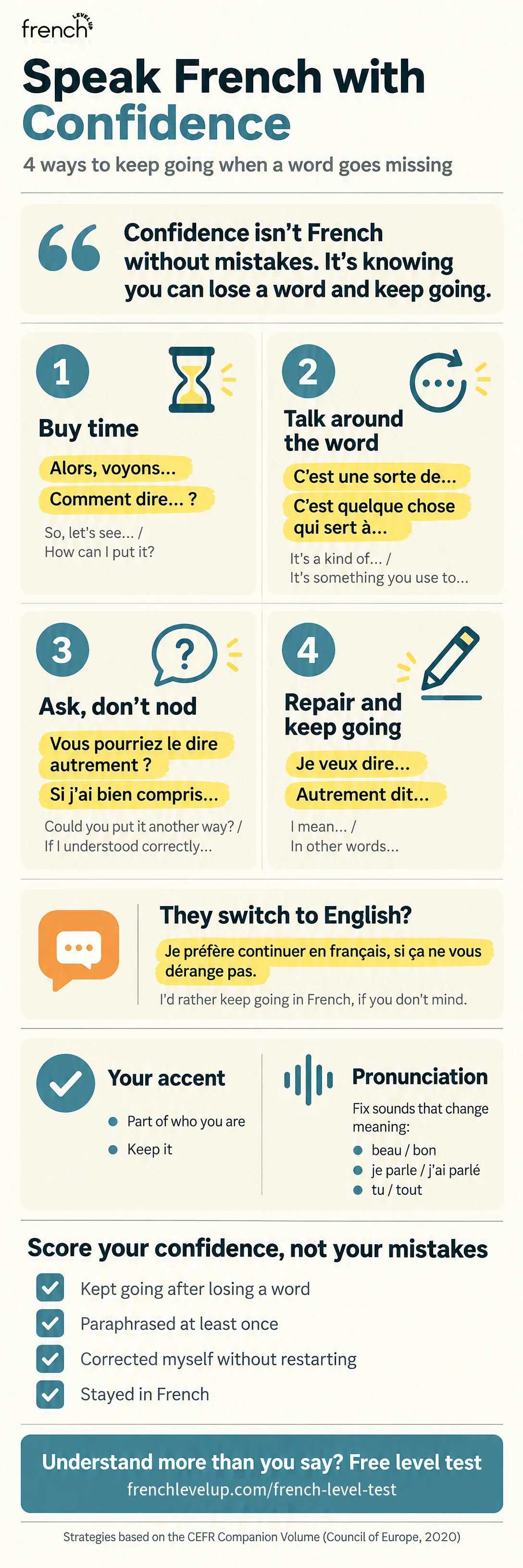
Confidence does not come from producing French without mistakes. It comes from knowing that you can hesitate, lose a word, repair the sentence and carry on without leaving French. The core of this guide is four groups of phrases that help you recover mid-conversation, and around them I explain what your English accent really changes and how to practice with difficulty built in on purpose.
It is written for intermediate speakers, roughly B1 to B2, who understand far more than they say. If you are not sure where you stand, my free French level test gives you two results, one for understanding and one for speaking, and the gap between them is what this article is about.
Why you freeze when you speak French
The missing word is the trigger, but it lands on something that was already there. In 1986, Horwitz, Horwitz and Cope described foreign language anxiety as “a conceptually distinct variable” in language learning. Their paper was about the classroom and not about a dinner table with your in-laws, but anyone who has frozen in front of a pharmacist will recognize the idea.
In 1998, MacIntyre, Clément, Dörnyei and Noels proposed a model of “willingness to communicate” in a second language, starting from students with strong linguistic competence who are unwilling to use the language while others who know very little speak whenever they can. In their model, that willingness changes from one situation to the next. It is a conceptual model rather than a measurement, but it puts into words what I see in my sessions: knowing French and being willing to speak it at a given moment are two different things.
Many of the people who come to me understand much more than they say and underestimate their speaking, which is mostly a confidence issue. They speak comfortably inside their comfort zone, about their week or their morning, and they freeze as soon as the conversation goes somewhere they have not rehearsed. My guide to French language levels explains why it is normal to understand at one level and speak at another.
So the first thing to fix is the lack of a way around the gap, and the four steps below give you one. Each matches a strategy that the Council of Europe’s CEFR Companion Volume describes as a communication skill at B1 and B2, so using them is not cheating. It is what competent speakers do.
Step 1: Buy time without going silent
The first thing to protect is your turn. When you go quiet to look for a word, the other person reasonably assumes that you have finished or need help, and they take the floor. A short phrase tells them that an answer is coming. The CEFR lists this among B2 skills, using stock phrases “to gain time and keep the turn” while you work out what to say, with the English example “That’s a difficult question to answer”.
These are the three I teach first.
- Alors, voyons… (“So, let’s see…”) It is neutral, and it sounds more purposeful than a long euh because it tells the other person you are preparing an answer.
- C’est une bonne question. Laissez-moi réfléchir un instant. (“That’s a good question. Let me think for a moment.”) It is useful in a lesson, an interview or a DELF-style discussion. With friends, Attends, je réfléchis (“Hang on, I’m thinking”) does the same job.
- Comment dire… ? (“How can I put it?”) It only works if you follow it straight away with an attempt to explain, and not with silence.
As for euh, a short one is perfectly normal in French. The problem is the chain, euh… euh… euh…, because it makes you feel more stuck than you are and makes it easy for the other person to take over. Replace it with a bridge that already says something, such as Alors, je pense que… (“Well, I think that…”) or Ce que je veux dire, c’est que… (“What I mean is…”).
Step 2: Talk around the missing word
This step answers the freeze directly. Talking around a word, which teachers call circumlocution, means describing what you mean when you cannot find the exact term. It is not an inferior substitute for knowing the vocabulary, and the CEFR lists it among the skills of these levels. At B1, a speaker “can define the features of something concrete” whose name they cannot remember, and at B2 they can use circumlocution and paraphrase “to cover gaps in vocabulary and structure”.
Start by saying that the word is gone, then describe what it is or what it does.
- Je ne retrouve plus le mot, mais… (“I can’t think of the word, but…”) It admits the gap while you keep control of the conversation.
- C’est une sorte de… (“It’s a kind of…”) For example, C’est une sorte de petit camion qu’on utilise en ville (“It’s a kind of small truck people use in town”).
- C’est quelque chose qui sert à… (“It’s something you use to…”) It is especially useful for objects, as in C’est quelque chose qui sert à ouvrir une bouteille (“It’s something you use to open a bottle”).
- C’est quelqu’un qui… (“It’s someone who…”) Use it for jobs and roles, as in C’est quelqu’un qui s’occupe des comptes d’une entreprise (“It’s someone who looks after a company’s accounts”).
- Ça ressemble à…, mais… (“It looks like…, but…”) For example, Ça ressemble à un vélo, mais il y a une grande caisse devant (“It looks like a bike, but there’s a big box at the front”).
- Le mot m’échappe, mais l’idée, c’est que… (“The word escapes me, but the idea is that…”) It suits a B1+ or B2 discussion, when the missing word is an abstract idea rather than an object.
The reflex I try to replace here is Comment on dit « … » ? (“How do you say [English word]?”). It is sometimes necessary in a lesson, but it should not become your automatic reaction, because it hands the problem to the other person and reinforces the belief that speaking French means finding an exact translation of your English. Describe the meaning first and ask for the exact word afterward, once you have kept your turn.
Step 3: Ask for clarification instead of nodding
The freeze also happens when you miss part of what the other person said, and the easy way out is to nod and hope the next sentence makes it clear. Asking is better, and it is another skill the CEFR names. At B1, you can ask someone “to clarify or elaborate” what they have just said, and at B2 you can ask follow-up questions to check that you understood what they meant.
- Vous pouvez répéter la dernière phrase, s’il vous plaît ? (“Could you repeat the last sentence, please?”) It is more precise than Répétez, s’il vous plaît, because it tells the other person exactly what you missed.
- Vous pourriez le dire autrement ? (“Could you put it another way?”) It is often more useful than hearing the same sentence again.
- Qu’est-ce que vous entendez par… ? (“What do you mean by…?”) It is useful at B2, because it asks about one specific expression or idea.
- Si j’ai bien compris, vous dites que… (“If I understood correctly, you’re saying that…”) It checks your understanding and buys you time to process.
I give these with vous. With friends and family, switch to tu, as in Tu peux répéter la dernière phrase ?, Tu pourrais le dire autrement ? or Qu’est-ce que tu veux dire par… ?
The same logic applies to Je n’ai pas compris (“I didn’t understand”). It is correct, but on its own it stops the exchange, so extend it: Je n’ai pas compris la dernière partie. Vous pourriez la reformuler ? (“I didn’t understand the last part. Could you rephrase it?”)
Step 4: Correct yourself and keep going
Repair means noticing that what you said is not what you meant and fixing it on the spot, without starting the sentence again. These are the two phrases I use most.
- Je veux dire… / Ce que je veux dire, c’est que… (“I mean… / What I mean is…”) This is the most useful general repair phrase, because it works after almost any wrong start.
- Enfin, pas exactement. Je reformule… (“Well, not exactly. Let me rephrase…”) Use it when your first sentence communicated the wrong idea, and not merely when it contained a grammar mistake.
You can vary them with Non, plutôt… (“No, more like…”), Ce n’est pas exactement ce que je voulais dire (“That’s not quite what I meant”), Autrement dit… (“In other words…”) or Je me suis mal exprimé(e) (“I didn’t put that well”).
The aim is not to correct every article or verb ending. Repair the mistakes that change or blur what you mean, then keep speaking. The CEFR sees B2, the level many of my students are working toward, in the same terms. A B2 speaker “can often retrospectively self-correct their occasional ‘slips’”, and B2 accuracy still allows slips as long as they do not lead to misunderstanding. Mistakes do not disappear at B2, and what changes is what you do afterward.
Phrases to use less
Some words are worth recognizing but not worth leaning on. None of them is wrong, but each can work against you once it becomes a habit.
- Du coup everywhere. It is useful for a real consequence, as in Le train a été annulé. Du coup, j’ai pris le bus (“The train was canceled, so I took the bus”). When it opens every idea, it turns into a verbal tic, and it sounds out of place when you need to speak formally.
- Genre, quoi at the end of a sentence, bah and ben. Learn to recognize them, but you do not need to use them right away. They are strongly conversational and too casual for an interview, a presentation or the DELF. Safer bridges are alors, en fait (“actually”), disons que (“let’s say”) or a short, silent pause.
- A bare je ne sais pas. It is correct, but it often closes the exchange. Extend it with Je ne suis pas sûr(e), mais je dirais que… (“I’m not sure, but I’d say…”) or Je ne connais pas le mot exact, mais c’est une sorte de… (“I don’t know the exact word, but it’s a kind of…”).
When French speakers switch to English
You are halfway through a sentence, you hesitate, and the other person answers in English. The temptation is to act like a deer in the headlights and rush into English with them, and once you are both there, the conversation tends to stay there.
My advice is to do the opposite. Take your time and tell them that you know how to say it and that you can keep going. Then ask for a chance, and insist politely if you need to, because you can do it. These are the sentences I suggest.
- Non, ça va, je sais le dire. Je peux continuer. (“No, it’s fine, I know how to say it. I can keep going.”)
- Laissez-moi une chance, je vais y arriver. (“Give me a chance, I’ll get there.”)
- Je préfère continuer en français, si ça ne vous dérange pas. (“I’d rather keep going in French, if you don’t mind.”)
- With friends or family, On peut rester en français ? J’ai besoin de pratiquer. (“Can we stay in French? I need the practice.”)
Then finish your sentence, even if you need a phrase from step 2 to get there. I know this temptation from the other side, because for years I was the quiet one in meetings in English, and what changed it for me was having no way back to French.
Your English accent: what matters and what doesn’t
The distinction I teach first is that accent and pronunciation are not the same thing. Your accent is part of your identity, and you cannot erase it. I have an accent when I speak English and you have one when you speak French, like everyone who speaks another language, so you can work with yours instead of fighting it. Pronunciation is different, because a pronunciation error turns one word into another or makes it hard to recognize, and that does need correcting. An accent only needs attention when it makes a word or a sentence hard to understand.
The CEFR made the same move in its 2020 Companion Volume. It replaced the old pronunciation scale, noting that a focus “on accent and on accuracy instead of on intelligibility” had been detrimental to the teaching of pronunciation, and the new scale separates levels by how much effort the listener needs to understand you. At B2, your accent tends to be influenced by the other languages you speak but “has little or no effect on intelligibility”, and even at C1 and C2 some features of accent may remain without affecting it. I go through these descriptors in what B2 French means, and for exam candidates, the DELF B2 speaking criteria ask for une prononciation plutôt claire (“rather clear pronunciation”), not a native one, as I explain in my DELF B2 guide.
Research on accent points in the same direction, with limits worth knowing. In a classic 1995 study, Munro and Derwing had 18 native English listeners rate unscripted English from 10 Mandarin speakers. The speech tended to be highly intelligible and easy to understand even though accent ratings ranged widely, so a strong accent did not necessarily make it harder to understand, although accent strength was still correlated with understanding. It is a small study of English, so it proves nothing about your French in Lyon or Geneva. In a 2009 review, Derwing and Munro argued that pronunciation teaching should aim for easy intelligibility rather than a native-like model, and that programs promising to reduce or eliminate an accent may do more harm than good. Closer to French, a 2017 study by Bergeron and Trofimovich of 40 Spanish-speaking learners, rated by French listeners, found that how easy the learners were to understand in a picture-story task was linked to their vocabulary, grammar and the richness of what they said, and not only to the features that made them sound accented. They were not English speakers, so take it as a hint rather than a rule.
Where I do insist is on two families of sounds, the nasal vowels and the e sounds (é, è and the nasal en). This is my coaching priority rather than a research finding, and the reason is that these sounds can change the meaning of a word, or the tense of a verb. The following pairs are illustrative.
- Nasal or not: beau (“beautiful”) and bon (“good”), gras (“fat”) and grand (“big”).
- The e sounds: je parle (“I speak”) and j’ai parlé (“I spoke”) differ only in their e sounds, and des (“some”) and dans (“in”) differ only by the nasal sound you hear in en.
- é against è: j’ai parlé (“I spoke”) and je parlais (“I was speaking”). Not every French speaker keeps the final é and è apart in everyday speech, and context often tells the listener which tense you mean, but I still train the distinction because it is a place where a sound carries the meaning of a verb.
One more sound has been studied with American English speakers: the French u in tu against the ou in tout. In a 2010 study where American English learners of Parisian French repeated French vowels, Levy and Law found that native French listeners frequently misidentified the learners’ u and ou, even after formal study and immersion, and the learners often produced the French u in a non-native way, for example close to the English “you”. A related study by Levy (2009) found that American English listeners tended to hear the French u as an English “oo”-type vowel, so train tu and tout apart with pairs like dessus (“on top”) and dessous (“underneath”).
For structured practice, the University of Texas at Austin’s free Français interactif course has a phonetics lesson on nasal vowels built around pairs of words that contrast oral and nasal vowels. The same course covers rhythm, the next area to explore, because French puts the stress at the end of a group of words where English keeps the stress of each word. Beyond that, I would not spend your energy trying to sound like someone from Paris.
How to get corrected without losing your flow
A correction that interrupts you mid-sentence fixes one word and costs you the rest of the sentence, which is why I think corrections should come in context.
With a tutor, the right moment depends on the exercise, but in a speaking exercise, ask your tutor to keep most corrections until you have finished your turn, unless a mistake stops them from understanding you. In my own sessions, I correct after a story or a thought, never in the middle of a sentence.
With a French-speaking friend or partner, the best correction is what teachers call a recast. Your friend lets you finish, then says your sentence back in its correct form as part of their answer, so you hear the right version in context and the conversation carries on. Here is an illustrative exchange.
You: Hier, j’achète le pain pour ce soir. (“Yesterday I buy the bread for tonight.”)
Your friend: Ah, tu as acheté le pain ? Super, merci. (“Oh, you bought the bread? Great, thanks.”)
Your friend did not stop you or explain the passé composé, and the correct form was in the answer. A friend cannot guess how you want to be corrected, so tell them, for example with Si je fais une faute, laisse-moi finir, puis redis ma phrase correctement (“If I make a mistake, let me finish, then say my sentence back correctly”).
How to practice speaking French on your own
Solo practice should include difficulty on purpose. If you only rehearse perfect written scripts, you may sound confident alone and still freeze the moment a real conversation changes direction, so the exercises below are built to make you lose a word and recover. Podcasts, books, the 20-minute routine that turns listening into speaking and the shadowing method are in my intermediate French guide, and what follows is specifically for confidence.
The recovery recording
This is the exercise I give between lessons.
- Choose one narrow question, such as Est-ce qu’il faudrait limiter les voitures en centre-ville ? (“Should cars be limited in city centers?”)
- Write down three keywords, and never complete sentences.
- Record a 90-second answer without restarting.
- If a word is missing, use one of the phrases from step 2 and describe it.
- Listen once and pick out only one unclear passage and one successful recovery.
- Look up the language you were missing.
- Record the answer again, changing the wording rather than reciting the first version.
What makes it work is the second recording, because you say the same thing with different words after fixing only one point, so you train flexibility instead of memorizing a script. Fixing one feature per recording also keeps the exercise from turning into a discouraging hunt for every mistake.
Score your confidence, not your mistakes
When you listen back, do not count errors. Score the behaviors that make communication work.
- Did I begin without switching to English?
- Did I keep going after losing a word?
- Did I paraphrase at least once?
- Did I express one complete idea?
- Did I correct myself without restarting?
- Would a patient French speaker understand my message?
The question becomes whether you handled the situation in French, and you can answer yes to that long before your French is perfect.
Spend a week on the same topic
Pick one subject that matters to you and stay with it for a week.
| Day | What you do |
|---|---|
| Monday | Describe the topic for one minute |
| Tuesday | Give your opinion on it for 90 seconds |
| Wednesday | Retell a podcast or article related to it |
| Thursday | Answer an imaginary objection |
| Friday | Speak about it for two minutes without notes |
| Weekend | Discuss it with a tutor, or send someone a voice message about it |
Staying on one topic takes some of the pressure off, so your effort goes into finding the words and organizing them. Over the week you move from short prepared answers toward unprepared follow-up questions, which is much closer to a real conversation than changing subject every day.
Rehearse the situations you actually live
If you live in France or Switzerland, the most useful scripts are the ones your week already contains. A few that I use with students:
- explaining a symptom to a pharmacist
- making an appointment by phone
- disagreeing politely in a meeting
- telling a neighbor about a problem
- explaining why a delivery is wrong
- answering a naturalization interview or DELF-style question
Play both roles and add one predictable complication, for example the appointment you wanted is not available or a word comes up that you do not know. The complication is the part that trains confidence.
What a realistic week looks like
For a working adult, this is a practical target:
- three solo sessions of five minutes
- one recording kept as evidence of progress
- one voice message sent to a real person
- one session with a tutor or conversation partner
- three phrases from this article reused deliberately during the week
Solo practice builds the speed at which words come back to you and gets you used to hearing your own French, but it cannot reproduce the unpredictable back and forth of a real conversation, so it prepares you for people without replacing them.
Can you learn to speak French faster?
Nobody can honestly promise fluent French in a set number of weeks, and I will not put a number on it. For an intermediate speaker, though, “faster” can mean something useful, which is the speed of your turn: how long it takes you to start, and how long your pauses are once you have started.
That is where the CEFR’s fluency scale draws the line between B1 and B2. A B1 speaker “can keep going comprehensibly, even though pausing for grammatical and lexical planning and repair is very evident”. A B2 speaker has a “fairly even tempo” and, although they can be hesitant while searching for expressions, “there are few noticeably long pauses”. B2 speakers still hesitate, but their pauses are shorter, and they have stock phrases to keep the turn while they think. The phrases in steps 1 to 4 are the part of that speed you can work on directly.
Signs your confidence is coming
The clearest marker I see is that a student stops interrupting themselves to ask “Is that right? Is that correct?” They stop waiting for the other person’s verdict on every sentence, and they tell their stories without stopping.
The second marker is a mistake that does not break anything. You know you got a gender or an ending wrong, but you keep going anyway because the message got through. That is confidence in action.
Progress also shows when you reuse, in one conversation, something you picked up in the previous one. And if you keep the confidence score from the recovery recording, you can watch the answers move toward yes.
Your next step
If you have not taken it yet, the French level test puts your speaking result next to your understanding result, which tells you where to start.
To have me hear where your French stops, book a free call: Talk to Yann, free, 25 minutes.
For readers with a B2 deadline, for naturalization or the DELF, my Bilan B2 is a paid one-to-one assessment of where you stand against B2. All three are my own services.
FAQ
How can I learn to speak French if I already understand most of it?
Start from your comprehension, because it is an asset. Use a few phrases from each of the four recovery groups on purpose in real conversations, practice between them with the recovery recording and the same-topic week, and keep at least one real conversation a week, because solo practice cannot reproduce turn-taking.
Will I ever lose my English accent?
You do not need to. The CEFR allows features of accent to remain even at C2 as long as they do not affect intelligibility. Work on the sounds that can change meaning, such as the nasal vowels, the e sounds and the u in tu, and let the rest of your accent be part of who you are.
How do I stop translating in my head?
Stop looking for the exact French equivalent of an English word before you speak. When it does not come, describe the meaning with C’est une sorte de… or C’est quelque chose qui sert à…, and use the same-topic week, because by Friday you have already said most of what you need on that subject in French.
How long does it take to feel confident speaking French?
I cannot give you an honest number, because it depends on where you start and on how often you put yourself in real conversations. What I can give you is what to watch for, which is the signs above, starting with the day you stop asking whether every sentence is right.