
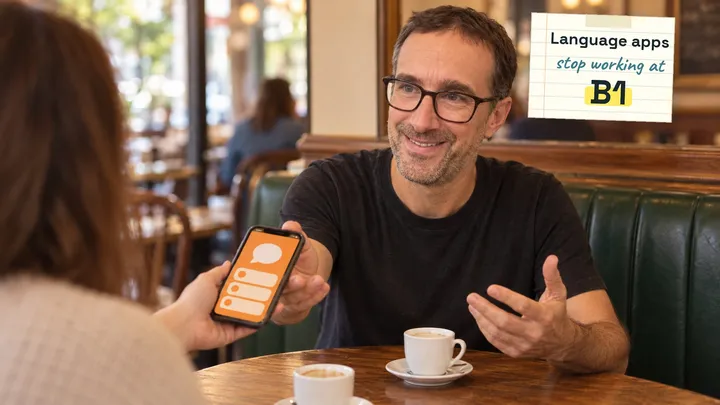
Most of my students used an app before they came to me, and most of them were right to. Apps are very good at the first part of learning a language, because that part is mostly recognition: you see a word, you match it to a meaning, you get it right, and the app rewards you for it.
What an app trains
An app trains you to recognize the right answer when it is in front of you. That is exactly what A1 to B1 asks of you. You need a few thousand words, the common verbs in a few tenses, and the reflex to understand a simple sentence without translating it. Recognition gets you there, and it gets you there faster than a textbook.
What B2 asks instead
B2 asks you to produce French when nobody is offering you options. You have to find the word yourself, build the sentence while someone is waiting, and keep going when you get it wrong. No app can put you in that position, because the moment it offers you four answers, the hard part is already done for you.
So the streak keeps growing and the conversation at the dinner table does not get any easier. That is not a lack of effort. You are training a skill the next level no longer tests.
What to do with the app
Keep it if you enjoy it, but treat it as maintenance for your vocabulary rather than as your progress. The progress now comes from situations where you have to speak first: a conversation where you have to defend an opinion, a call you would rather avoid, a sentence you start without knowing how it ends.
That is uncomfortable at first, and it is also the only part of the work an app cannot do for you.