
In this article
Sources checked in November 2026.
You’re at B1, maybe B1+. You can handle most of daily life in French, but the last few months haven’t felt like progress. If B2 is your next target, for a citizenship file or for yourself, you want to know how long it will take and why it suddenly feels so slow.
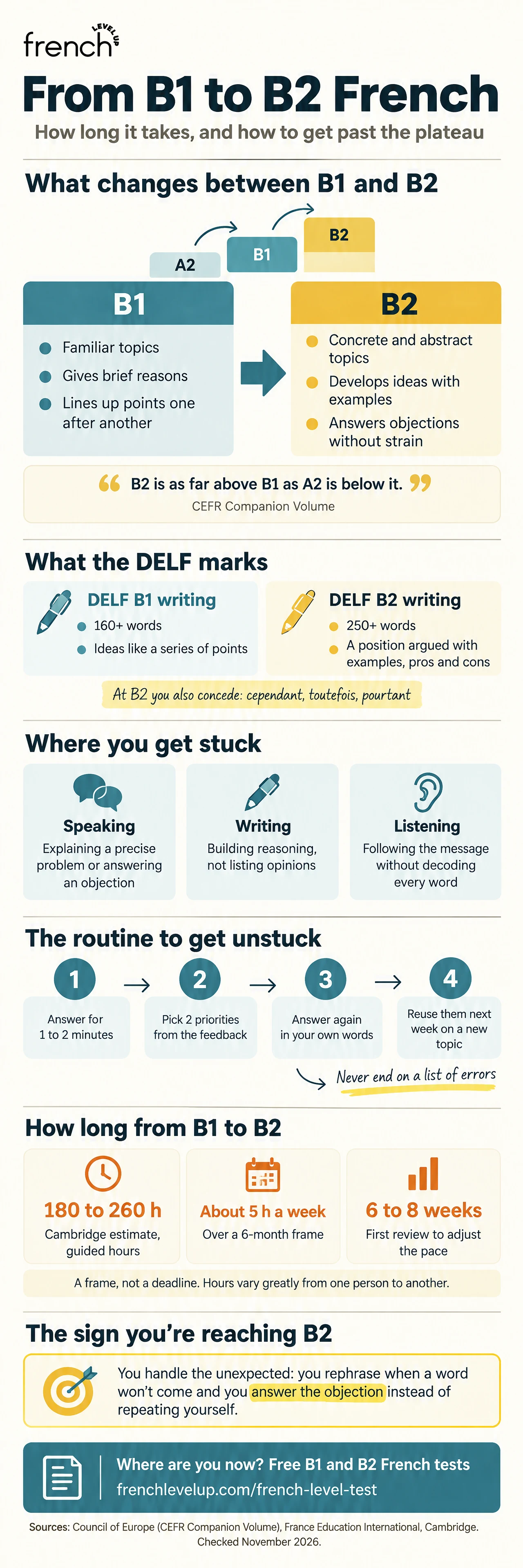
The answer on time makes more sense once you see what B2 asks for. In my view the step to B2 is less about knowing more French than about using what you already know when the situation gets complicated, for example when you have to explain a precise problem or answer an objection. The Council of Europe, which publishes the CEFR, treats the gap as a big one. Its CEFR Companion Volume states that “Level B2 represents a new level as far above B1 (‘Threshold’) as A2 (‘Waystage’) is below it.”
On time, Cambridge estimates 180 to 260 guided hours from B1 to B2 for learners of English, a figure I take with a pinch of salt. What I recommend for an adult starting from a solid B1 is a six-month working frame at about five hours a week, with a first review after six to eight weeks to adjust the pace. The frame is there to organize your work, and it doesn’t promise B2 by a date.
What actually changes between B1 and B2
My guides to the B2 French level and to B1 French take each level skill by skill, so here I’ll stay with the difference between them.
On the Council of Europe’s global scale, a B1 user understands the main points of clear input on “familiar matters” and can “briefly give reasons and explanations for opinions and plans.” A B2 user understands “complex text on both concrete and abstract topics” and can interact “with a degree of fluency and spontaneity that makes regular interaction with users of the target language quite possible without imposing strain on either party.” When you speak at length, a B1 description is “a linear sequence of points,” while a B2 presentation is clear and detailed, “expanding and supporting ideas with subsidiary points and relevant examples.”
Between the two sits B1+, which the Companion Volume calls “strong Threshold.” At a plus level, it says, “features of the level above are starting to appear,” which fits what I describe about B1+ in my guide to French language levels. The same document reports research suggesting that “inaccuracy increases at around B1 as the learner is beginning to use language more independently and creatively,” so more mistakes at this stage can simply mean you’re attempting more.
The Council of Europe does use the image of a plateau, but it describes what comes before B2 and doesn’t use it as a label for stuck B1 learners. At B2, it says, “having been progressing slowly but steadily across the intermediate plateau, the user/learner finds they have arrived somewhere.” (Quotations from the CEFR Companion Volume, 2020, © Council of Europe.)
What the DELF marks differently at B1 and B2
France Education International (FEI), which runs the DELF, makes the difference concrete. Its DELF B1 page already expects you to give your opinion, justify it with arguments and even convince someone. So what changes at B2 is how far the argument is developed and how well it holds up when someone pushes back, rather than whether you argue at all.
In the B1 writing paper you write an email or a postcard of at least 160 words, and FEI’s explanation of its criteria describes sentences that follow each other comme une suite de points (like a series of points), with adverbs such as premièrement and deuxièmement (first, second). In the B2 writing paper you write at least 250 words, either a forum contribution or a formal letter, and FEI’s B2 criteria ask you to take a position, argue in detail with precise examples and set out the advantages and disadvantages, in paragraphs with an introduction, a development and a conclusion.
In speaking, the B2 monologue asks you to state a clear problématique (the question the document raises) and announce your plan. The interaction asks you to vary your arguments to nuance your ideas and to express concession with words such as cependant, toutefois or pourtant (however, nevertheless, yet), and FEI’s performance descriptors expect a B2 candidate to react to questions and counter-arguments.
A B1 and a B2 answer to the same question
I wrote this example for this article, so it isn’t a student’s answer. Both versions are correct French, and the difference lies in how the ideas are built.
The question. À votre avis, est-ce que les magasins devraient pouvoir ouvrir le dimanche ? (In your opinion, should shops be allowed to open on Sundays?)
A B1 answer
Oui, je pense que c’est une bonne idée. Le dimanche, j’ai du temps libre, alors c’est pratique pour faire les courses. En semaine, je travaille beaucoup et les magasins ferment tôt. Et puis, c’est bien pour les touristes aussi. Mais pour les employés, ce n’est pas toujours agréable de travailler le dimanche. Moi, je préfère quand c’est ouvert.
(Yes, I think it’s a good idea. On Sundays I have free time, so it’s convenient for shopping. During the week I work a lot and the shops close early. And it’s good for tourists too. But for employees, it isn’t always nice to work on Sundays. Personally, I prefer it when they’re open.)
A B2 answer
Je suis plutôt favorable à l’ouverture des magasins le dimanche, mais pas à n’importe quelles conditions. Pour quelqu’un qui travaille tard en semaine, c’est souvent le seul moment où il peut faire ses courses sans se presser. Dans une ville touristique, par exemple, un petit commerce peut réaliser une bonne partie de son chiffre d’affaires le dimanche, parce que c’est le jour où les visiteurs sont les plus nombreux. Pour ce commerce, fermer le dimanche, c’est renoncer à sa meilleure journée. Cela dit, je comprends qu’on s’inquiète pour les salariés. Si le travail du dimanche devient obligatoire, ceux qui ont des enfants risquent de perdre le seul jour de la semaine qu’ils peuvent passer en famille. C’est pourquoi il me semble indispensable que ce travail reste fondé sur le volontariat et qu’il soit mieux payé.
(I’m fairly in favor of shops opening on Sundays, but not on just any terms. For someone who works late during the week, it’s often the only time they can shop without rushing. In a tourist town, for example, a small shop can make a good share of its sales on Sunday, because that’s the day with the most visitors. For that shop, closing on Sunday means giving up its best day. That said, I understand the concern for employees. If Sunday work becomes compulsory, those with children risk losing the only day of the week they can spend with their family. That’s why I think it’s essential for this work to stay voluntary and to be better paid.)
The B1 answer gives an opinion and lines up personal reasons one after the other. It mentions the employees’ side but drops it straight away to return to personal preference. The B2 answer takes a qualified position and develops one example far enough to show why it supports that position. Then it concedes a point (Cela dit, je comprends…) and turns it into a condition.
Where learners get stuck between B1 and B2
If you feel stuck at B1, my advice is to look at each skill separately, because the block isn’t necessarily the same in all of them.
Speaking: leaving familiar conversations
You can talk about your work or your weekend, but you struggle to explain a precise problem, defend an idea or answer an objection. What I look for is whether the problem is a lack of vocabulary or a lack of automatic reflexes, in other words whether you don’t know the words or know them but can’t retrieve them fast enough.
I also look out for the search for the perfect sentence, which can stop you finishing an idea that was within your reach. In my view perfectionism is a real brake on simple, daily practice, and I write more about that freeze in my guide to speaking French with confidence.
Writing: developing ideas rather than lining them up
The shift in writing is from “I give my opinion” to “I build reasoning the reader can follow.” Adding cependant (however) and de plus (moreover) isn’t enough. My advice is to explain why your argument holds, give a precise example and then show how that example supports your point, and a simple illustration really helps. If you’re preparing the exam, my guide to DELF B2 writing goes into the argued text in detail.
Listening: following the message without decoding every word
In listening, there are three difficulties I’d look for:
- recognizing by ear words you already know in writing
- following how the speech is organized
- keeping on listening after a passage you missed
“Listen to more podcasts” isn’t enough on its own. What I recommend is to find out first which of these difficulties is blocking you, then work on short pieces of two minutes at most, identify what causes the trouble (vocabulary, articulation, liaisons and so on) and practice on that.
The routine I recommend to get unstuck
You make a first attempt, you get targeted feedback, which is where a teacher comes in, and then you redo the task immediately. My advice is never to end a session on a list of errors without a chance to reuse the corrections.
For speaking, it can look like this:
- Give a spoken answer of one to two minutes to a concrete question.
- Pick only two priorities from the feedback, such as developing an example and expressing a reservation.
- Answer again in your own words, without reading a corrected text.
- Bring the same two goals back the following week on a different topic.
The first attempt finds the problem, the second tries a solution, and the change of topic checks that you can reuse it somewhere new. If you’re working toward the exam, my guide to DELF B2 speaking covers the monologue and the debate.
For writing, I recommend rewriting one paragraph rather than having a whole paper corrected and never touching it again.
For listening, I recommend working on a short extract in four steps:
- Listen once for global understanding.
- Listen again, targeting the passages that gave you trouble.
- Check against the transcript.
- Listen a last time without the text.
For material at this level, see my guide to intermediate French resources.
What I look for as the sign of B2
The sign I look for is the ability to handle the unexpected without me having to take back control of the conversation. For example, when a word won’t come, you rephrase around it, and when I raise an objection, you answer it instead of repeating what you said at the start.
An answer like « Je comprends cette objection. C’est vrai dans certains cas, mais il faut aussi tenir compte de… » (I understand that objection. It’s true in some cases, but you also have to take into account…) is a good example. The formula itself matters less than the fact that the answer really takes into account what the other person has just said.
This matches what the DELF B2 expects, which is to develop a point of view with arguments and examples, to nuance an opinion and to react to counter-arguments. But my advice is not to conclude that you’re B2 overall from one good conversation. Look for that autonomy across several tasks and in the other skills too, because, as the Companion Volume puts it, a simple level label “hides a complex profile.”
How long it takes from B1 to B2
A 2018 research post from Cambridge by Ben Knight puts the step from B1 to B2 at 180 to 260 guided hours, against 100 to 150 from A1 to A2. It was written for learners of English, and its guided hours include homework. The CEFR Companion Volume gives no learning hours per level, so a figure credited to “the CEFR” comes from another source. These numbers vary greatly from one person to another, and I never promise a duration, as I explain in my guide on how long it takes to learn French.
What I recommend instead is a six-month frame for an adult starting from a solid B1, with a first review after six to eight weeks. My starting point is about five hours of targeted work a week, lessons included, split like this:
| Part of the week | Time | What it’s for |
|---|---|---|
| Guided practice | 1 to 2 hours | Practicing, getting feedback and working on the difficulties again |
| Personal work | Four sessions of 30 to 40 minutes | Active listening, production and reuse |
| Regular review | A comparable task every 6 to 8 weeks | Deciding what to keep and what to change |
To be frank, about five hours a week for six months adds up to roughly 130 hours, which is less than Cambridge’s estimate of 180 to 260. That’s why the six months are a frame rather than a deadline, and the review at six to eight weeks is there so you can see how far you’ve moved and adjust the pace.
I prefer a sustainable rhythm to an intensive program that gets dropped after two weeks. My advice is to book regular slots in your week, to plan a redo after every correction, and to measure your progress by what you can now do, not only by the hours you’ve accumulated.
If your B2 is for a citizenship application, my guide to the French citizenship language requirement explains which diplomas and test results count.
Where to start
Start by finding out where you really are, skill by skill. The B1 French test and the B2 French test give you a verdict for each skill, so you can see which one is furthest behind. You mark the writing and speaking tasks yourself, though. The Bilan B2 is a one-hour video session with me (€95) in which we talk, you write a short text and you do a listening task. You leave with an estimated score for each paper on a DELF-style scale and a written plan. It’s an estimate and not an official certificate, and it’s meant for people already at B1 or above.
If you’d rather do the attempt, feedback and redo routine with me, that’s what my one-to-one sessions are for.
Common questions
Can I go from B1 to B2 in three months?
I won’t promise it. Three months is about 13 weeks, so Cambridge’s 180 to 260 guided hours would mean roughly 14 to 20 hours a week, far more than the five I recommend as a starting point. The real distance depends on where you start and which skill is furthest behind, so I’d measure first and then set the pace.
Why do I understand more than I can say?
Because a level isn’t the same across every skill. Many of the English-speaking expats I work with understand far more than they can say, and in my view that comes from a protective habit rather than a lack of French. When you start pushing your speaking, expect more mistakes for a while.