
In this article
- How the DELF B2 oral exam works
- What happens in the room, step by step
- Which topics come up in the production orale
- The 30 minutes of preparation, minute by minute
- The monologue suivi: presenting and defending your view
- The exercice en interaction: holding the debate
- A full example: monologue and debate
- Pronunciation and fluency: what the grid judges
- How to practice the DELF B2 oral at home
- DELF B2 oral exam: common questions
Rules checked against official sources in November 2026.
For many candidates the oral is the DELF B2 paper they fear most. You speak alone for five to seven minutes on a document you discovered half an hour earlier, and then an examiner you have never met questions your view for another ten minutes or more. You cannot learn it by heart, since you discover the subject on the day, but most of it can be prepared, because France Education International (FEI), which designs the exam, publishes what happens in the room, what the examiners look for and how they mark it.
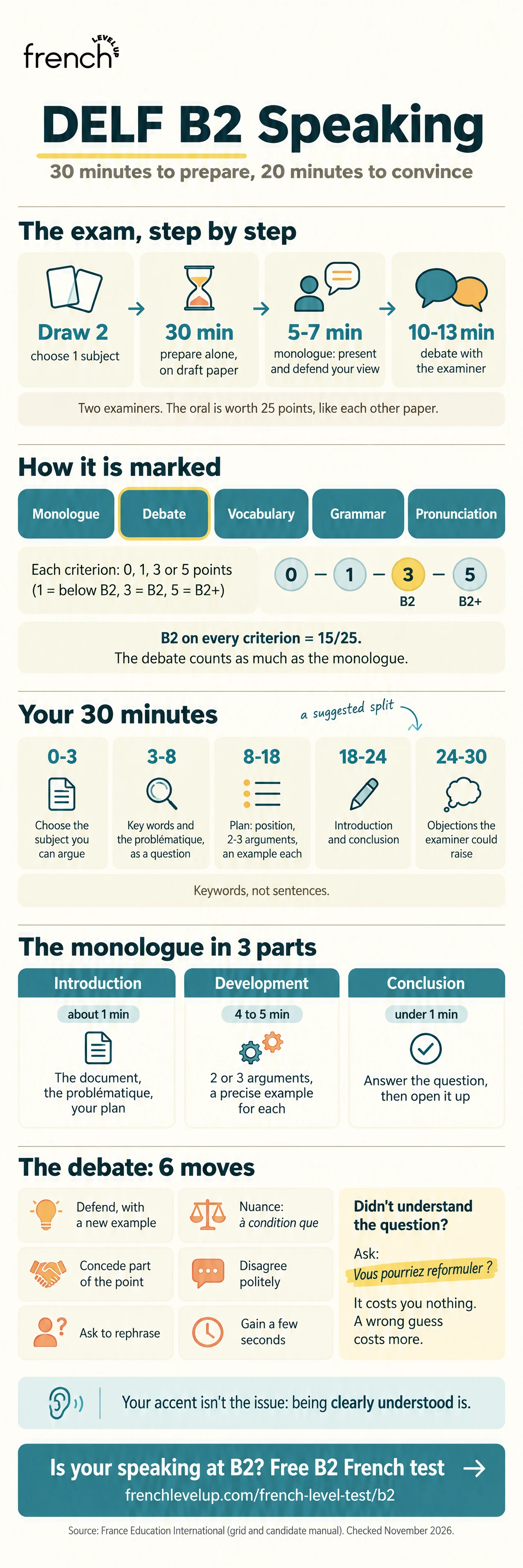
The short answer. You draw two subjects, choose one, and prepare it alone for 30 minutes with draft paper. You then spend about 20 minutes with two examiners: 5 to 7 minutes presenting and defending your view on the document (the monologue suivi), then 10 to 13 minutes debating it with the examiner (the exercice en interaction). Both examiners mark you on the official grid, with one criterion for each part and three for your French across both, and the oral is worth 25 points like each of the other papers.
The DELF B2 guide covers the four papers and sets out the speaking grid criterion by criterion, so here the format and the grid get a few lines and the rest of the page goes to how to prepare and perform each part: the 30 minutes, the monologue, the debate, a full worked example of both, and how to practice at home. If you are sitting the DELF B2 for a nationality file, the French citizenship language requirement explains why speaking is tested at B2.
How the DELF B2 oral exam works
FEI’s July 2026 candidate manual calls the oral the individual paper (épreuve individuelle), because you take it alone, unlike the three group papers. It lasts 20 minutes after 30 minutes of preparation, and its two parts follow on from each other in this order.
- The monologue suivi, 5 to 7 minutes, with preparation. The instruction asks you to bring out the problem raised by the document you chose and present your opinion on it clearly and with arguments. The manual adds that you identify the theme, formulate a problématique from the important points of the document, announce your plan and defend your view with relevant examples.
- The exercice en interaction, 10 to 13 minutes, without preparation. You defend your point of view in a debate with the examiner, who asks questions based on what you have just said.
FEI’s examiner document for the sample paper adds a detail worth knowing: the two parts run on without a break, but the examiner tells you when you move from one to the other.
The grid in a few lines
The two examiners each mark you with the official DELF B2 speaking grid, which has five criteria: task achievement for the monologue, task achievement for the debate, vocabulary (lexique), grammar (morphosyntaxe) and pronunciation (maîtrise du système phonologique). The last three are judged across both parts. Each criterion gets 0, 1, 3 or 5 points, where 1 means below B2, 3 means at B2 and 5 means B2+, so an oral at B2 on every criterion scores 15 out of 25 from each examiner.
Two things follow from that grid. The debate is a criterion of its own, as heavy as the monologue you rehearsed, and it is also the longer part, so it gives the examiners much of the French they mark for vocabulary, grammar and pronunciation. And unlike the writing grid, the speaking grid has no separate criterion for register, because it groups the pragmatic and sociolinguistic side under the two task criteria, so the way you address the examiners counts through the task rather than as a mark on its own.
When the oral takes place
In France, the oral is not on FEI’s national calendar. The 2027 calendar for France sets the rule that each center fixes the date and time of the individual papers, after the group papers, at the earliest on the same day, over 30 consecutive days at most, and ending no later than the 15th of the month after the session. So the oral can be on the afternoon of the written papers or a few weeks later, and your convocation, the notice your center sends after you register, gives you the date. Abroad, calendars differ by country, and some centers hold the oral before the written papers.
If you have not chosen between the DELF and the TCF yet
The two other tests accepted for a nationality file test speaking very differently. The TCF IRN has three short tasks in 10 minutes, face to face with one examiner and with no preparation time, and CCI Paris’s TEF IRN has two sections of 5 minutes each, a phone call to get information and a conversation where you help a friend make a decision. The DELF B2 asks for one longer argued presentation and a real debate, which suits some candidates better and others worse, and the DELF vs TCF comparison helps you decide. This guide covers the DELF B2 tout public, the adult version that what the DELF is describes alongside the others.
What happens in the room, step by step
FEI’s manual and sample papers describe the sequence below. What they leave to the center, such as where you prepare and who calls you in, varies, so follow your center’s instructions on the day.
- Arrive 30 minutes early, with an original ID with a photo and signature (not digital, not a photocopy) and your convocation, and sign the attendance sheet next to your name.
- Draw two subjects and choose one. Each subject is a short document (the document déclencheur) with a title, and you keep the one you prefer.
- Prepare for 30 minutes. FEI gives candidates draft paper (feuilles de brouillon) to prepare their answers, and its advice is to note your ideas and your plan on it without writing long sentences.
- Greet the examiners when you come in. There are two, and the manual says both can speak to you and ask you questions, and both take notes on what you say, your errors and also what you get right.
- Present your monologue, for 5 to 7 minutes.
- Debate with the examiner, for 10 to 13 minutes, once the examiner has told you that the second part is starting.
- Greet the examiners again when you leave. FEI’s rules also ask candidates to hand the exam subjects back and not to share them.
Can you use your notes in the room?
FEI’s documents tell you to prepare on draft paper and to look the examiners in the eyes when you speak, but the ones I checked do not say in so many words whether you keep your sheet in front of you during the 20 minutes. Prep sites disagree. FEI’s rules do ask you to put away your personal belongings, so the only paper you work on is the draft paper the center gives you. Ask your center when your convocation arrives, and prepare as if you will have only a page of keywords in front of you, because a sheet of full sentences tempts you to read, and the descriptors reward a clear, organized delivery that reading does not give you.
Which topics come up in the production orale
FEI publishes no list of themes for the oral, and it publishes one sample individual paper, the same for Exemple 1 and Exemple 2. Its examiner document holds five subjects, each a short press text of about ten lines under a title phrased as a question. In paraphrase, they ask whether school expects too much of parents, whether work brings happiness, whether the role of a university is to prepare students for a job, whether you can live without television, and whether remote work is a lasting solution. The candidate document has only the instructions, so open the examiner document to see the texts.
All five raise a question of society that concerns ordinary adults in France and needs no specialist knowledge, and each document gives facts or voices on more than one side. That is the B2 descriptor at work, since the vocabulary criterion asks for a wide range on your areas of interest and on common social topics (sujets de société courants). Sites that publish lists of “official subjects” often do not say where they come from, so treat them as practice topics in the same spirit, not as the subjects of past sessions, which FEI does not publish.
The families below cover the official samples and the kind of subjects prep books build on them. It is a way to organize your vocabulary, not an official list.
| Family | Kinds of question | Words worth having ready |
|---|---|---|
| Work | Remote work, working hours, happiness at work, changing career | le télétravail, la charge de travail, l’équilibre vie pro et vie perso, un salarié, embaucher |
| Education | The role of school, parents and school, university and jobs | la réussite scolaire, les devoirs, l’insertion professionnelle, un établissement |
| Media and technology | Screens, social networks, television, artificial intelligence | les écrans, la dépendance, s’informer, la désinformation, les données personnelles |
| Environment and consumption | Transport, local food, waste, sustainable fashion | les déplacements, consommer local, le gaspillage, réduire son empreinte carbone |
| Society and daily life | Family, older people, cities and the countryside, leisure | le lien social, la solitude, le vivre-ensemble, le pouvoir d’achat, les loisirs |
The 30 minutes of preparation, minute by minute
FEI’s advice for the preparation is short: read the document carefully and underline the key words, find the problématique, note your ideas and your plan on the draft paper without long sentences, think of examples for your arguments and try to anticipate the examiner’s questions. A plan built on that advice:
| Minutes | Step | What you do |
|---|---|---|
| 0 to 3 | Choose | Read both documents once and pick one with the criteria below |
| 3 to 8 | Read and frame | Underline the key words, write the theme in a few words and the problématique as a full question |
| 8 to 18 | Plan | Your position in one line, two or three arguments, one precise example for each, and one concession |
| 18 to 24 | Introduction and conclusion | Keywords for presenting the document, the plan announcement, your answer and an opening |
| 24 to 30 | The debate | Two or three objections the examiner could raise, with a one-line answer to each, then a last read-through |
The split is my arithmetic, not an FEI rule, so move the lines once you know which step slows you down. The last six minutes matter more than they seem, because they prepare the part worth as much as the monologue.
Choosing between the two subjects
Choose the subject you can argue, which is not always the one you find more interesting. In three minutes, ask yourself four things about each document.
- Can I state a position on it in one sentence?
- Do I have one precise example for it, from my life, my town or the news, and not only from the document?
- Do I know the key words of the subject, or will I be looking for them for seven minutes?
- Can I imagine what someone who disagrees with me would say?
If both pass, take the one where you have the clearer opinion, and do not go back on your choice once you have started your plan.
Finding the problématique
The theme is what the document talks about, and the problématique is the question it raises, the point on which reasonable people disagree. The theme of a document on the four-day week is working time, but its problématique could be whether working four days really improves employees’ lives or only suits some jobs.
The title of the document is often already a question, and you can start from it, but reformulate it in your own words and keep the tension between two sides, because that tension is what your plan answers. FEI’s descriptor below B2 says the candidate can identify the theme, while at B2 they present the problématique in a brief introduction.
Illustrative example, not a model answer. A theme presented as a problem: Le document parle du télétravail. A problématique: On peut se demander si le télétravail est vraiment une solution durable, ou s’il ne convient qu’à certains métiers et à certains salariés.
Building the plan
The manual asks for an introduction, a development and a conclusion, with your ideas in a logical order, and its advice to candidates includes giving arguments for and against. Two plans cover almost every subject.
- For, against, my view. The advantages, then the limits, then your position with its conditions. It is the easiest to build under time pressure, and it shows the arguments for and against that the manual asks for.
- My position, defended and then qualified. Two arguments for your view, then the strongest objection, granted and answered. It sounds more committed, and it suits a subject where you have a firm opinion.
Either way, give your position in the introduction or at the latest in the conclusion of the first part, so the examiners never wonder what you think. A plan in two or three parts is enough for five to seven minutes, and a plan in five parts usually means five arguments of one sentence each.
Keywords, not sentences
Five to seven minutes of speech is far too long to write out in 30 minutes, and a written text read aloud loses the eye contact and the natural pace the grid rewards. Write keywords, arrows and examples, and leave out articles and verb endings. Write out two things in full and nothing else: the problématique, because it has to be clear, and the first sentence of the introduction, because it gets you started when your nerves are highest.
Preparing examples
The B2 descriptor asks for relevant examples to support your arguments, and below B2 it speaks of a few personal examples. A precise example names a situation, a place, a figure or a type of person: a parent whose children have no school on Wednesdays, a commute of one hour each way, a hospital that cannot close on Fridays. Beaucoup de gens pensent que… is not an example. Take one example from the document if it fits, and at least one from outside it, because the manual reminds you to use the document but also to develop your own ideas.
Anticipating the debate
Keep the last minutes for the examiner. Write down two or three objections someone could raise against your position, and one line of answer for each, with a new example if you can. The examiner’s questions will not match your list exactly, but most of the time they press on the weak point of your argument, and you will have thought about it once already.
The monologue suivi: presenting and defending your view
The monologue follows the plan you prepared, in three movements.
The introduction, about a minute. Present the document briefly (its title, its subject and the views it gives), then the problématique as a question, then your plan. The B2+ descriptor speaks of an introduction that makes things easier for the listener (introduction facilitante), and announcing the plan does exactly that. Do not summarize the document line by line, because the examiners have read it.
The development, four to five minutes. Two or three arguments, each one built the same way: the idea, why it holds, a precise example, and a sentence that links it to the next. Mark each move with a connector the examiners can hear, because spoken French has no paragraphs and the connectors do their job.
The conclusion, under a minute. Answer the question of your introduction in one or two sentences, then open on a wider question or a proposal. Thank the examiners, so they know you have finished.
FEI publishes no rule for a monologue that runs short or long, so treat 5 to 7 minutes as the target and aim for about six. A monologue that stops after three minutes leaves the examiners less to mark for the first criterion, and one that runs past seven eats into the debate.
Spoken register
The oral is not the letter you write in the writing paper. You speak to two people in the room, so vous, short sentences and spoken signposts (je vais commencer par, j’en viens maintenant à) are right, and the formulas of a formal letter, which the guide to DELF B2 writing sets out, have no place here. On and ça are normal in standard spoken French. What does not suit an exam is familiar French, such as genre, bah or du coup at the start of every sentence, and English fillers like so or like, which slip in under stress. A single voilà to close is fine.
A skeleton you can reuse
- Le document que j’ai choisi s’intitule « … ». Il présente… / Il s’agit d’un article qui traite de…
- La question que pose ce document est la suivante : … ?
- Pour y répondre, je vais d’abord…, ensuite…, et pour finir, je vous donnerai mon avis.
- Je vais commencer par… Le premier argument, c’est que… Prenons l’exemple de…
- Passons maintenant à… / J’en viens maintenant à…
- Certes, … mais… / Il faut reconnaître que…
- Personnellement, je suis plutôt favorable à…, à condition que…
- Pour conclure, je dirais que… Ce débat pose une question plus large : …
- Je vous remercie.
Phrases for the monologue, by function
| Function | Phrases |
|---|---|
| Presenting the document | Le document que j’ai choisi s’intitule…, Ce texte présente…, Il s’agit d’un article qui traite de… |
| Stating the problématique | La question que pose ce document est la suivante…, On peut donc se demander si…, Dans quelle mesure… ? |
| Announcing the plan | Je vais d’abord…, ensuite…, et pour finir…, Dans un premier temps… Dans un second temps… |
| Moving on | Passons maintenant à…, J’en viens à mon deuxième argument., Après les avantages, voyons les limites. |
| Giving an example | Prenons l’exemple de…, C’est le cas, par exemple, de…, Je pense notamment à… |
| Conceding | Certes…, mais…, Il faut reconnaître que…, Même si…, je pense que… |
| Giving your opinion | Personnellement, je suis plutôt favorable à…, Il me semble que…, Je suis convaincu(e) que… |
| Concluding and opening | Pour conclure, je dirais que…, En résumé…, Ce débat pose une question plus large… |
The same advice as in writing applies to opinions. Je pense que is fine once, and the vocabulary criterion asks you to vary your wording to avoid repetition, so the fourth je pense que is the one the examiners notice.
The exercice en interaction: holding the debate
In the second part, the examiner asks you questions based on your monologue and pushes back on your arguments, and you defend your view. The B2 descriptor asks you to express, confirm and even nuance your opinion with further examples, and to react to questions and counter-arguments on the subject. FEI’s list for candidates is more concrete: confirm your opinion, vary your arguments to nuance it, give details, express a concession, show agreement or disagreement, react to what the examiner says and defend your view.
FEI also tells candidates not to hesitate to take the opposite view from the examiner, because the aim of the task is to argue a position and show you can nuance it. The examiner is not marking your opinion, and disagreeing politely is part of what you are asked to do.
Where I see candidates lose points in the debate
As the DELF B2 guide explains, a pattern I correct in mock orals is a candidate who has prepared the monologue carefully and the debate not at all. They give short answers, repeat the same argument when the examiner pushes, or agree straight away instead of defending or nuancing their position.
Another pattern I see is a candidate who breaks their flow because they did not fully understand a question. They are afraid that asking the examiner to say it again will cost them points, so they guess, and the guess turns into a long answer that is off the subject. The fix is simple, and it is a confidence you build while you practice: admit that you did not understand and ask for the question to be rephrased. You will not be penalized for it, because FEI’s own advice to candidates is to ask the examiner to rephrase, repeat or speak more slowly when you do not understand.
Six moves for the debate
- Defend. Confirm your view and add something new, a reason or an example you did not use in the monologue. Repeating the same sentence louder is not defending it.
- Nuance. Say when your view holds and when it does not (à condition que, dans certains cas, ça dépend de). Nuance is the word that comes back in every FEI document on this part.
- Concede part of the point. Grant what is true in the counter-argument, then say why your position still stands. Vous avez raison sur un point, mais… shows the concession the grid asks for, while a bare vous avez raison closes the debate.
- Disagree politely. Say that you disagree, then give the reason straight away. The manual’s own examples are Je comprends ce que vous dites mais…, Oui, c’est vrai. Toutefois… and Je ne suis pas d’accord avec vous parce que….
- Ask for clarification. Ask for a repetition, a rephrasing or the meaning of one word, then answer the question you were actually asked.
- Gain a few seconds. A stock phrase holds your turn while you think, which is far better than a silence or a chain of euh.
A good answer in the debate is usually three or four sentences long: your answer, the reason, an example, and sometimes a link back to your position. Then stop and let the examiner come back, because the debate is an exchange and the examiner needs room to push you further.
If the examiner’s argument convinces you, you can move your position, as long as you say what you now think and why. That counts as nuance, but dropping your view at the first objection leaves you nothing to defend for the next ten minutes.
Phrases for the debate, by function
| Function | Phrases |
|---|---|
| Asking to repeat or rephrase | Pardon, vous pouvez répéter la question ?, Vous pourriez reformuler, s’il vous plaît ?, Je ne suis pas sûr(e) d’avoir bien compris. Vous voulez dire que… ? |
| Gaining time | C’est une bonne question. Laissez-moi réfléchir un instant., Je n’y avais pas pensé, mais je dirais que… |
| Confirming | Je maintiens que…, Comme je le disais tout à l’heure…, C’est justement pour cette raison que… |
| Nuancing | Oui, mais seulement si…, Ça dépend de…, à condition que + subjunctive, dans certains cas |
| Conceding part of the point | Vous avez raison sur un point, mais…, C’est vrai, toutefois…, Je comprends ce que vous dites, mais… |
| Disagreeing politely | Je ne suis pas tout à fait d’accord avec vous, parce que…, Je vois les choses un peu différemment., Je ne pense pas que ce soit… |
| Adding an example | Je vais vous donner un exemple concret., Regardez le cas de… |
| Coming back to your point | Pour revenir à ce que je disais…, Au fond, ce qui compte pour moi, c’est que… |
Je ne pense pas que takes the subjunctive (que ce soit), and je pense que takes the indicative, which is one of the grammar points examiners hear most often in this part.
A full example: monologue and debate
Illustrative example, not a model answer. The document is written for this guide in the style of FEI’s sample subjects. It is not an FEI subject and it quotes no real source.
The document.
LA SEMAINE DE QUATRE JOURS, UNE FAUSSE BONNE IDÉE ?
Travailler quatre jours au lieu de cinq : l’idée séduit de plus en plus de salariés. Depuis quelques années, des entreprises françaises, mais aussi certaines administrations, testent cette nouvelle organisation. Dans certains cas, les salariés font le même nombre d’heures sur quatre jours, avec des journées plus longues. Dans d’autres, le temps de travail diminue, sans baisse de salaire. Ses défenseurs mettent en avant un meilleur équilibre entre vie professionnelle et vie personnelle, moins de fatigue et moins de trajets. Ses critiques rappellent que tous les métiers ne peuvent pas s’organiser ainsi : un hôpital, une école ou un commerce doivent rester ouverts. Ils craignent aussi que des journées plus longues n’augmentent le stress au lieu de le réduire.
(The four-day week: more and more employees like the idea, and some French companies and public bodies are testing it, either with the same hours over four longer days or with fewer hours and the same pay. Supporters point to a better work-life balance, less fatigue and less commuting. Critics say not every job can work this way and fear that longer days add stress.)
The preparation notes, as they could look on the draft paper after 30 minutes.
- Thème : semaine de 4 jours, organisation du travail
- Problématique : « La semaine de quatre jours améliore-t-elle vraiment la vie des salariés, ou ne convient-elle qu’à certains métiers ? »
- Position : oui, mais 2 conditions (vraie baisse du temps de travail + adapter selon métiers)
- I. Avantages : équilibre (parents, mercredi, garde) / trajets (1 h aller = 2 h de moins par semaine, environnement)
- II. Limites : métiers ouverts 5 j (hôpital, magasin) → inégalités / PME clients / journées longues (35 h ÷ 4 ≈ 9 h) → stress
- III. Mon avis : oui SI temps réduit + rotation (plannings tournants)
- Concl. : ni miracle ni fausse bonne idée → ouverture : mesurer le travail par les résultats ?
- Débat : 1. productivité ? → fatigue = erreurs, présence ≠ travail fait / 2. coût d’embaucher ? → aide au début, moins d’arrêts maladie / 3. luxe ? → santé
The monologue, about 680 words, which takes five to six minutes at a calm speaking pace.
Bonjour. Alors, le document que j’ai choisi s’intitule « La semaine de quatre jours, une fausse bonne idée ? ». Il présente une nouvelle façon d’organiser le travail, que des entreprises françaises et certaines administrations testent depuis quelques années. Selon le texte, cette organisation peut prendre deux formes : soit on garde le même nombre d’heures sur quatre jours, soit on travaille moins, sans perdre de salaire. Le document donne la parole aux défenseurs de cette idée, qui parlent d’équilibre et de fatigue, mais aussi à ses critiques, qui rappellent que tous les métiers ne peuvent pas fonctionner comme ça.
La question que pose ce document est donc la suivante : est-ce que la semaine de quatre jours améliore vraiment la vie des salariés, ou est-ce qu’elle ne convient qu’à certains métiers ?
Pour y répondre, je vais d’abord présenter les avantages de cette organisation, ensuite j’en montrerai les limites, et pour finir, je vous donnerai mon avis personnel.
Je vais commencer par les avantages. Le premier, c’est évidemment l’équilibre entre la vie professionnelle et la vie personnelle. Avec un jour libre en plus, on a du temps pour sa famille, pour le sport, ou tout simplement pour se reposer. Prenons l’exemple d’un parent qui a des enfants à l’école primaire. En France, beaucoup d’enfants n’ont pas classe le mercredi, donc si ce parent ne travaille pas ce jour-là, il n’a plus besoin de trouver une solution de garde, et en plus, ça lui fait faire des économies.
Le deuxième avantage, ce sont les trajets. Quelqu’un qui habite en banlieue et qui met une heure pour aller au travail passe deux heures par jour dans les transports. Avec un jour de travail en moins, il gagne deux heures par semaine, et il y a aussi moins de voitures sur la route ce jour-là. C’est donc bon pour les salariés, mais aussi pour l’environnement.
Passons maintenant aux limites, parce que le document a raison sur un point : tous les métiers ne peuvent pas s’organiser de cette façon. Un hôpital, une école ou un supermarché doivent rester ouverts, et une infirmière ne peut pas laisser ses patients tous les vendredis. Si seuls les employés de bureau ont droit à la semaine de quatre jours, on risque de créer une nouvelle inégalité entre les salariés. Et pour les petites entreprises, ce n’est pas simple non plus. Si une entreprise de cinq personnes ferme le vendredi, ses clients iront peut-être chez un concurrent.
Il y a aussi un deuxième problème, celui des journées plus longues. Si on fait trente-cinq heures en quatre jours, ça fait presque neuf heures de travail par jour, sans compter la pause déjeuner. Pour certaines personnes, ce n’est pas du tout un repos, c’est plutôt une fatigue supplémentaire, et comme le disent les critiques cités dans le texte, le stress peut augmenter au lieu de diminuer.
J’en viens maintenant à mon avis personnel. Personnellement, je suis plutôt favorable à la semaine de quatre jours, mais à deux conditions. La première, c’est que le temps de travail diminue vraiment. Je ne pense pas qu’il soit utile de faire les mêmes heures en moins de jours, parce qu’on remplace simplement un problème par un autre. La deuxième condition, c’est qu’on l’adapte selon les métiers. Dans un hôpital ou dans un magasin, on pourrait par exemple organiser une rotation : chaque employé aurait un jour libre, mais pas tous le même jour, si bien que le service resterait ouvert cinq ou six jours sur sept. Certes, c’est plus compliqué à organiser, mais ce n’est pas impossible, puisque beaucoup de commerces fonctionnent déjà avec des plannings tournants.
Pour conclure, je dirais que la semaine de quatre jours n’est ni une solution miracle ni une fausse bonne idée. Elle peut vraiment améliorer la vie des salariés, à condition qu’elle ne se transforme pas en une semaine de quatre longues journées et qu’elle ne soit pas réservée à quelques métiers. Et finalement, ce débat pose une question plus large : est-ce qu’un jour, on ne mesurera pas le travail par les résultats, plutôt que par le nombre d’heures passées au bureau ? Voilà, je vous remercie.
An excerpt of the debate.
Illustrative example, not a model answer. E is the examiner and C the candidate.
E: Vous dites que le temps de travail doit diminuer. Mais si les salariés travaillent moins, l’entreprise produit moins, non ?
C: Pas forcément. Pour moi, il y a une différence entre le temps passé au travail et le travail réellement fait. Quand on est fatigué, on est moins efficace, on fait plus d’erreurs. Un salarié reposé peut faire en quatre jours une grande partie de ce qu’il faisait en cinq. Mais je reconnais que ça ne marche pas pour tous les postes.
E: Justement, pour quels postes est-ce que ça ne marche pas ?
C: Par exemple, pour un caissier ou un chauffeur de bus. Leur travail se mesure en heures de présence : si le chauffeur travaille moins, il faut que quelqu’un d’autre conduise le bus. C’est pour ça que je parlais de rotation tout à l’heure.
E: Mais embaucher, ça coûte cher. Qui va payer ?
C: C’est une bonne question. Laissez-moi réfléchir un instant… Je dirais que l’État pourrait aider les entreprises au début, pendant une période d’essai. Et puis il faut aussi compter ce qu’on économise, par exemple moins d’arrêts maladie. Cela dit, je comprends que pour une petite entreprise, ce soit un vrai risque.
E: Et la question de l’attractivité ? Les entreprises qui ne pourront pas suivre ne risquent-elles pas d’être désavantagées sur le marché de l’emploi ?
C: Pardon, je ne suis pas sûr d’avoir bien compris. Vous voulez dire que les salariés vont préférer les entreprises qui proposent quatre jours ?
E: Oui, exactement.
C: Ah, d’accord. Oui, c’est possible. Mais je ne pense pas que ce soit forcément négatif, parce que ça pousserait les autres entreprises à proposer autre chose, par exemple plus de télétravail ou des horaires plus souples. Donc au final, ce sont les salariés qui y gagnent.
E: Franchement, travailler quatre jours, ce n’est pas un peu un luxe, alors que beaucoup de gens cherchent du travail ?
C: Je ne suis pas tout à fait d’accord avec vous. Pour moi, ce n’est pas un luxe, c’est plutôt une question de santé, parce que la fatigue au travail a des conséquences sur la vie de famille et sur les arrêts maladie. En revanche, vous avez raison sur un point : ce n’est pas la priorité pour quelqu’un qui n’a pas d’emploi.
E: Donc vous avez changé d’avis depuis votre exposé ?
C: Non, je dirais plutôt que je nuance. Je reste favorable à la semaine de quatre jours, mais je pense maintenant qu’il faudrait la mettre en place progressivement, en commençant par les entreprises qui en ont les moyens.
What the example does, criterion by criterion
- Task achievement, monologue. The introduction presents the document in three sentences without summarizing it, turns the title into a problématique with two sides and announces a plan in three parts. Each argument has a precise example (Wednesdays and childcare, the arithmetic of a one-hour commute, the nurse, the five-person company), and the opinion comes with two conditions rather than a simple yes. The conclusion answers the question and opens on a wider one. Connectors mark every move: d’abord, ensuite, pour finir, prenons l’exemple de, passons maintenant à, j’en viens à, certes… mais, si bien que, pour conclure.
- Task achievement, debate. The candidate confirms (pas forcément), gives new examples that were not in the monologue (the cashier, the bus driver), reacts to each counter-argument, gains time with a stock phrase rather than a silence, asks for a rephrasing instead of guessing, disagrees politely, concedes part of a point (vous avez raison sur un point) and, when challenged, presents the change as a nuance and explains it. Each answer stops after three or four sentences and leaves the examiner room.
- Vocabulary. Precise words on a social topic (le temps de travail, une solution de garde, les plannings tournants, les arrêts maladie, embaucher, des horaires plus souples) and varied opinion verbs (je suis plutôt favorable, je ne pense pas que, je dirais que, je reconnais que).
- Grammar. The subjunctive after je ne pense pas que, à condition que, il faut que and je comprends que (soit, se transforme, conduise), the conditional for a proposal (aurait, resterait, pourrait), the future (iront), the imperfect (je parlais), relative clauses with qui and que, and ne… ni… ni.
- Pronunciation. A transcript cannot show it. Spoken aloud, this is where the examiners would listen for a natural pace, clear articulation of the endings and an intonation that rises on the questions and falls at the end of each argument.
The same moment below B2
Illustrative example, not a model answer.
E: Mais embaucher, ça coûte cher. Qui va payer ?
C: Euh… oui. Vous avez raison. C’est cher, c’est vrai.
E: Donc ce n’est pas une bonne idée ?
C: Si, c’est une bonne idée, parce que c’est bien pour les salariés. Ils sont moins fatigués.
The French is correct, so the gap is in the task. The candidate agrees at once without nuancing, gives no example, and when pushed repeats an argument from the monologue instead of answering the cost, which is the “answers simply” level of the descriptor below B2. The same examiner question, in the B2 version above, produced a proposal, an example and a concession.
Pronunciation and fluency: what the grid judges
The pronunciation descriptor at B2 asks for generally correct intonation and stress and clear articulation, with any difficulties not affecting the general meaning or the communication. FEI’s criteria for candidates put it in plainer terms: rather clear pronunciation, a natural rate of speech, neither too fast nor too slow, and varied intonation. At B2+, the descriptor says outright that a possible foreign accent does not affect comprehension in any way. So what the grid judges is how easily the examiners understand you, and an accent only matters when it gets in the way of that.
For English speakers, these points make the most difference in an exam.
- Stress the end of each group of words. French puts the stress on the last syllable of a rhythm group (la semaine de quatre JOURS), where English stresses each word. Pausing at the end of a group, rather than in the middle with euh, also makes your plan easier to follow.
- Let your intonation show the structure. A yes or no question rises at the end, a statement falls, and in a list each item rises except the last. When you announce your plan, that pattern tells the examiners where each part begins and ends.
- Articulate the endings that carry meaning. Je parle and j’ai parlé, il parlait and il a parlé differ by a vowel, and nerves make you swallow them.
- Slow down at the start. Nerves speed most people up, and a calm first minute sets the pace for the other nineteen.
- Correct yourself when it matters. The manual lists je peux me corriger si je fais une erreur among the criteria, so a quick pardon, je voulais dire… counts for you. Fix the slips that change your meaning and let the others go.
For the confidence side of speaking, what to do when a word will not come and what your English accent really changes, the guide to speaking French with confidence goes further, with the sounds that change meaning for English speakers.
How to practice the DELF B2 oral at home
The official material. FEI’s sample papers page gives you the five sample subjects in the examiner document, the grid and the descriptors. Ask someone to draw two for you, so you practice the choice as well. For more subjects, PUG’s Préparer le DELF B1 & B2, Production orale comes with downloadable videos of simulated exams to analyze, and the DELF B2 practice tests guide lists the books with full mock exams and fits the oral into a study plan.
The vocabulary of each family. Neither RFI nor TV5Monde had DELF B2 speaking practice that I could find in November 2026. RFI’s DELF B2 sessions train listening, and TV5Monde’s B2 exercises are built on news reports and current topics, which makes them useful for collecting the words of each family in the table above.
A weekly mock oral. Set a timer for 30 minutes of preparation, then record yourself for the monologue and for the debate. Recording only the monologue trains the half you are already preparing.
Listen the next day, with the grid. A day’s distance helps you hear the answer you gave rather than the one you meant to give. Check a few things in order.
- Did the monologue last 5 to 7 minutes?
- Did you state a problématique as a question, and announce a plan?
- Did each argument have a precise example?
- In the debate, how long were your answers, and did any of them stop at vous avez raison?
- Did you concede part of a point at least once, and disagree at least once?
- Which three words were you looking for, and how do you say them now?
A partner who pushes back. The debate cannot be practiced alone. Give a French speaker your list of objections and ask them to disagree with whatever you say, to interrupt you when an answer runs long, and once per session to ask a question in deliberately complicated words, so you practice asking for a rephrasing until it feels normal.
Where self-marking stops. You hear your own French with the meaning already in mind, and the examiners do not, so marking your own oral against the grid has the limit the practice tests guide describes. The B2 French test includes a speaking task with a verdict. If you want an estimated score per paper before you book, the Bilan B2 gives you one in a single session, and Objectif B2, my small-group preparation, includes two full mock exams with the oral debriefed one to one, although its next cohort has no dates yet. For regular mock orals and debate practice with feedback after each one, there are my one-to-one sessions.
DELF B2 oral exam: common questions
How long is the DELF B2 oral exam?
About 20 minutes in front of the examiners, after 30 minutes of preparation. The monologue lasts 5 to 7 minutes and the debate 10 to 13 minutes.
Is the oral on the same day as the written papers?
It can be. In France, your center sets the date after the group papers, at the earliest on the same day and within 30 consecutive days, and your convocation gives it. Abroad, some centers hold it before the written papers.
Can I use notes in the DELF B2 oral?
You prepare on draft paper the center gives you, and FEI advises keywords rather than long sentences. The FEI documents checked for this guide do not say whether you keep the sheet during the 20 minutes, so ask your center, and never read from it.
Can I disagree with the examiner?
Yes. FEI’s advice to candidates is not to hesitate to take the opposite view from the examiner, because the task is to argue a position and nuance it. The examiner marks how you defend your view, not the view itself.
Can I ask the examiner to repeat a question?
Yes. FEI tells candidates to ask the examiner to repeat, rephrase or speak more slowly when they do not understand, and nothing in the grid takes points off for it. A wrong guess at the question costs you more.
Does my accent matter in the DELF B2?
Not as such. The grid judges whether your pronunciation is clear and your intonation and stress help communication, and at B2+ the descriptor says a foreign accent does not affect comprehension in any way.
What topics come up in the DELF B2 oral?
Questions of society that concern adults in France: in FEI’s sample, school and parents, happiness at work, university and jobs, life without television and remote work. FEI publishes no list of themes and does not publish past subjects.
Can I learn my monologue by heart?
Not the monologue itself, because you discover the subject on the day. What you can learn is the skeleton of the introduction and the conclusion, and the phrases for moving on, giving examples, conceding and debating, so that your 30 minutes go to the ideas.