
In this article
- How the DELF B2 writing paper works
- Which types of text can come up
- The lettre formelle
- The contribution à un forum
- The courrier des lecteurs
- The article critique
- Less likely: the rapport, the lettre personnelle and the essai argumenté
- Building a B2 argument
- A full example: a lettre formelle to the mayor
- The hour, minute by minute
- Check before you hand in
- How to practice DELF B2 writing at home
- DELF B2 writing: common questions
Rules checked against official sources in November 2026.
The writing paper is the part of the DELF B2 that most people find hardest to prepare alone, because nobody hands you an answer key. You write one text, and two markers judge it against a grid you never see filled in. What you can see is everything the grid looks for, and France Education International (FEI), which designs the exam, publishes it along with the instructions it gives candidates.
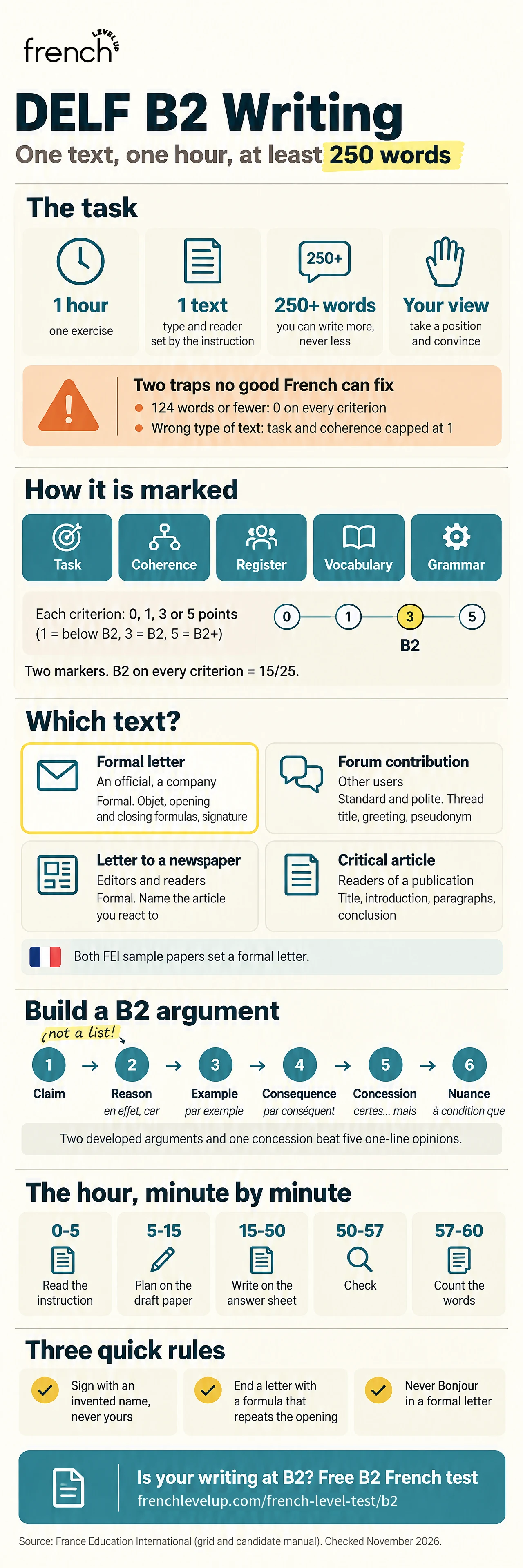
The short answer. You have one hour to write one text of at least 250 words that defends a personal point of view. The instruction sets the type of text, most often a formal letter (lettre formelle) or a contribution to a debate, and tells you who you are and who will read you. Two markers score the text on five criteria, and a text of 124 words or fewer, or one written in the wrong form, loses points that no quality of French can win back.
This guide is about how to write the text. The DELF B2 guide covers the four papers and sets out the official writing grid criterion by criterion, so here the grid gets a short summary and the rest of the page goes to each type of text, how to build a B2 argument, a full example compared with a weaker one, and the hour itself. If you need the DELF B2 for a nationality file, the French citizenship language requirement explains why writing is tested at all.
How the DELF B2 writing paper works
The writing paper is the third of the three group papers, after listening and reading, and it lasts one hour for a single exercise. FEI’s July 2026 candidate manual says you must defend a personal point of view, take a position, argue for your ideas and try to convince the reader, and it sets the length plainly: Je peux écrire plus mais je ne dois pas écrire moins (I can write more but I must not write less). The theme can concern France or the French-speaking world.
The grid in a few lines
Two markers each score your text on five criteria with the official DELF B2 writing grid: task achievement (réalisation de la tâche), coherence and cohesion (cohérence et cohésion), sociolinguistic appropriateness (adéquation sociolinguistique), vocabulary (lexique) and grammar (morphosyntaxe). Each criterion gets 0, 1, 3 or 5 points, where 1 means below B2, 3 means at B2 and 5 means B2+, so a text at B2 on every criterion scores 15 out of 25 from each marker.
The grid also lists anomalies that override the scoring:
- 124 words or fewer (less than half the expected length) scores 0 on every criterion, which eliminates you.
- The wrong type of text caps task achievement and coherence at 1.
- The right type of text on the wrong subject caps task achievement and vocabulary at 3.
- Off topic entirely gives 0 for task achievement, coherence and sociolinguistic appropriateness, with vocabulary and grammar capped at 1.
Two of those four rules are about the form of the text, which is why most of this guide is about form.
How FEI counts words
FEI’s preparation page for the DELF B2 gives the rule: Un mot est un ensemble de caractères, séparé par un espace (a word is a set of characters separated by a space). Its examples count Je mange une pomme as 4 words, J’ai fait des travaux chez moi as 6, because j’ai is one word, and rendez-vous as 1.
FEI does not say whether the sender’s address, the date or the signature of a letter count. Make the body of the text reach 250 words on its own, and you never depend on the answer.
If you have not chosen between the DELF and the TCF yet
The citizenship tests ask for very different writing. The TCF IRN has three short tasks in 30 minutes, of 30 to 60, 40 to 90 and 40 to 90 words, and CCI Paris’s TEF IRN has two sections in 30 minutes, of at least 40 and at least 100 words. The DELF B2 asks for one longer argued text in an hour, and the DELF vs TCF comparison helps you decide which suits your profile. This guide covers the DELF B2 tout public, the version for adults that what the DELF is describes alongside the others. The DELF B2 junior uses the same grid and the same 250-word task, with themes chosen for teenagers, and FEI’s current catalog of diplomas no longer lists a DELF Pro.
Which types of text can come up
FEI names the possible types in three places, and the lists overlap without matching exactly.
- The cover page of both sample papers describes the task as a prise de position personnelle argumentée (an argued personal position), such as a contribution to a debate, a formal letter or a critical article.
- The candidate manual adds a report (rapport), and its criteria list a formal letter, a personal letter, an essay for a forum (essai pour un forum), an article for a newspaper and a professional report.
- The explanation of the criteria on FEI’s sample papers page names two, a contribution to a debate on a forum, or a formal letter written in a personal or a collective capacity.
FEI publishes no figure on how often each type is set, so treat any percentage you read elsewhere as a guess. What the official material does show is that both sample papers, Exemple 1 and Exemple 2, carry the same writing subject, a formal letter, written as the representative of your building, to contest a mayor’s decision. That is why this guide starts with the letter and gives it the full example.
| Type | Who reads it | Register | Layout the grid expects |
|---|---|---|---|
| Lettre formelle, including a complaint | An official, a company, an institution | Formal (soutenu) | Sender, recipient, place and date, Objet, formulas, signature |
| Contribution à un forum | Other users of a forum or a website | Standard, polite (courant) | Reference to the thread, greeting, paragraphs, pseudonym |
| Courrier des lecteurs | The editors and readers of a newspaper | Formal | Reference to the article, letter formulas, signature |
| Article critique or article for a newspaper | The readers of a publication | Standard to formal | Title, introduction, paragraphs, conclusion, signature |
The lettre formelle
Purpose. You write as a person or on behalf of a group to someone with authority (a mayor, a director, a company) to contest a decision, ask for a change or support a proposal. The instruction gives you a role, such as a resident, a parent or an employee, and you keep that role from the first line to the signature.
Register. Formal throughout, with vous and no spoken connectors. The grid’s B2 descriptor for sociolinguistic appropriateness asks you to adapt to the reader and the register, with rare confusions, and FEI’s candidate criteria single out greetings and closing formulas suited to the situation.
Layout. French formal letters follow a fixed order, and coherence and cohesion is the criterion that checks you respect the layout of the type of text.
- The sender, top left: an invented name and address. FEI forbids your real name anywhere in your answers, so sign with a made-up name (nom d’emprunt).
- The recipient, on the right, below the sender: Monsieur le Maire, Mairie de…, the address.
- Place and date, on the right: Villeneuve, le 4 novembre 2026.
- The subject line: Objet : fermeture de la bibliothèque le samedi. A few words, no full sentence.
- The opening formula, followed by a comma: Madame, Monsieur, when you do not know who will read the letter, or the title of the person, Monsieur le Maire, or Madame la Directrice,. Never Cher Monsieur to someone you do not know, and never Bonjour in a letter.
- The body, in paragraphs: why you write and your position, then your arguments one per paragraph, then your request or proposal.
- The closing formula, which repeats the opening exactly: Je vous prie d’agréer, Monsieur le Maire, l’expression de ma considération distinguée. or Veuillez agréer, Madame, Monsieur, l’expression de mes salutations distinguées. A lead-in such as Dans l’attente de votre réponse, can come before it. Cordialement ends many emails, but on its own it reads as abrupt at the end of a formal letter.
- The signature: the invented name again, and your role if the letter speaks for a group.
What the grid checks in this genre. Task achievement looks for the position the instruction asks for (to contest is not to describe), arguments justified for and against, and examples that fit the situation. Sociolinguistic appropriateness looks at the formulas and at whether the register holds in every paragraph. Coherence looks at the blocks above and at paragraphing.
A skeleton you can reuse
- Je me permets de vous écrire au sujet de… / J’ai appris avec surprise que…
- En tant que [rôle], je tiens à vous faire part de mon désaccord avec cette décision.
- Tout d’abord, … En effet, … Par exemple, …
- Par ailleurs, … Cela aurait pour conséquence de…
- Certes, … Toutefois, …
- C’est pourquoi je vous propose de… / je vous demande de bien vouloir…
- Dans l’attente de votre réponse, je vous prie d’agréer, [formule d’appel], l’expression de ma considération distinguée.
The lettre de réclamation and the protest letter
A complaint letter (lettre de réclamation) is a formal letter to a company or a service about a problem you have had, and it asks for a remedy. It keeps the same layout and adds three things the reader needs to act: the facts with their dates and references (an order number, a contract, a booking), what you have already done, and exactly what you ask for, such as a refund, a repair or compensation. A protest letter (lettre de protestation) does the same with a public decision, like the mayor’s in FEI’s sample.
At B2 a complaint is still an argued text. A list of grievances describes a problem, and the grid’s task achievement descriptor asks you to justify a position, so explain why the problem is unacceptable and why your remedy is fair.
- Le 12 octobre, j’ai commandé sur votre site… (commande n° …).
- Or, à ce jour, … / Malgré deux appels à votre service client, …
- Je vous demande donc de bien vouloir procéder au remboursement de…
- Sans réponse de votre part d’ici quinze jours, je me verrai dans l’obligation de…
The contribution à un forum
Purpose. You react to a message or an article posted online and give your argued opinion to the other users. FEI’s criteria call it an essai pour un forum or a contribution to a debate on a forum, and it is the other type that the explanation on the sample papers page names.
Register. Standard and polite (courant), which is less formal than a letter but never familiar. Address the readers as vous, avoid the shortcuts of text messages and spoken connectors such as du coup, and keep the same register to the end.
Layout. There is no address block. The text needs:
- A reference to the thread you answer, such as a title or Re : followed by the title of the thread.
- A short greeting suited to a forum, such as Bonjour à tous,.
- An opening that names the message or the claim you react to, then your position.
- Paragraphs, one argument each, then a conclusion.
- A sign-off and a pseudonym.
What the grid checks in this genre. The reaction to someone else’s view is the core of the task, so reformulate the claim before you answer it. The guide to the B2 level compares a below-B2 and a B2 forum answer on remote work, and the difference lies mostly there.
- Je réagis au message de Julie sur…
- Selon elle, … Je comprends ce point de vue, mais je ne le partage pas entièrement.
- D’une part, … D’autre part, …
- Pour ma part, je suis convaincu que…
- En définitive, … Qu’en pensez-vous ?
The courrier des lecteurs
Purpose. A letter to a newspaper or a magazine (the “letters to the editor” page) in reaction to an article it published. FEI’s documents do not use the name, but many prep sites and practice papers use it as a writing prompt, and it combines the two types above: you react to a published view, as on a forum, and you write a letter to a publication, so the formal register applies.
Layout. Take the formal letter as your model. Address the editors (Madame, Monsieur,), name the article you react to with its title and date in the first paragraph, and end with a closing formula that repeats the opening and an invented signature, often with the town you write from.
- Madame, Monsieur,
- Dans votre édition du 3 novembre, l’article intitulé « … » affirme que…
- Lecteur fidèle de votre journal, je souhaite réagir à cet article, car…
- Je vous prie d’agréer, Madame, Monsieur, l’expression de mes salutations distinguées.
The article critique
Purpose. An article for a newspaper, a magazine or a website that gives an argued judgment on something, such as a book, a film, an event, a public policy or a trend. FEI’s lists name both the critical article and the article for a newspaper.
Register. Standard to formal. You write for readers you do not know, so vous for the reader or an impersonal style, with no greeting and no closing formula.
Layout.
- A title, short and clear about your position.
- An introduction that presents the subject and announces your judgment.
- Development paragraphs, one argument each, with the strengths you grant and the weaknesses you criticize.
- A conclusion with a recommendation or an opening.
- A signature, the invented name again.
The trap in an article is to describe the subject at length and judge it in one line at the end. The grid marks the argument, so the description should only serve it.
- Titre : La gratuité des transports, une fausse bonne idée ?
- Depuis le mois de septembre, … Si l’intention est louable, le résultat reste discutable.
- Il faut reconnaître que… En revanche, …
- En fin de compte, cette mesure mériterait d’être repensée.
Less likely: the rapport, the lettre personnelle and the essai argumenté
The report (rapport). The manual lists a report, and its criteria a professional report. It is written to a superior or an organization, with a title and an Objet, an introduction that states the purpose, factual sections on the situation, then your assessment and your proposals, in a formal and impersonal register.
The personal letter (lettre personnelle). It appears in the manual’s criteria. To a friend or a relative, tu and a warm greeting (Cher Paul,, Chère Anna,) are right and Je vous prie d’agréer would be a register error. The text must still argue a position, because the B2 task always does.
The essai argumenté. Searches for a “DELF B2 essay” usually mean this, but FEI’s documents speak of an essay for a forum, not of a school dissertation with no reader. Read the instruction for who will read your text and in what form, and use that layout. If it names no form, write a titled text with an introduction, a development and a conclusion, which is the structure FEI asks for in every case.
Building a B2 argument
The B2 descriptor for task achievement asks for a clear argument with justifications for or against, an explanation of the advantages and disadvantages of different options, and examples that fit the situation. Below B2, the descriptor says you set out your opinion simply. The difference is rarely about how many ideas you have. It is about what you do with each one.
From listing opinions to developing them
As the DELF B2 guide explains, listing opinions is one of the patterns I correct most in mock writing papers. A developed argument takes one idea through several steps, and each step answers a question the reader could ask.
- The claim: what you think about one aspect of the question.
- The reason: why it is true (en effet, car).
- An example: a precise case, a figure, a situation from the prompt (par exemple, c’est le cas de).
- A consequence: what follows (par conséquent, ce qui, si bien que).
- A concession, then your answer: the best point on the other side, granted and then answered (certes… mais, il est vrai que… toutefois).
- A nuance: the condition under which your view holds (à condition que, dans la mesure où).
You do not need all six in every paragraph. Two well developed arguments and one concession usually fill 250 words better than five arguments of one sentence each.
Illustrative example, not a model answer. A list: Les devoirs à la maison sont inutiles. Les enfants sont fatigués. Les parents ne peuvent pas toujours aider. The same idea developed: Les devoirs à la maison creusent d’abord les inégalités entre les élèves, car tous les enfants ne trouvent pas chez eux l’aide dont ils auraient besoin. Un élève dont les parents rentrent tard, par exemple, fait souvent ses exercices seul, si bien qu’il accumule les erreurs sans le savoir. Certes, les devoirs permettent de revoir la leçon, mais cet avantage n’existe qu’à condition que l’enfant puisse être aidé.
The second version moves through cause (car), example (par exemple), consequence (si bien que), concession (certes… mais) and condition (à condition que), and it brings in the relative pronoun dont, the conditional (auraient) and the subjunctive (puisse) because the argument needs them, which is what the grammar criterion rewards.
Connectors by function
The coherence criterion at B2 asks for a range of connectors, and FEI’s own examples for candidates are néanmoins, bien que, ainsi, par conséquent and du fait de. A connector chosen for its function also helps vocabulary, because it saves you from repeating mais and et.
| Function | Connectors for a formal text | Avoid or use with care |
|---|---|---|
| Adding | de plus, en outre, par ailleurs, d’une part… d’autre part | en plus is spoken. Aussi at the start of a sentence means “therefore”, not “also” |
| Contrasting | cependant, toutefois, néanmoins, en revanche, alors que, tandis que | par contre is common, but en revanche is safer in a letter |
| Conceding | certes… mais, il est vrai que… toutefois, bien que + subjunctive, même si + indicative, malgré + noun | bien que with the indicative is a grammar error |
| Giving a cause | car, puisque, étant donné que, dans la mesure où, en raison de + noun | à cause de introduces a negative cause, grâce à a positive one |
| Giving an example | par exemple, à titre d’exemple, notamment, ainsi, c’est le cas de | comme par exemple says the same thing twice |
| Showing a consequence | donc, c’est pourquoi, par conséquent, si bien que, ce qui explique que | du coup is spoken |
| Concluding | en définitive, en somme, pour conclure, c’est pourquoi | bref and voilà are spoken |
Opinion formulas beyond je pense
One habit I correct often, in writing as in speaking, is je pense que for every opinion, and the vocabulary criterion at B2 asks you to vary your wording to avoid repetition. FEI’s own criteria for candidates cite je trouve que and je pense que as opinion verbs, so je pense is fine once. What the markers notice is the fourth one. Vary the strength of your opinion as well as the words, and watch the mood that follows.
| Formula | What follows | Use it to |
|---|---|---|
| À mon avis, / Selon moi, / Pour ma part, | A full sentence | State your view neutrally |
| Il me semble que | Indicative | Soften a view |
| J’estime que / Je considère que | Indicative | State a firm view in a formal text |
| Je suis convaincu(e) que / Il est évident que | Indicative | Show certainty |
| Je ne pense pas que / Je doute que | Subjunctive | Disagree or doubt |
| Il est regrettable que / Il est inacceptable que | Subjunctive | Judge a decision, in a protest or complaint |
| Force est de constater que | Indicative | Present a fact as undeniable, once per text |
Note the difference between il me semble que, which takes the indicative, and il semble que, which usually takes the subjunctive.
A full example: a lettre formelle to the mayor
Illustrative example, not a model answer. The prompt is written for this guide in the style of FEI’s sample papers. It is not an FEI subject.
The prompt. La mairie de votre ville a annoncé que la bibliothèque municipale serait désormais fermée le samedi, afin de réduire les dépenses. Membre de l’association des parents d’élèves de votre quartier, vous écrivez au maire pour contester cette décision. Vous justifiez votre point de vue et vous proposez d’autres solutions. (250 mots minimum)
(Your town hall has announced that the public library will now close on Saturdays to cut costs. As a member of your neighborhood’s parents’ association, you write to the mayor to contest the decision, justify your view and suggest other solutions.)
Camille Durand
Association des parents d’élèves des Tilleuls
12, rue des Tilleuls, VilleneuveMonsieur le Maire
Mairie de Villeneuve
Place de la République, VilleneuveVilleneuve, le 4 novembre 2026
Objet : fermeture de la bibliothèque municipale le samedi
Monsieur le Maire,
J’ai appris par le bulletin municipal que la bibliothèque serait fermée le samedi à partir du mois de janvier, afin de réduire les dépenses de la commune. Au nom de l’association des parents d’élèves du quartier des Tilleuls, je souhaite vous faire part de notre profond désaccord avec cette décision.
Nous comprenons bien entendu que la ville doive faire des économies. Cependant, le samedi est le seul jour où de nombreuses familles peuvent se rendre à la bibliothèque. En semaine, la plupart des parents travaillent jusqu’à dix-huit heures, alors que la bibliothèque ferme à dix-sept heures trente. Fermer le samedi reviendrait donc à priver beaucoup d’enfants d’un lieu qu’ils fréquentent avec plaisir. À titre d’exemple, l’atelier de lecture du samedi matin accueille chaque semaine une trentaine d’élèves, dont beaucoup n’ont presque pas de livres chez eux.
Par ailleurs, cette mesure risque d’aggraver les inégalités entre les familles. Celles qui en ont les moyens achèteront des livres ou iront à la médiathèque de la ville voisine, tandis que les autres n’auront plus aucun accès à la lecture le week-end.
Nous ne contestons pas la nécessité de réduire les coûts, mais d’autres solutions nous semblent possibles. La bibliothèque pourrait, par exemple, fermer le lundi, jour où elle reçoit le moins de visiteurs. Certes, ce changement gênerait quelques lecteurs, mais il en pénaliserait beaucoup moins. Notre association est également prête à mobiliser des parents bénévoles pour aider le personnel lors des animations du samedi.
C’est pourquoi nous vous demandons de bien vouloir reconsidérer cette décision et de recevoir une délégation de parents afin d’en discuter. Nous sommes convaincus qu’une solution satisfaisante pour tous peut être trouvée.
Dans l’attente de votre réponse, je vous prie d’agréer, Monsieur le Maire, l’expression de ma considération distinguée.
Camille Durand, pour l’association des parents d’élèves des Tilleuls
The body of the letter, from Monsieur le Maire, to the closing formula, is 293 words by FEI’s rule, before the address blocks and the signature.
What the letter does, criterion by criterion
- Task achievement. It does both things the prompt asks, contesting and proposing, from the role the prompt gives (a member of the parents’ association). The position is clear in the first paragraph. Each argument has a justification and a precise example (the closing time, the Saturday reading workshop), and the alternative is weighed rather than just stated (ce changement gênerait quelques lecteurs, mais il en pénaliserait beaucoup moins), which is the advantages and disadvantages of different options that the B2 descriptor names.
- Coherence and cohesion. It has every block of a formal letter in the right order, and one idea per paragraph, from the reason for writing to the request. Connectors mark each step: cependant, donc, à titre d’exemple, par ailleurs, tandis que, certes… mais, c’est pourquoi.
- Sociolinguistic appropriateness. The opening Monsieur le Maire, is repeated in the closing formula, vous holds throughout, and the tone stays firm without being aggressive (nous ne contestons pas la nécessité de réduire les coûts, mais…). The signature is an invented name.
- Vocabulary. Precise words on a social topic (bulletin municipal, dépenses de la commune, aggraver les inégalités, délégation, bénévoles), and no word repeated where a synonym exists (économies, réduire les dépenses, réduire les coûts).
- Grammar. Past tense (j’ai appris), the conditional for a reported decision and a hypothesis (serait fermée, reviendrait, pourrait, gênerait), the subjunctive after comprendre que in the sense of accepting (que la ville doive), the future (achèteront, iront), the passive (peut être trouvée) and relative pronouns (où, qu’, dont).
The same argument below B2
Illustrative example, not a model answer. An opening and one paragraph, shortened.
Bonjour Monsieur le Maire,
Je pense que fermer la bibliothèque le samedi n’est pas une bonne idée. Je pense que les enfants aiment aller à la bibliothèque. Les parents travaillent pendant la semaine, alors c’est difficile. Aussi, les livres coûtent cher. Il faut trouver une autre solution. Je pense que vous devez changer votre décision. Merci beaucoup et à bientôt !
Most of its French is correct, so the gap lies in how it is built. It states an opinion and lists reasons without developing any of them, there is no example and no consequence, and it rejects the decision without weighing it or offering the alternatives the prompt asks for, so task achievement falls to the “simple opinion” level below B2. Je pense que three times hurts vocabulary. Bonjour and Merci beaucoup et à bientôt ! belong to an email to a friend, not a letter to a mayor, which is a register error the sociolinguistic criterion picks up straight away. Aussi at the start of a sentence is an English habit, because in French it means “therefore” and is followed by an inversion, so here De plus is what the writer means. The grammar is correct but limited to simple sentences, which is the below-B2 descriptor for grammar.
The hour, minute by minute
FEI’s advice for the hour is to read the instruction and identify the theme, the type of text, the key words and the main idea, to plan on the draft paper, to copy what you need onto the answer sheet (the draft paper is not marked), to check spelling and grammar at the end and to write the word count at the bottom. The candidate manual gives 5 to 10 minutes for the check and the preparation page 5. A plan built on that advice:
| Minutes | Step | What you do |
|---|---|---|
| 0 to 5 | Read the instruction | Underline who you are, who you write to, the type of text and each verb of the task (contester, proposer, justifier) |
| 5 to 15 | Plan on the draft paper | Your position in one sentence, two or three arguments with an example each, one concession, the layout blocks and the formulas |
| 15 to 50 | Write on the answer sheet | Write the text once, from the plan, paragraph by paragraph |
| 50 to 57 | Check | Agreements, verb endings, the subjunctive after the connectors that need it, accents, then the register of the formulas |
| 57 to 60 | Count | Count the words of the body, write the number at the bottom, and add a sentence if you are short |
Writing the whole text twice, once in draft and once in ink, rarely fits in an hour, which is why the plan above drafts only the plan and the formulas. To count faster, count the words in your first five lines and multiply by the number of lines you have written for an estimate, then count exactly if the estimate comes close to 250.
If you make a mistake on the answer sheet, the manual asks you to cross it out neatly and write the correction below it.
Check before you hand in
- The count. The body of the text reaches 250 words by FEI’s rule, with a margin, and the number is written at the bottom.
- The type. The text is the type the instruction asks for, with the layout of that type.
- The task. Every verb of the instruction is answered, and you write in the role and to the reader it gives.
- The position. It is clear in the first paragraph and the same in the conclusion.
- The argument. Each argument has a justification and an example or a consequence, and at least one concession is granted and answered.
- The paragraphs. An introduction, a development and a conclusion, with one idea per paragraph.
- The register. Vous throughout a formal text, no spoken connectors, and a closing formula that repeats the opening.
- The name. An invented name, never yours.
- The grammar sweep. Agreements, the subjunctive after bien que, à condition que and il faut que, and accents.
How to practice DELF B2 writing at home
FEI’s sample papers give you one official writing prompt, because the writing subject of Exemple 1 and Exemple 2 is the same letter to the mayor. Write it once under exam timing, and keep it for when you know the method. The other prompts have to come from prep books, and the DELF B2 practice tests guide lists the books with full mock exams and explains how to mark your text in order, the word count first, then the type of text and the task, then the grid criterion by criterion. For writing alone, PUG’s Préparer le DELF B1 & B2, Production écrite (November 2024 edition, updated for the latest grids) has a method, step-by-step practice on argued texts and the formal letter, and answer keys you can use on your own.
Because FEI lists several types, practice at least the formal letter and the forum contribution, and write one article and one courrier des lecteurs so that no layout is new on the day. Write against the clock from the start, because the hour is part of the task.
Self-marking has a limit with writing. When you mark your own text you already know what you meant to say, and the markers only see what is on the page. The B2 French test includes a writing task with a verdict, and if you want an estimated score per paper before you book, the Bilan B2 gives you one in a single session. Objectif B2, my small-group preparation, includes two full mock exams with the writing marked against the grid and debriefed one to one. Its next cohort has no dates yet.
DELF B2 writing: common questions
How many words is the DELF B2 writing?
At least 250. FEI’s candidate manual says you can write more but must not write less, and a text of 124 words or fewer scores 0 on every criterion.
What happens if I write fewer than 250 words?
At 124 words or fewer, the grid gives 0 on every criterion, which is below the 5 out of 25 you need on each paper, so you fail the exam whatever your other marks. Between 125 and 249 words, the grid states no specific rule, so a short text is not automatically zero, but the task is not done as the instruction asks, and you should not count on any particular treatment.
Can I write more than 250 words?
Yes. FEI sets a minimum and no maximum. A longer text gives you more room to develop your arguments, but it also takes more time and leaves more places for errors, so aim for a length you can still check in the last minutes of the hour.
Do the address, the date and the signature count?
FEI’s word rule does not say. Make the body of the text reach 250 words on its own.
Is the DELF B2 writing formal or informal?
It depends on the reader the instruction gives you, and the grid marks whether your register suits that reader. A letter to a mayor, a company or a newspaper is formal, a forum contribution is standard and polite, and a personal letter to a friend uses tu. A familiar register is never right at B2.
What types of text are in the DELF B2 writing?
FEI’s documents list a contribution to a debate or a forum, a formal letter, a critical article or an article for a newspaper, a report and a personal letter. Both FEI sample papers set a formal letter.
Can I use a dictionary in the DELF B2 writing paper?
No. FEI’s candidate manual allows a monolingual dictionary only in some DALF papers, not in the DELF B2.
Should I sign with my real name?
No. FEI’s rules forbid your real name or any distinctive mark in your answers, so sign a letter or a forum post with an invented name.